CivicScience engages directly with consumers, collecting over one million survey responses daily, to turn real-time insights into high-performing advertising campaigns. See how leading brands use CivicScience to drive campaign performance here.
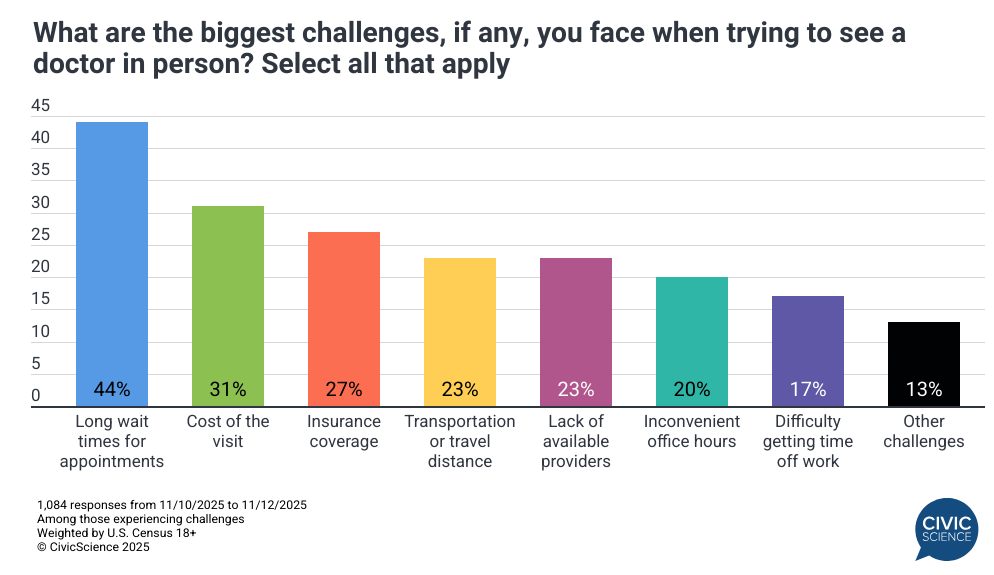
1. Twenty-nine percent of respondents say they’ve experienced obstacles scheduling in-person medical appointments in the past six months, led by long wait times.
Nearly 3 in 10 U.S. adult respondents tell CivicScience that scheduling an in-person appointment with a primary care provider or specialist in the past six months has been a ‘somewhat’ or ‘very’ difficult experience (excluding those unsure). Millennials are the most likely to have encountered challenges when attempting to book appointments, whereas Americans aged 65+ reported the least difficulty. A discernible gender gap exists as well, with women more likely than men to report difficulty in the appointment scheduling process (33% to 26%, respectively).
Among the Americans who experienced challenges seeing a doctor in person, the most common obstacles, each encountered by more than one-quarter of respondents, included excessively long general wait times, the outright cost of the visit, and issues related to insurance coverage.
2. When it comes to automated ordering at restaurants, most prefer ordering through humans instead. Speed of service expectations play a key role.
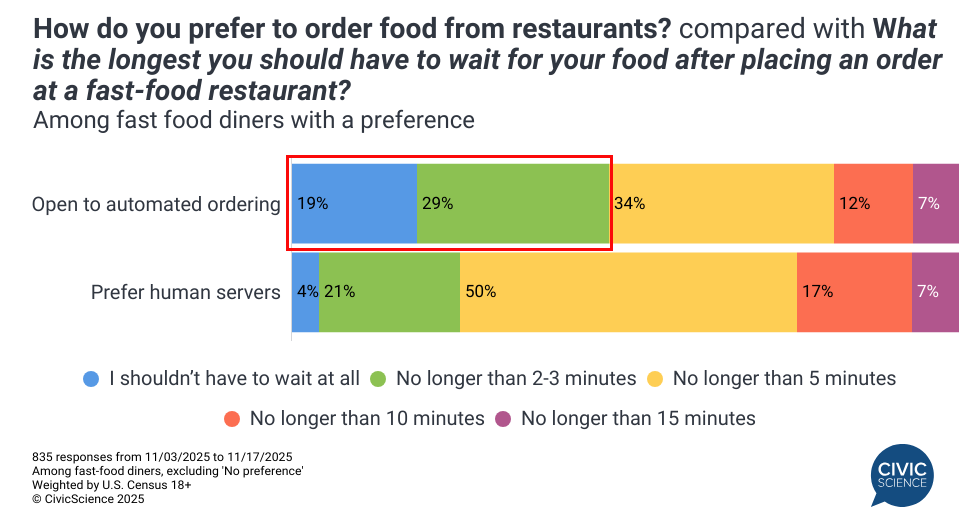
Automated food ordering systems are a growing trend in the restaurant industry; however, new survey data from CivicScience reveals that many consumers have not yet warmed to the concept. Just 9% of those with an opinion say they prefer to order through an automated system at all restaurants, while 24% are open to automated ordering, but only at fast-food or quick-service restaurants. Over two-thirds (67%), meanwhile, say they prefer only human servers.
Additional data suggest this preference for automation may correlate with a perception of faster service. Among fast food diners, those who are open to automated ordering are far more likely to expect to receive their food within 2-3 minutes of placing the order at fast food restaurants, specifically, compared to those who prefer to order from human staff.
Weigh In: Would you eat at a fully automated fast food restaurant with no human employees?
3. Goal setting isn’t just for New Year’s, as nearly half of U.S. adults say they set personal goals for themselves in the past month.
New CivicScience data show goal-setting isn’t just reserved for New Year’s — 45% of U.S. adults tell CivicScience that they have set personal goals in the past month alone. Among those who set goals, 41% report setting them spontaneously. Generational differences are evident in shaping this trend: older adults tend to set goals only when necessary, whereas Gen Z is the most time-motivated and more likely than the general population to choose a specific day or month (e.g., New Year’s Day, birthday).

Take Our Poll: Do you feel like your life goals are within reach?