CivicScience has the world’s largest proprietary database of real-time declared intent, allowing brands to activate high-performing advertising that drives up to 80% better performance. See how our partners achieve superior marketing outcomes here.
In a world where financial confidence is constantly fluctuating amid uncertainty, understanding how Americans assess their personal financial health remains of the utmost importance. Fortunately, the CivicScience Consumer Financial Health Index sheds light on data that help decision-makers anticipate consumer spending.
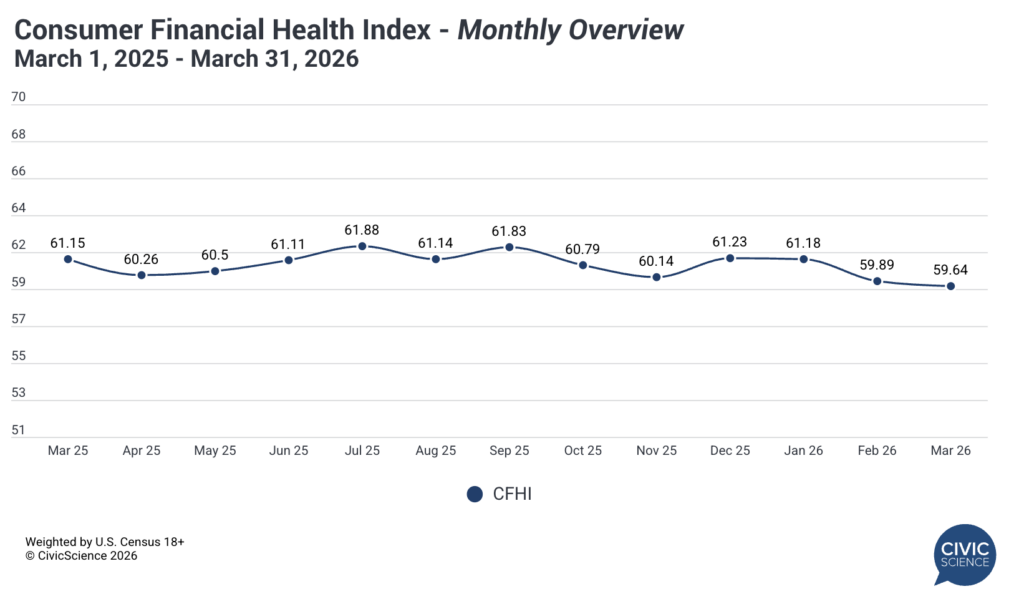
After a substantial 1.29 point drop in February, the March reading shows a further, yet comparatively less severe, 0.25-point drop, landing the index at 59.64. Although the most recent dip is smaller in scale, this figure remains 1.51 points lower than at this point last year.
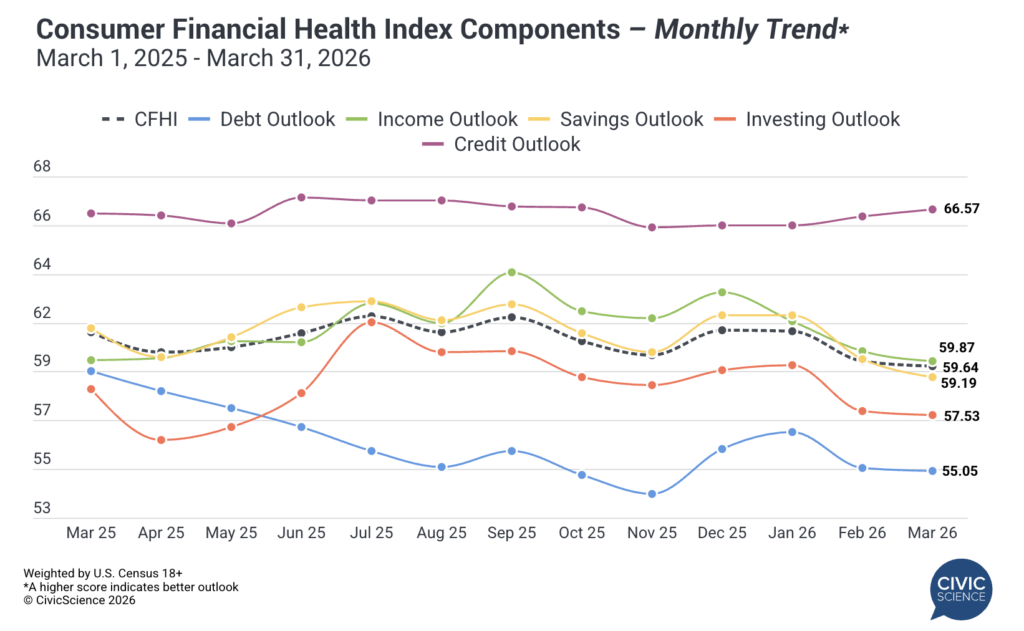
A closer look at the CFHI’s individual components reveals that savings outlook led the drop (0.78 points), followed by income outlook (0.46 points). After a brief increase in January, debt outlook declined for a second consecutive month, dropping 0.16 points since February, while the investing outlook fell 0.15 points. While all other components are on a downward trajectory of late, credit outlook is trending up. However, its slight 0.31-point gain wasn’t enough to offset the compounding negative impact of the other components in March.
Although the month-over-month drop was less severe, March furthered February’s decline. How these figures continue to evolve, especially in light of the ever-changing global economic landscape, remains to be seen. CivicScience clients across industries leverage insights like these to stay ahead of spending shifts and create strategies to meet consumers where they are now and where they’re headed.