CivicScience engages directly with consumers, collecting over one million survey responses daily, to turn real-time insights into high-performing advertising campaigns. See how leading brands use CivicScience to drive campaign performance here.
1. Early tax season has seen a surge of Americans who have already filed their taxes amid the possibility of seeing a larger refund than last year.
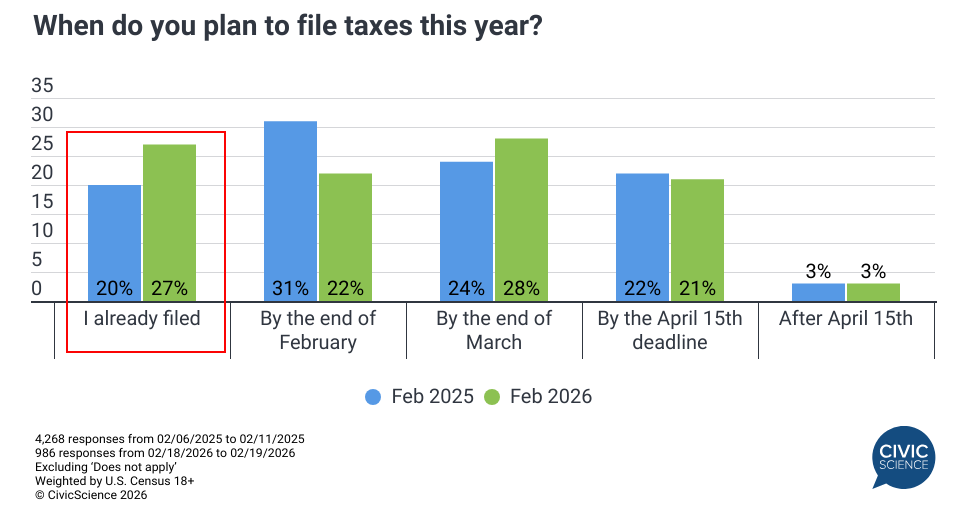
With tax season nearly a month underway, new CivicScience data reveals there’s been an early-season surge in the percentage of those who say they have already filed, compared to February of last year. More than one-quarter say they’ve already filed their taxes, seven points ahead of last year’s pace (excluding ‘does not apply’).
The prospect of receiving a larger refund is likely playing a key role in this early-season increase in tax filings. Notably, 69% of those who say their tax refund is ‘extremely’ important for their overall financial health say they plan to file by the end of February, 22 points higher than those whose refunds are ’not at all’ important for their financial health (among those expecting a refund).
Let Us Know: When do you typically file your taxes?
2. More than two-thirds of U.S. adults say they seek advice from the internet, with Gen Z women leaning most heavily on social media platforms.
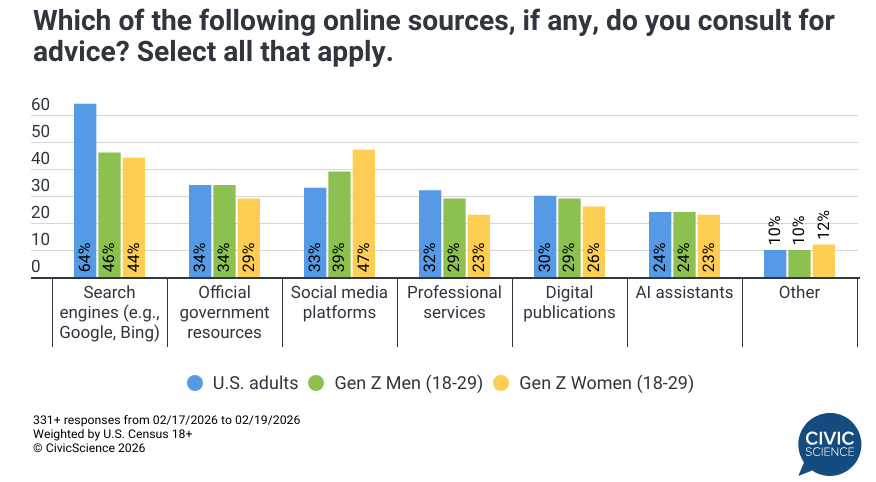
New CivicScience survey data reveal that 68% of U.S. adults turn to the internet for advice. Among them, search engines and official government resources are the primary channels, particularly among those aged 65 and older. Gen Z adults and Millennials, meanwhile, are over 10 percentage points more likely to use social media than their older counterparts, with Gen Z reporting that social media is nearly as popular as search engines. Notably, Gen Z women aged 18-29 are eight percentage points more likely than men of the same age to seek advice on social media.
Take Our Poll: How often do you give advice that you wouldn’t take yourself?
3. Nearly 2 in 5 U.S. adults are ‘very’ concerned about the state of public infrastructure in their area, with likely 2026 midterm election voters showing much stronger concern.
While anxiety regarding the quality of public infrastructure has dipped slightly over the past four years, over 38% of U.S. adults remain ‘very’ concerned (compared to 18% who are ‘not at all’ concerned), though these feelings vary across demographic lines. Forty-two percent of city dwellers report being strongly concerned about the current state of public infrastructure, compared with 31% of rural residents.
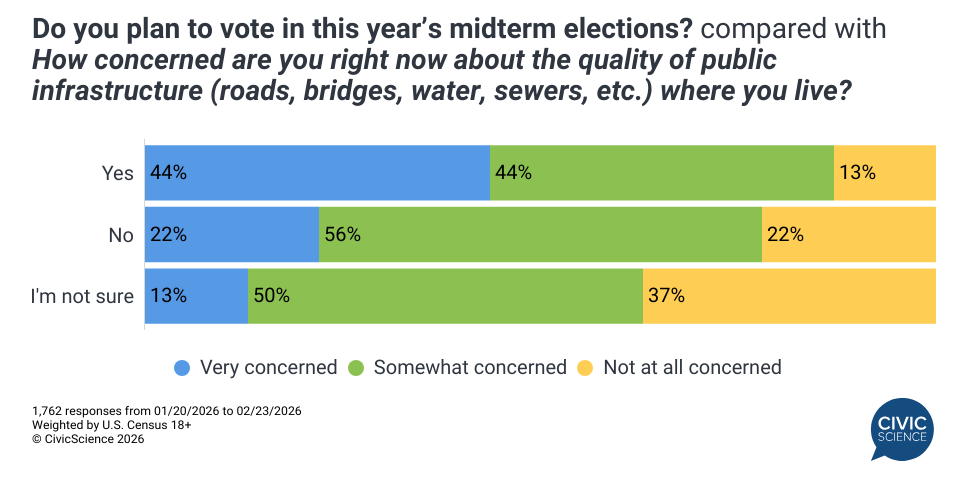
This apprehension is particularly pronounced among those who say they are planning to vote in the 2026 midterm elections this November: 44% of these likely voters express high levels of concern about the nation’s infrastructure, double the percentage of those not likely to vote in this election.
Ultimately, while the general public’s anxiety may be stabilizing, targeted audiences—including urbanites and likely 2026 midterm election voters—increasingly view modernizing public facilities as a high-stakes priority.