CivicScience engages directly with consumers, collecting over one million survey responses daily, to turn real-time insights into high-performing advertising campaigns. See how leading brands use CivicScience to drive campaign performance here.
1. New USDA food guidelines recommending more protein and full-fat dairy are largely met with confusion and skepticism among consumers.
Public reception to the “Inverted Food Pyramid” is defined by a disconnect between official recommendations and consumer trust. While the USDA is now advocating for increased protein and full-fat dairy, only 23% of Americans who are aware of the new guidelines currently support or follow this shift. The majority of the market remains hesitant, with 57% saying they are either skeptical of the health claims (28%) or that they find the new framework confusing or contradictory (29%).
Notably, consumers who say they are ‘not interested’ in fitness activities are the most likely to support the guidelines, whereas those most passionate about health and fitness — the traditional “early adopters” — are the most likely to find the recommendations confusing or contradictory.

What Do You Think: Do you personally approve or disapprove of the new upside-down food pyramid?
2. Americans are increasingly looking forward to seeing the Super Bowl ads this year, but the ads with the most impact vary by economic outlook.
Super Bowl LX is this Sunday, and CivicScience has already examined consumer viewership plans, finding that women are increasingly likely to tune in, compared to years past. Additional consumer-reported data on the big game shows that while the game itself remains the primary driver of viewership, this figure has declined by six points from 49% last year to 43% this year. Instead, viewers are increasingly motivated by the commercials (26%, up from 21%), followed by the halftime show (17%, up from 16%). Social gatherings related to the game, on the other hand, fell slightly (13%, down from 14% last year).
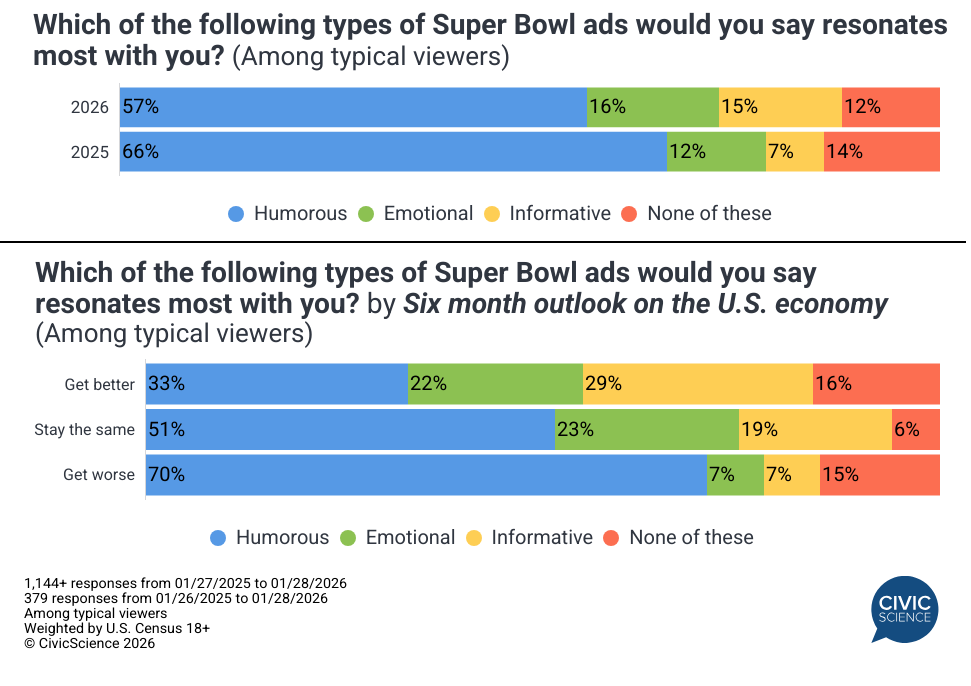
Speaking of Super Bowl advertising, humorous ads continue to resonate most with typical viewers, though their appeal has dropped by nearly 10 points since last year. In contrast, emotional (+4 points) and informative (+8 points) ads have gained traction this year, particularly among those who feel optimistic about the future of the economy. Meanwhile, viewers who believe the economy will worsen in the next six months are far more likely to say that humorous Super Bowl ads resonate most with them.
3. The percentage who donate to charities holds steady, but distinct motivations emerge across household income levels.
Recent consumer-declared data show that more than 8 in 10 (82%) U.S. adults say they donate to charity, consistent with levels seen in January 2025 (81%). But how Americans are donating has changed significantly since 2022. Currently, 35% of donors give through websites, apps, or QR codes—up from 26% in 2022. This growth has largely replaced mail-in donations, which dropped from 26% to 17% over the same period. In-person giving at events or retail locations remains steady at around 28%.
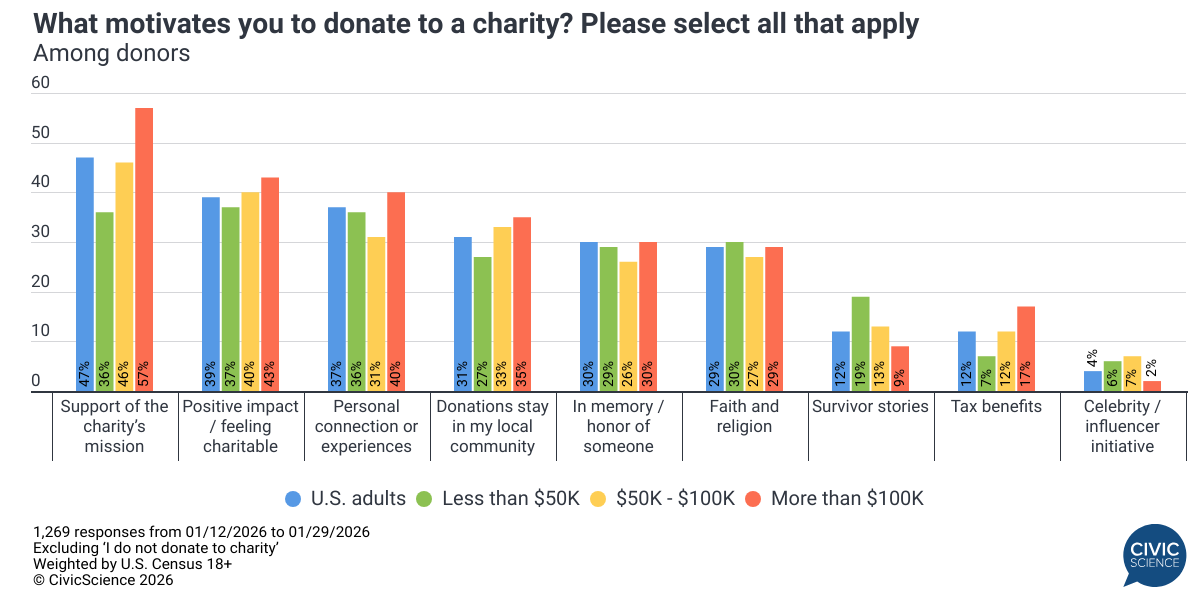
Donor motivations are deeply rooted in a charity’s mission, general altruism, and personal experiences, though these drivers fluctuate significantly based on household income. High-income donors ($100K+) are notably more likely to be mission-driven or motivated by tax incentives, whereas lower-income donors (those earning less than $50K) are twice as likely to be driven by survivors and emotional storytelling.
Let Us Know: Do you typically watch the Super Bowl for the game or the commercials?