CivicScience engages directly with consumers, collecting over one million survey responses daily, to turn real-time insights into high-performing advertising campaigns. See how leading brands use CivicScience to drive campaign performance here.
As in-app purchasing becomes increasingly embedded in the social media experience, new CivicScience data reveal how the path to purchase is shifting and who’s driving what comes next.
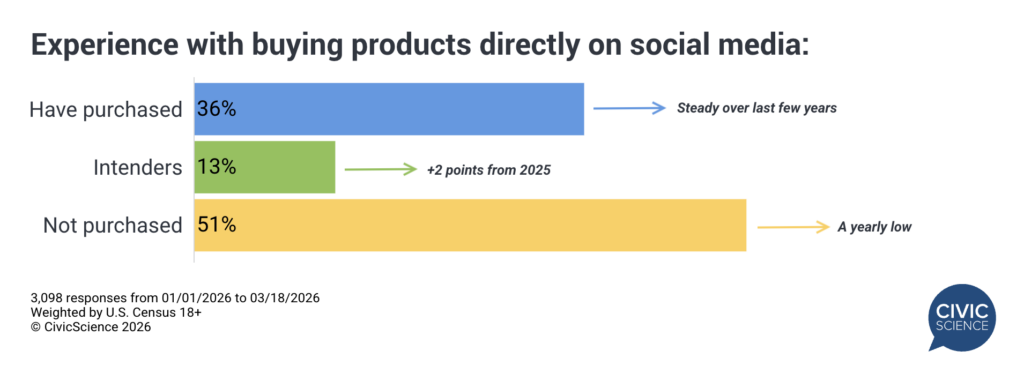
Key Finding: More than one-third (36%) of U.S. adults now say they’ve purchased an item directly through social media, while another 13% haven’t yet, but plan to. While adoption appears to be stabilizing, intent is at an annual high and continues to grow, signaling that there’s still an untapped market.
The Path to Purchase
That intent momentum – paired with steady adoption – is being shaped well before consumers reach the point of purchase.
Social media is increasingly serving as the starting point for shopping behavior, particularly as a source of product and service discovery. Just over one-fifth (21%) say social media sparks their initial purchase interest, up two points YOY.
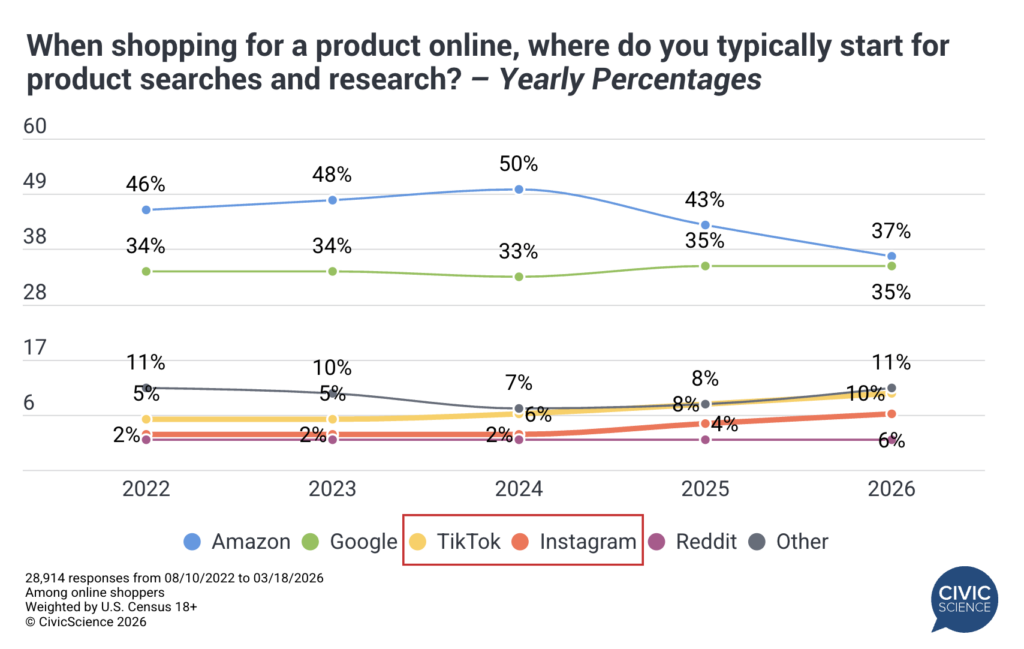
In particular, social platforms are increasingly functioning as search engines. Among online shoppers, the share who say they start their product searches on TikTok has doubled from 5% in 2022 to 10% today, while the percentage starting searches on Instagram has tripled from 2% to 6% over the same period. Google and Amazon still lead overall as search engines, but Google has remained flat, and Amazon continues to fall.
The growth in social media platforms as search engines comes as TikTok Shop usage overall reaches a high of 35% so far in 2026, up from 23% in 2025.
Lastly, content creators’ influence continues to grow. The percentage of social media users who report purchasing a product or service based on an influencer recommendation in the past six months has risen from 14% in 2025 to 19% in 2026, led by those under 45 (27% in 2026).
The State of In-App Social Media Buying: Audience Breakdown
While this social commerce continues to expand, not all audiences engage with it the same way.
Younger consumers are leading the charge, but the 45+ crowd shouldn’t be overlooked. Nearly half (48%) of Gen Z and Millennials report they’ve made purchases directly through social platforms. Still, the behavior extends beyond younger audiences, with roughly one in four Gen X and Baby Boomers saying the same. Notably, intent remains strong across age groups – 18% of adults under 45 say they plan to purchase via social media, while intent among those 45+ has reached a high of 8%.
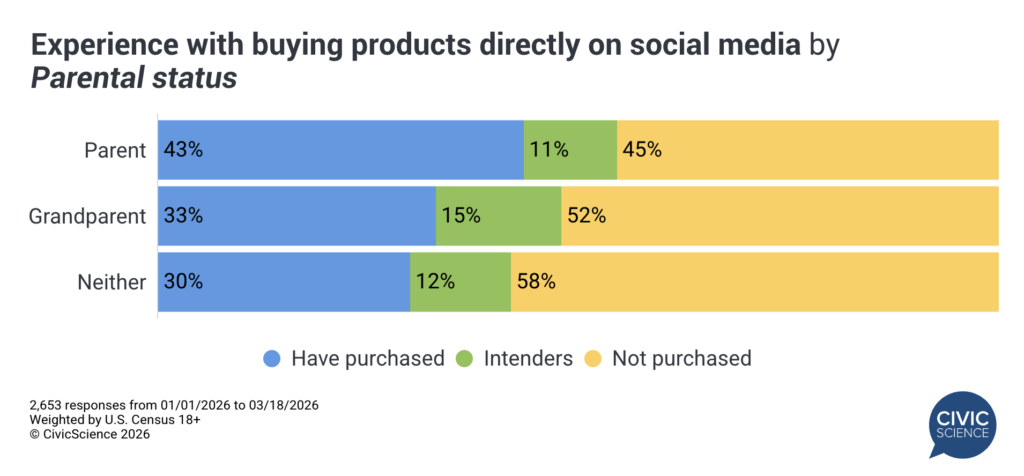
Parents also stand out as a particularly engaged audience. Just over two-fifths (43%) say they’ve made purchases directly through social media, outpacing grandparents and non-parents by at least 10 points.
Consumers who report feeling ‘very’ stressed this year are seven percentage points more likely than those who are ‘not at all’ stressed to say they’ve purchased items through social media. Their intent is also more than double (18% vs. 8%).
However, household income shows little influence on in-app social media buying. Consumers earning above and below $75K are nearly equally likely to report having made or plan to make purchases through social platforms, pointing to broad adoption.
Gender differences are similarly nuanced. While women are slightly more likely to have already made purchases through social media, men are more likely to express future intent (14% vs. 11%).
For brands, the takeaway is less about whether social commerce has arrived and more about where it’s heading. Intent is growing across age groups, influencer-driven purchasing is accelerating, and social platforms are increasingly functioning as the first stop in the shopping journey. The audiences most likely to convert – parents, younger consumers, and stress-driven shoppers – are already engaged and signaling more activity ahead. Reaching them effectively means showing up not just at the point of purchase, but at the point of discovery.