CivicScience has the world’s largest proprietary database of real-time declared intent, allowing brands to activate high-performing advertising that drives up to 80% better performance. See how our partners achieve superior marketing outcomes here.
Snacking is a ubiquitous part of American food culture, and CivicScience has been on the pulse of it in real-time for years. Especially during times of economic uncertainty, how people eat isn’t just a culinary preference but an insight into how food trends intersect with other consumer lifestyle habits.
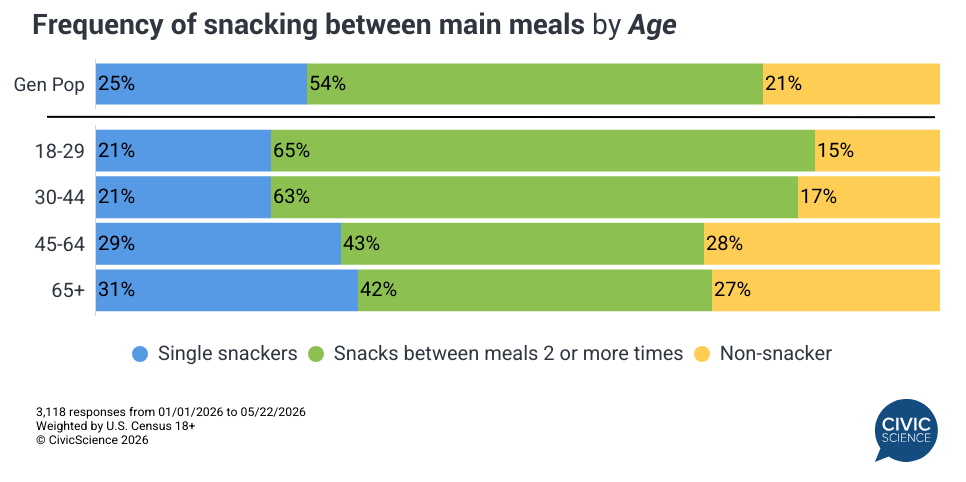
The latest CivicScience data finds that nearly 8 in 10 U.S. adults (79%) report snacking between meals at least once a day on average. While this matches the percentage who said the same in 2025, it’s an increase of four percentage points from 2020. While in-between-meal snacking overall is consistent with last year, the percentage of Americans grabbing a bite to eat between meals multiple times per day is up to 54%, the highest such figure since CivicScience began asking about snacking habits in 2015.
And while every generation snacks, multi-snackers are led by adults 18-29 (35% say they snack between meals three or more times) and women, while single snackers are led by adults aged 65+ and men.
Snack Times are Shifting Slightly, But Salty Snacks Remain the Top Choice
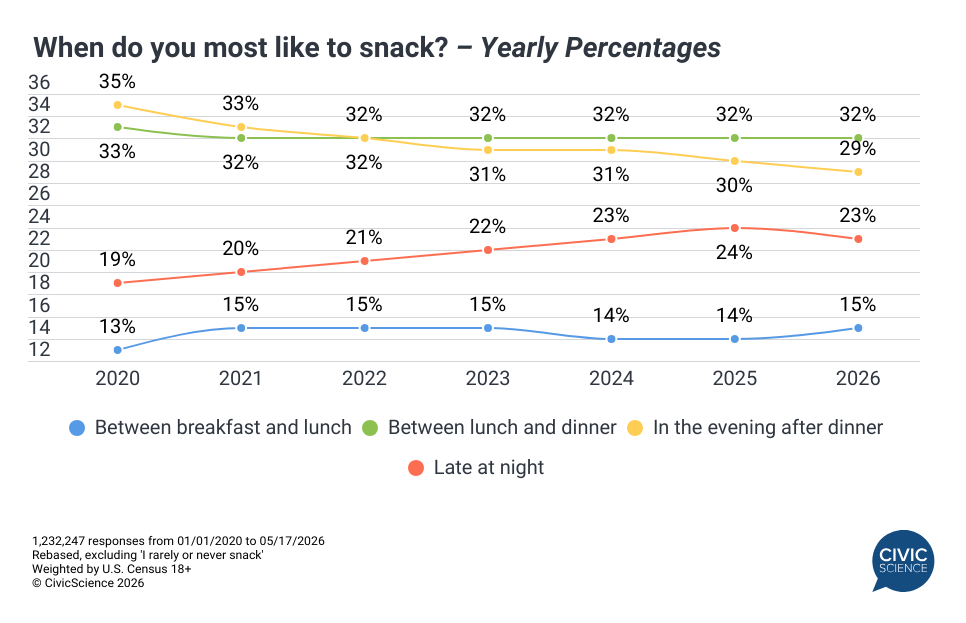
Coinciding with the rise in between-meal snacking is a slight shift in when Americans typically snack. Data show that snacking between lunch and dinner (32%) remains the most popular time, while the share who most enjoy snacking in the evening after dinner (29%) and late at night (23%) each fell by a single percentage point compared to 2025. The slight drop in late-night snacking also breaks a trend of increases that had been ongoing since 2020. At the same time, indulgence between breakfast and lunch is back up to 15% after a dip in 2024.
What Americans grab for a snack has remained consistent: salty snacks like chips and pretzels remain the leading type of snack foods, followed by sweet snacks like candy or chocolate, and healthy snacks like fruit or nuts (excluding ‘other’ and those who never snack). These preferences have changed very little over the past year or so.
The Lifestyle Habits of Those Who Snack Multiple Times Per Day
Given how widespread snacking is among American adults, it’s worth zeroing in on those who snack multiple times a day. This frequent snacking correlates with distinct lifestyle trends that brands, publishers, and advertisers can leverage. Here is what sets multi-snackers apart from the average U.S. adult:
- Shopping online more often than usual: Nearly two in five multi-snackers (37%) say they’re shopping online more than they typically would this time of year, a rate seven points higher than the Gen Pop.
- Paid publisher content subscriptions: Multi-snackers are close to 50% more likely than the average adult to hold two or more paid publisher subscriptions (e.g., ESPN, NYT, WSJ) – 34% do so, versus 23% of the Gen Pop.
- Beauty trend followers: Multi-snackers over-index on beauty interest, with more than half (57%) reporting they follow trends in beauty at least ‘somewhat’ closely, compared to 44% of the Gen Pop.
- Traveling for self-care: Nearly half of multi-snackers (47%) say they use travel as a form of self-care at least ‘somewhat’ often, compared to 34% of the Gen Pop who say the same.
Trend to Watch: Many Americans Replace a Traditional Meal With Snacks
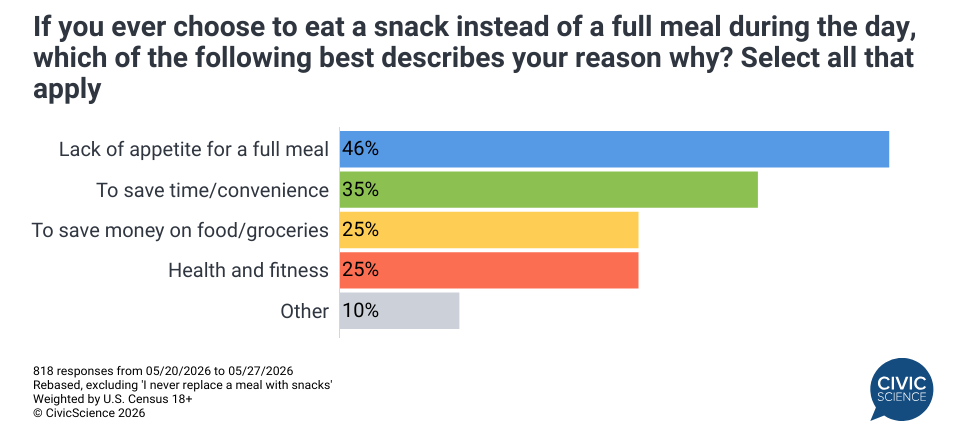
Amid the trend of multi-snacking between meals, a significant portion of the adult population also reports often replacing a full traditional meal with snacks. Additional consumer-reported data show nearly 6 in 10 U.S adults report they replace a meal by snacking at least once per week, while only 24% ‘never’ do this.
The data also points to a variety of motivations that are driving meal replacement. For those who choose to replace a meal with a snack, appetite is the most commonly cited reason, but it’s far from the only one. Convenience, portion preference, health goals, and cost savings all factor in for a meaningful share of adults, pointing to a trend that spans both practical necessity and personal choice.
From between-meal bites to full meal replacements, snacks are a key part of the average American’s daily routine. The data paint a nuanced picture of who snacks, when, and why, with implications that extend well beyond the pantry. For brands and advertisers, the snacking consumer represents an audience worth understanding in full.