CivicScience engages directly with consumers, collecting over one million survey responses daily, to turn real-time insights into high-performing advertising campaigns. See how leading brands use CivicScience to drive campaign performance here.
It’s that time of the year in the sports world. The NCAA basketball tournament, also known as March Madness, is officially here. With the full field finalized via play-in games, new consumer-declared data from CivicScience offers a closer look at intent and key insights into the respective audiences of both the men’s and women’s tournaments this year. Here’s what viewers are telling CivicScience:
March Madness Interest Spikes
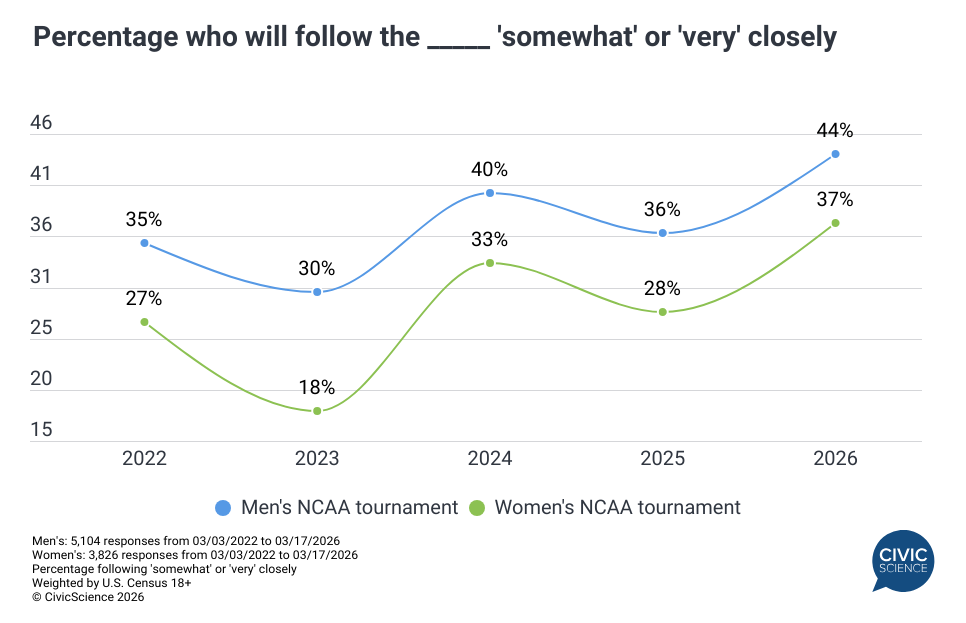
The percentage of Americans who say they plan to follow the NCAA men’s basketball tournament at least ‘somewhat’ closely is surging compared to last year – 44% of U.S. adults say they plan to follow the men’s tournament this year, up from 36% ahead of the tournament in 2025. But it’s not just the men’s side of things that’s seen a spike in interest, as there’s been an even more pronounced nine-point jump in the percentage of Americans who say they’ll follow the women’s tournament, rising from 28% last year to 37% this year.
Data also show that men are the primary drivers of interest across both tournaments, while those aged 18-44 (which can prove to be particularly responsive for ads during major sporting events) will also be a key audience for the men’s and women’s games.
Betting, Brackets, and School Pride Drive the Jump
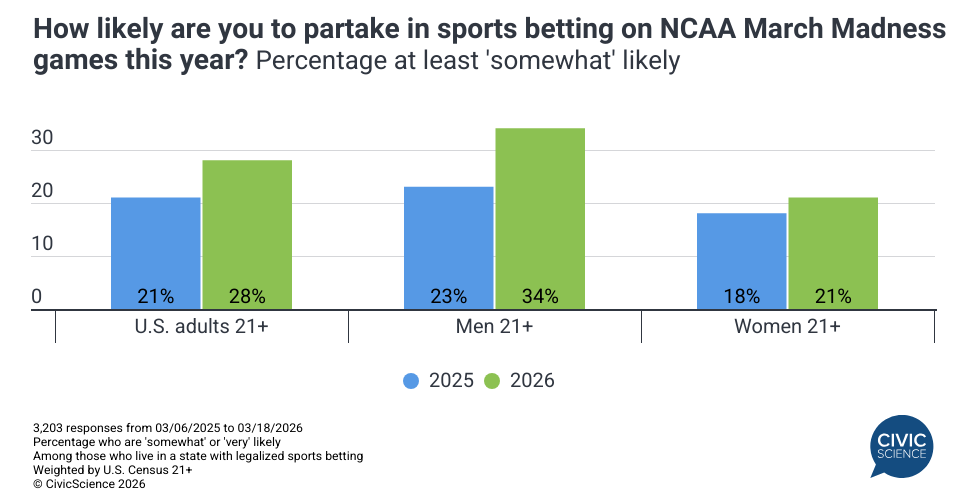
One key contributor to the rising interest in March Madness? Sports betting. Consumer data in Q4 2025 suggested sports betting was entering 2026 with momentum, and that carried over into the Super Bowl last month. According to new CivicScience data, this trend is likely to continue with the NCAA basketball tournament, as betting intent specific to the tournament is up 33% this year among Americans 21+ who live in a state where sports betting is legal. Men are largely the primary drivers of this rising intent, though betting interest also increased by three points among women year-over-year.
Coinciding with rising sports betting intent is an interest in casual competition through NCAA tournament bracket pools. This year, 24% of U.S. adults say they will participate in an NCAA tournament pool, the highest percentage observed since CivicScience began tracking in 2019.
Additionally, when asked the primary reason Americans typically watch the NCAA basketball tournament, 22% say it’s ‘to see how my bracket does.’ Still, rooting for a specific school program, whether it’s their favorite team (25%) or their current school or alma mater (22%), is the most likely motivation behind viewership. Another 21%, meanwhile, say they watch because they are college basketball fans in general, while 10% cited ‘other.’
Watching via Streaming is Closing the Gap in March Madness Viewership
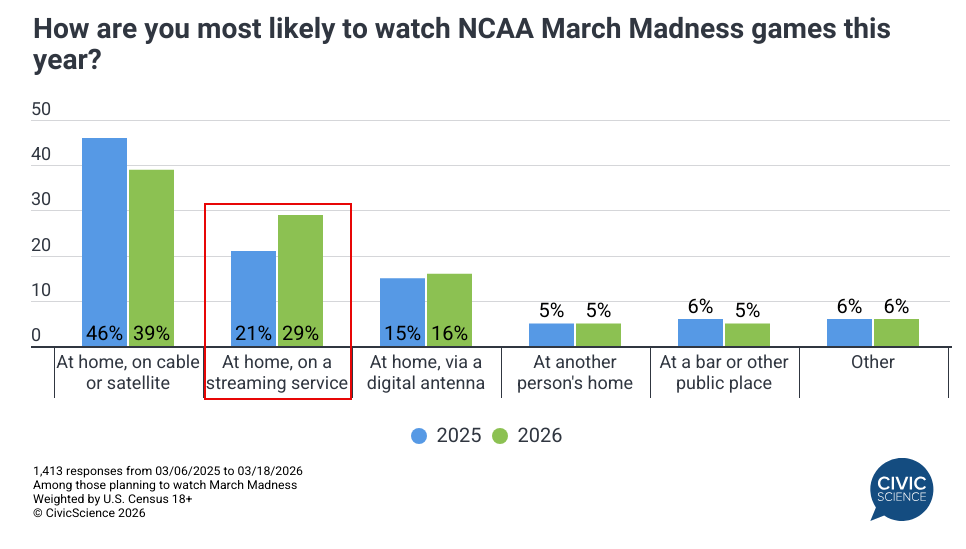
While traditional cable/satellite broadcasts continue to lead in March Madness viewing, new CivicScience data show that their share has fallen significantly year over year. Twenty-nine percent of viewers say they’ll watch the events through a streaming service, such as Max or YouTube TV, a seven-point increase from 2025, leading to a seven-point drop in traditional broadcasts. This comes as the share of Americans who say they’ve cut the cord on cable/satellite in favor of streaming services continues to climb – 67% of paid TV subscribers now report they’ve cut the cord on cable/satellite TV and have moved to streaming-only services, up from a yearly average of 64% in 2025.
A Glimpse of the March Madness Audience Insights CivicScience Can Deliver
Tournament hype is temporary, but audience value persists. Move beyond basic demographics with CivicScience’s consumer-declared data to unlock the specific drivers that resonate with these fans year-round.
Here’s what followers of both the men’s and women’s tournaments are telling CivicScience and how they compare to the average American adult:
- Solo Restaurant Dining for Self-Care: 56% of Men’s March Madness viewers and 62% of Women’s March Madness viewers say they dine at restaurants alone for self-care at least ‘a few times per month,’ outpacing solo-diners overall who say the same (54%).
- Near-Term Mattress Buying Intent: 23% of Men’s March Madness viewers and 29% of Women’s March Madness viewers are ‘very’ likely to buy a new mattress in the next six months, 10 points higher than the average U.S. adult (13%).
- Reaching Them with Advertising: 26% of Women’s March Madness viewers and 23% of Men’s March Madness viewers say they ‘always’ notice digitally inserted advertisements on sports playing surfaces during broadcasts (22% sports fans overall say the same). Additionally, when it comes to what most often leads to a final purchase decision, both Men’s and Women’s March Madness viewers are more than twice as likely as the Gen Pop to say website ads most often guide them to hit checkout.
March Madness is clearly resonating with more Americans, with viewership intent, bracket participation, and sports betting all trending upward heading into this year’s tournament. The women’s game, in particular, is continuing to build momentum, reflecting a broader shift in how fans are engaging with college basketball as a whole. For brands and advertisers, this expanding and commercially engaged audience presents a timely opportunity — one backed by data that goes well beyond the box score.