CivicScience has the world’s largest proprietary database of real-time declared intent, allowing brands to activate high-performing advertising that drives up to 80% better performance. See how our partners achieve superior marketing outcomes here.
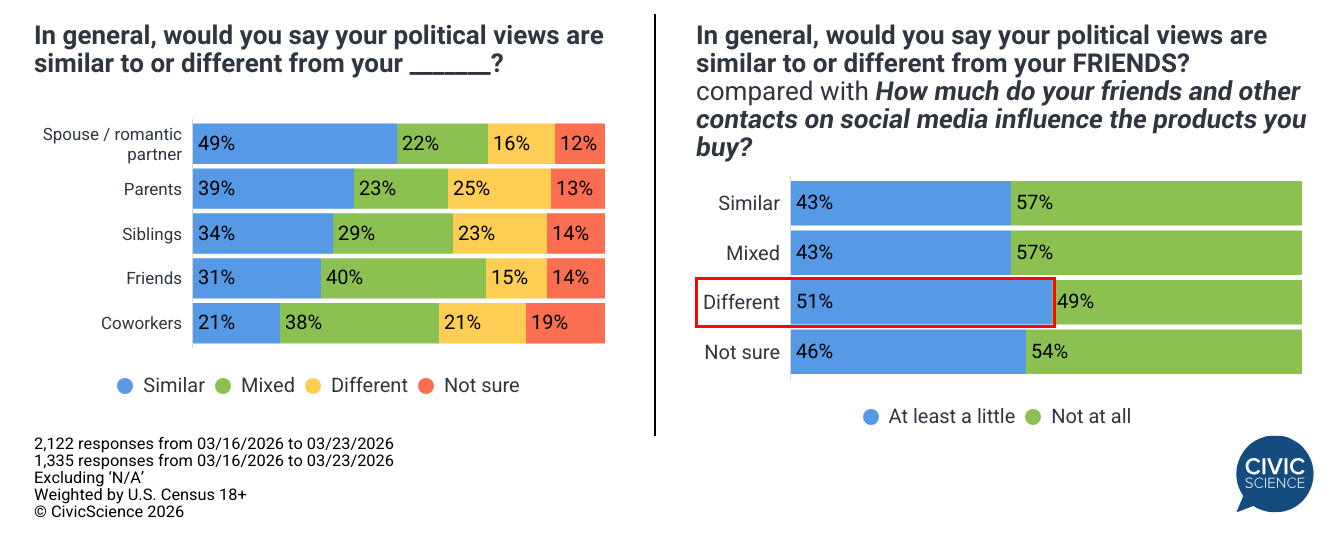
1. While romantic partners are the most politically aligned, Americans report mixed or different views across their wider social circles.
How much do Americans align or differ when it comes to their political beliefs and the relationships in their lives? Across a range of relationships, Americans are, unsurprisingly, most likely to report having political beliefs similar to those of their spouse or romantic partner. While immediate family members, such as parents and siblings, follow, consumers also report some of the highest levels of differing political views in these relationships (23%–25%). Americans are least likely to report close alignment on political views with their coworkers, while friends are most often described as having ‘mixed’ political views.
These findings follow a recent CivicScience study on trust in friends and the strong influence of friendships on purchasing decisions. Notably, new data show purchasing influence is most pronounced among those who say they disagree politically with their friends, specifically: 51% of Americans say they generally have differing views from their friends report that their friends influence their purchasing decisions at least ‘a little.’ This level of influence is at least five percentage points higher than for those whose friends share similar (43%), mixed (43%), or whose political leanings are unknown to them (46%).
Let Us Know: Do you discuss politics with friends?
2. The growing influence of content creators extends beyond product purchases, as more than one-third say they’ve visited a physical location based on an influencer’s recommendation in the past year.
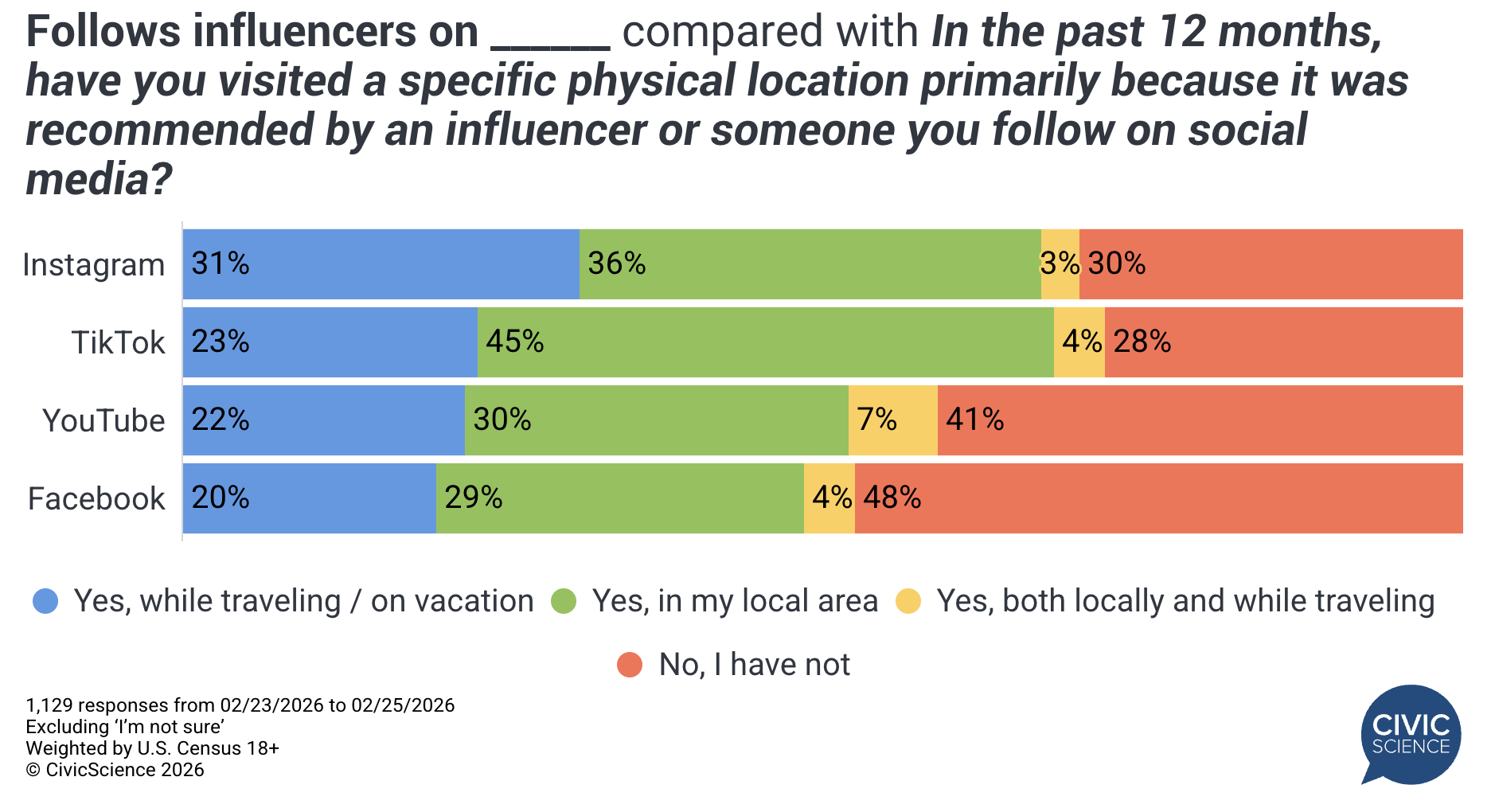
Last week, CivicScience explored in-app social media purchasing, including the influence of content creators. Building upon that, new consumer-reported data show that influencer content is also driving “real-world” foot traffic for over a third of the adult population. Thirty-six percent of U.S. adults say they have visited a physical location—be it a local eatery or a vacation landmark—specifically due to social media recommendations.
But this influence varies by platform: Instagram serves as a primary discovery engine for travel and tourism, with 31% of users who follow influencers on the platform reporting they’ve visited a recommended location while on vacation (excluding those unsure). Conversely, TikTok is a powerful driver of local economies; 45% of respondents who follow influencers on TikTok have visited a local spot based on a creator’s suggestion (with an additional 4% saying they’ve been influenced both locally, and while traveling).
3. Roughly one in two U.S. adults say they’re aware of Kalshi amid surging prediction markets, and nearly a quarter of them are interested in trying it soon.
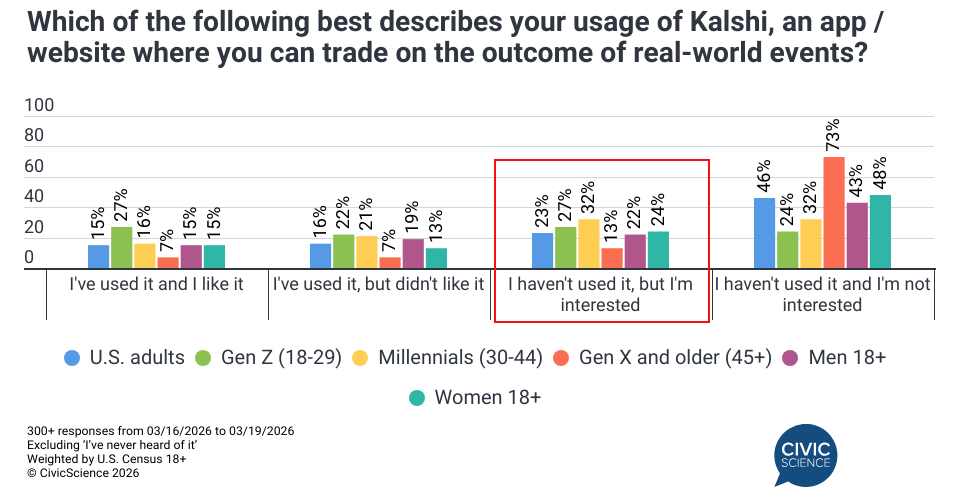
The prediction market, which allows traders to buy and sell contracts on the outcomes of real-world events, is surging. Kalshi is one of the platforms driving this industry growth and notably made a $1 billion March Madness bracket offer last week. New CivicScience data show 51% of U.S. adults are aware of Kalshi, and among them, roughly 3 in 10 say they have tried it before, led by Gen Z aged 18-29 and men. The data also show a noteworthy “growth pipeline” for Kalshi: 23% of those aware of Kalshi are interested in trying it, with Millennials and women showing the highest level of untapped interest.
Take Our Poll: Do you think prediction markets like Kalshi should or should not be regulated by the government?