CivicScience has the world’s largest proprietary database of real-time declared intent, allowing brands to activate high-performing advertising that drives up to 80% better performance. See how CivicScience partners achieve superior marketing outcomes here.
Since CivicScience began tracking, sentiment toward plant-based meat alternatives has ebbed and flowed as the category navigates questions about taste, price, nutrition, and its place in consumers’ diets. Ongoing affordability concerns and processing challenges have strained the category, leaving brands to figure out what it will take to bring more consumers on board. Against this backdrop, new CivicScience data offer a look at where American consumers stand today and whether attitudes toward plant-based meat are beginning to shift.
Openness to Plant-Based Meat Is Growing
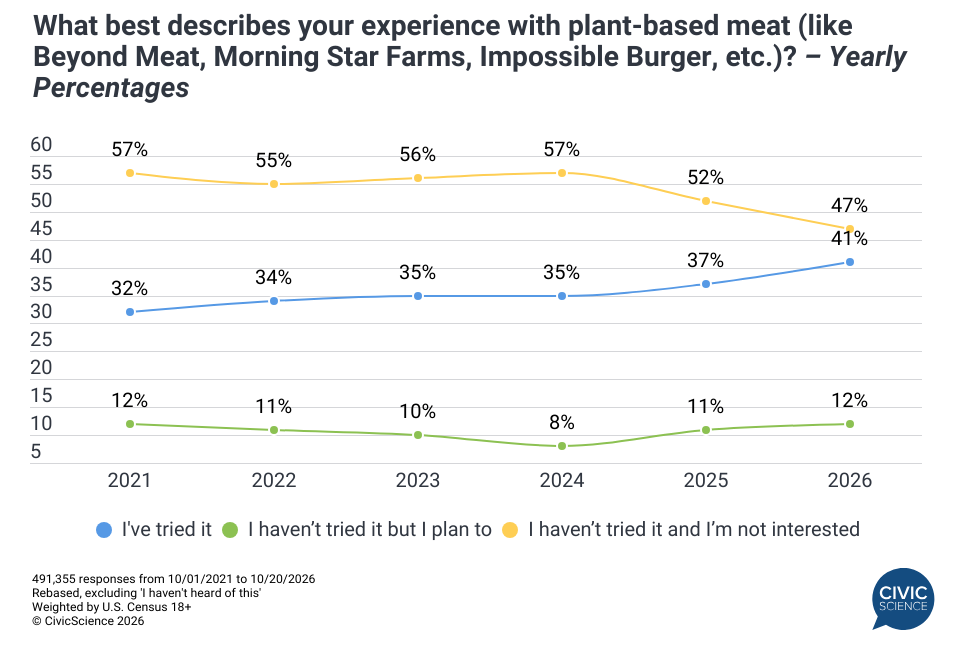
According to the latest data, 41% of U.S. adults report they have tried plant-based meat, up four percentage points from 2025. Interest in trying these products has also rebounded from a 2024 low point of 8%, rising back to 12% so far this year. Meanwhile, the share of Americans who have never tried plant-based meat and aren’t interested in doing so fell five percentage points year over year, suggesting some consumers may be warming to the category.
Generational and gender differences offer further insight into that interest. Millennials aged 30-44 are the most likely to have tried plant-based meat (49%), while Gen Zers aged 18-29 are the most likely to express interest in trying it (22%). Women and men are equally likely to have tried these products (41%), but men are more likely to say they’re interested in trying them (13% vs. 11%).
How Americans assess their personal health also appears to play a role. Nearly 6 in 10 consumers (58%) who consider themselves ‘very’ healthy have tried plant-based meat, notably outpacing those who say they’re ‘not very healthy’ right now (20%). However, that gap could narrow, as these self-described unhealthy individuals are more than twice as likely as ‘very’ healthy respondents to express interest in trying plant-based meat (15% vs. 6%).
These findings suggest that plant-based meat may still have room to grow, even as brands work to overcome lingering skepticism. The question is how that interest translates into everyday food choices.
Familiar Formats and Practical Priorities Could Help Drive Trial
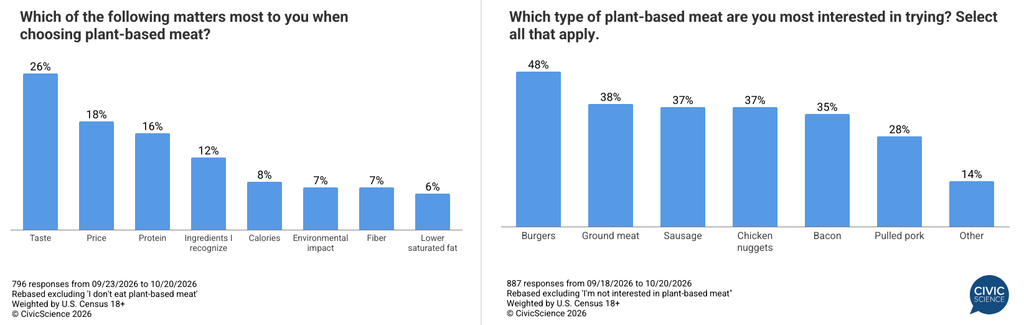
Converting interest means aligning with what consumers value most today. According to CivicScience data, that starts with taste (26%), price (18%), and protein content (16%). Recognizable ingredients come next (12%). Fewer than 1 in 10 prioritize calories, fiber, lower saturated fat, or environmental impact.
Taste becomes much more important for consumers 45 and older. More than half of those 65+ (55%) and over a third of those 45-64 (36%) say it matters most. Younger consumers weigh other factors more heavily, with Gen Z most focused on protein content (22%) and Millennials on price (21%). Millennials are also the most likely to prioritize environmental impact (10%).
Familiar formats appear to drive interest as well. Among consumers open to plant-based meat, burgers (48%) are the clear favorite to try, well ahead of ground meat, sausage, and chicken nuggets. That preference for everyday staples aligns with where consumers are eating plant-based meat. Nearly 4 in 10 recent plant-based meat consumers (39%) say they last had it at home, more than twice the share who had it at a restaurant (17%), suggesting the grocery aisle is a key point of entry for the category.
Americans Have Mixed Views on Plant-Based Meat’s Health and Environmental Benefits
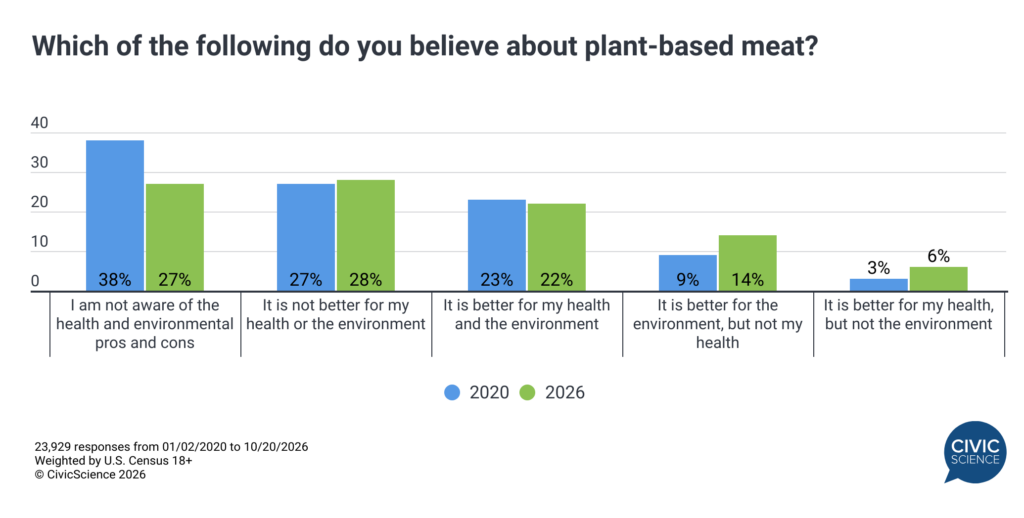
Environmental impact isn’t the deciding factor for most consumers when choosing plant-based meat, but it still shapes how they view the category overall. Since 2020, more Americans have formed opinions about its health and environmental benefits. The share who say they aren’t aware of plant-based meat’s health and environmental pros and cons fell 11 percentage points, from 38% to 27%.
Over the same period, more consumers have come to see plant-based meat as offering one benefit but not the other. The share who say it’s better for the environment but not their health rose five percentage points, from 9% to 14%. The share who say it’s better for their health but not the environment doubled, from 3% to 6%, though it remains the least common view.
Views at either end held relatively steady. Twenty-eight percent say plant-based meat isn’t better for their health or the environment, up one percentage point. Another 22% say it’s better for both, down one point.
As more Americans form opinions about plant-based meat, they’re increasingly likely to see it as delivering a single benefit rather than both.
What Comes Next for Plant-Based Meat?
Plant-based meat appears to be making modest progress with American consumers, as trial and interest rise and the share of uninterested consumers declines year over year. The next phase of growth may depend on addressing what different consumers prioritize. Taste, price, protein, and familiar formats all play a role, with their importance varying by age. Clearer answers about plant-based meat’s health and environmental benefits could also help shape whether initial curiosity becomes a lasting habit.
For brands, the opportunity lies in understanding which consumers are most open to plant-based meat, what each group values, and what might encourage them to make it a more regular part of their diets.