CivicScience clients and partners have access to our millions of daily survey responses, allowing them to generate actionable, forward-looking strategies. See what you’re missing here.
Vaccinations have long been a requirement for school-aged children. However, Florida’s recent move to end vaccination requirements has spurred a new wave of discussion around vaccination comfort levels, both in and out of the classroom.
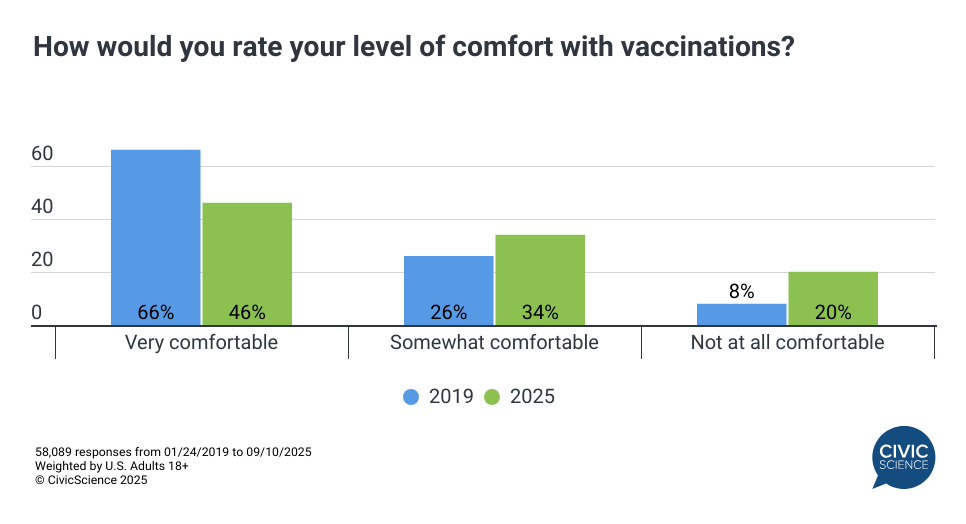
We’ve dug into the data to get a fresh sense of Americans’ current position on vaccines. While just under half of U.S. adults (46%) are ‘very’ comfortable with vaccinations, the fact that 20% of respondents are ‘not at all’ comfortable demonstrates the tension that currently exists around this topic.
This tension has been brewing over time. Year-over-year data show that overall comfort with vaccines has decreased since 2019, when 66% of Americans were ‘very’ comfortable and just eight percent were ‘not at all’ comfortable, less than half of the current percentage.
Although comfort is relatively equal among men and women, older adults and those making $100K and above demonstrate the most comfort of all age and income groups.
Let Us Know: Do you typically get a flu shot every year?
There are a variety of factors that influence an individual’s comfort level with vaccinations. For instance, those most comfortable are far more likely to prefer local news broadcasts for breaking news than other news sources, and those who are less comfortable with vaccines. They’re also the most likely to be traveling in the next month. Especially for frequent travelers, impending flights and public transportation–places where a variety of viruses can easily spread–may play a role in where they land on the vaccine comfort scale.
Despite Overall Comfort in Getting Vaccinations Falling, Two-Thirds Plan to Get a Flu Shot This Year
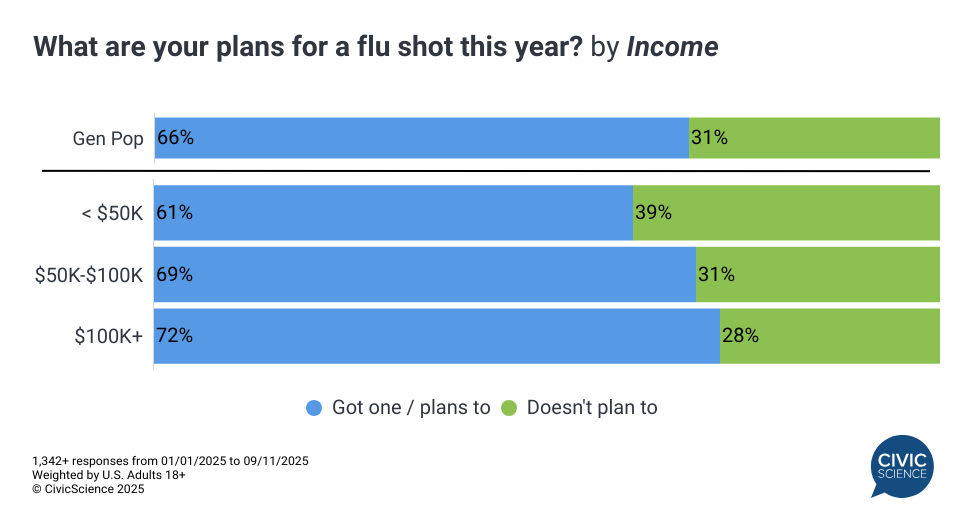
One of the most common vaccines–for kids and adults–is the flu shot, and current sentiment shows that 66% of U.S. adults plan to get a flu shot this year. It’s worth noting that interest in the vaccine has generally held steady since data collection began in 2018. As for those most interested, adults aged 65+, who may be most at risk for severe sickness, are the most likely to get a flu shot this year, followed by Gen Z adults. In terms of income, adults earning $100K+ lead the way.
Getting a flu shot appears to go hand in hand with a brighter outlook on the future. Whether their optimism prompted getting the shot or the other way around, what’s clear is that a association does exist. And it may impact more than just their vaccination plans.
Additional data show, those who have already or who plan to get their flu shot prioritize buying locally grown food ‘fairly often.’ They also consider themselves healthier and exercise more than those who do not plan to get a flu shot.
But Consumers Are Far Less Willing to Get the New COVID-19 Vaccines
As it stands, more than half of Americans (54%) believe that the COVID-19 vaccination is at least ‘somewhat’ relevant in protecting public health in the U.S. However, plans around the vaccine for the fall reveal more of a mixed bag.
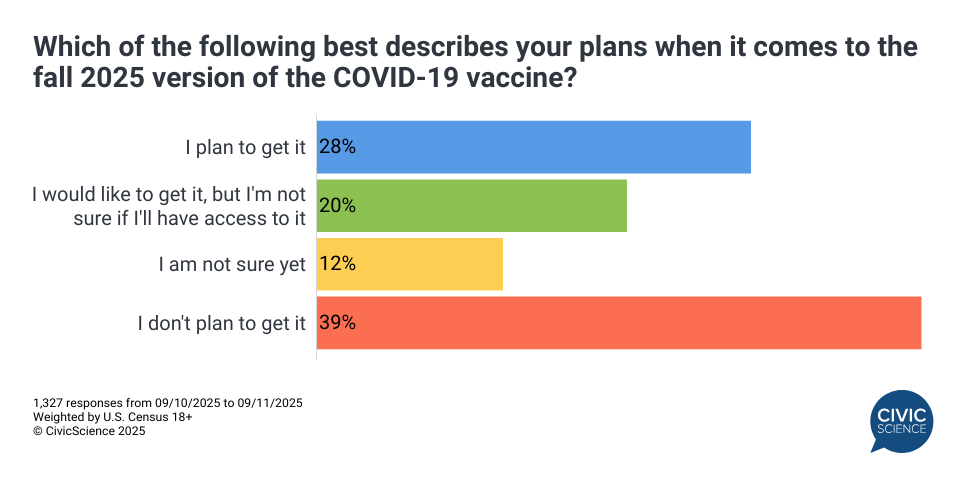
Although 28% of Americans plan to get the new fall version of the COVID-19 vaccine, 39% do not. That 39% marks a significant uptick from initial CivicScience polling in 2020, which found 26% saying they would not get the vaccines once they became available (compared to 48% who said they would get it and 26% who were unsure). The rest of the respondents are split between wanting the vaccine but being unsure of accessibility and those who are undecided altogether. It remains to be seen if the meeting next week by the Advisory Committee on Immunization Practices will provide the clarity that some Americans may be looking for to help tip the balance of their decision.
The discrepancy between sentiment about the COVID-19 vaccine and plans to receive it aligns with the decline in comfort with vaccines overall seen above. Though a majority believe the COVID-19 vaccine is a meaningful tool for public health, a sizable share don’t plan to get it, with most feeling uncomfortable with vaccines.
Take Our Poll: Do you plan to get any preventative vaccines this year?
Vaccinations are reaching an inflection point in the U.S., with new government guidance and policy taking shape. Although the vast majority of Americans are still at least somewhat comfortable with vaccines, the percentage who are not at all comfortable has more than doubled since 2019. This discomfort is manifesting itself in actions, with many opting to skip the new version of the COVID-19 vaccine despite valuing its role in public health. These trends suggest that vaccination decisions in the U.S. are becoming increasingly nuanced and individualized and may change the course of vaccinations as a whole.