CivicScience has the world’s largest proprietary database of real-time declared intent, allowing brands to activate high-performing advertising that drives up to 80% better performance. See how our partners achieve superior marketing outcomes here.
Prescription medications are woven into daily life for most Americans, and according to CivicScience data, that’s increasingly true each year. Sixty-nine percent of U.S. adults now take at least one prescription drug every day — up slightly from last year — with the share taking 2+ prescriptions (54%) up two points from 2025. New consumer-declared data dives deeper into this trend, exploring consumer decisions around who’s filling prescriptions where, who’s eyeing a new insurance plan, and who’s willing to get creative about managing costs.
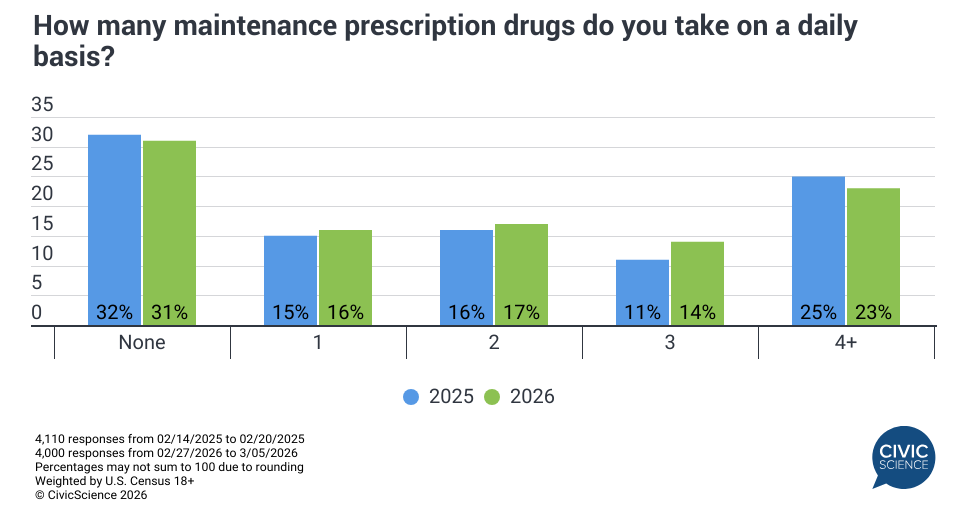
Understanding users’ demographics is important, too. Age, as expected, is a key predictor of daily prescription medication use: 54% of those 55+ take three or more daily prescriptions, while 21% take none. In contrast, adults 30-44 are the least likely to have a daily regimen (41% take none). Women and White Americans (18+) are most likely to take 3+ prescriptions, while Hispanic Americans are least likely to take any. Additionally, 39% of those who have used a GLP-1 for weight loss in the past year say they currently take 3+ prescription medications daily.
How Insurance Factors in
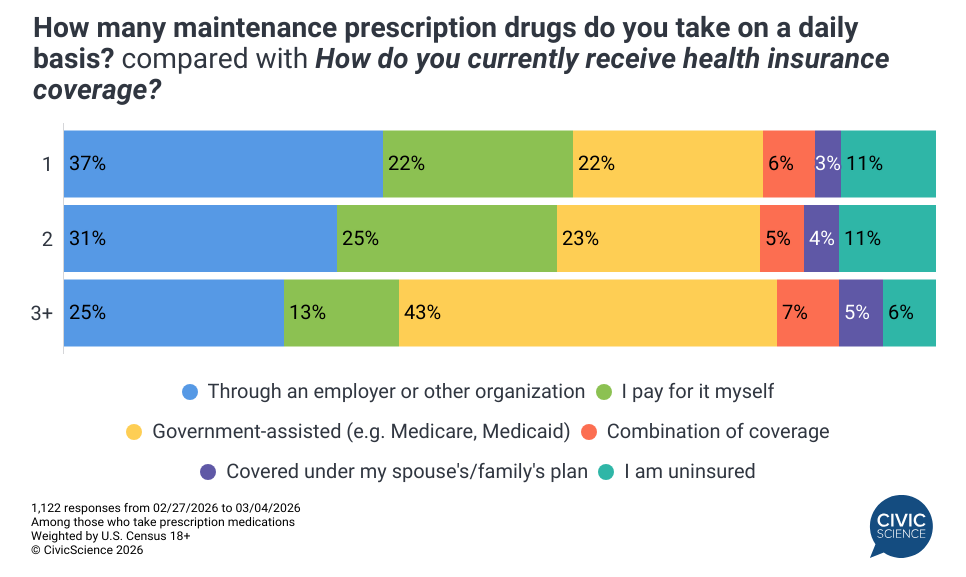
Employer-sponsored plans are most common for those taking one or two prescription medications daily, though this group is also most likely to report being uninsured (among those who take prescription medication). Those taking two prescriptions are most likely to pay for coverage out of pocket, while consumers on 3+ daily medications are nearly twice as likely to rely on government-assisted programs, a pattern that likely reflects the older age skew of that group.
Big Box Pharmacies Capture Growing Share of Prescription Filling
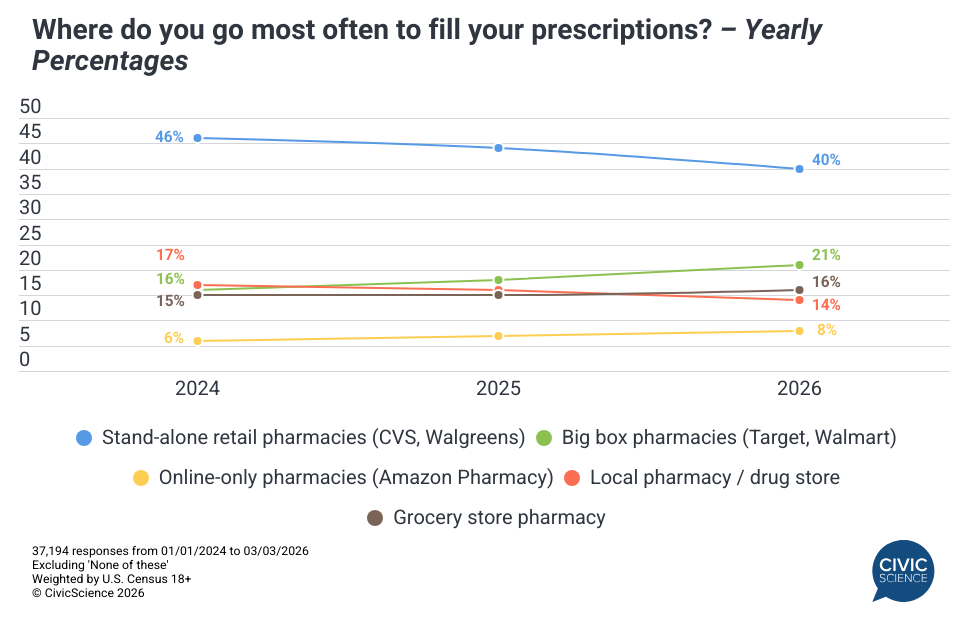
The retail pharmacy landscape has faced significant turbulence recently, marked by the bankruptcy and closure of Rite Aid and Walgreens’ strategic closures. As a result, big-box retailers have emerged as the primary beneficiaries, with prescription volume rising by 30% since 2024, while local independent pharmacies continue to lose foot traffic.
Single-prescription users and younger adults (under 45) are driving big-box demand, with single medication users outpacing those who take multiple by 14 points (32% to 18%). Conversely, those 55+ favor local pharmacies or grocery stores.
Practicality is the dominant factor in where consumers fill their prescriptions, with over half choosing based on physical convenience (28%) or insurance coverage (25%). Secondary considerations include an alignment with where they shop for other items (9%), followed by a four-way tie (8%) among customer service, trusted pharmacists, delivery options, and lowest out-of-pocket costs.
Cost Concerns Run Deep, and Americans Are Willing to Travel Out of State
The vast majority of Americans taking at least one prescription are ‘very’ (32%) or ‘somewhat’ (40%) concerned about the cost of those medications. This financial stress intensifies as regimens grow more complex, with 37% of those on 3+ medications feeling ‘very’ concerned.
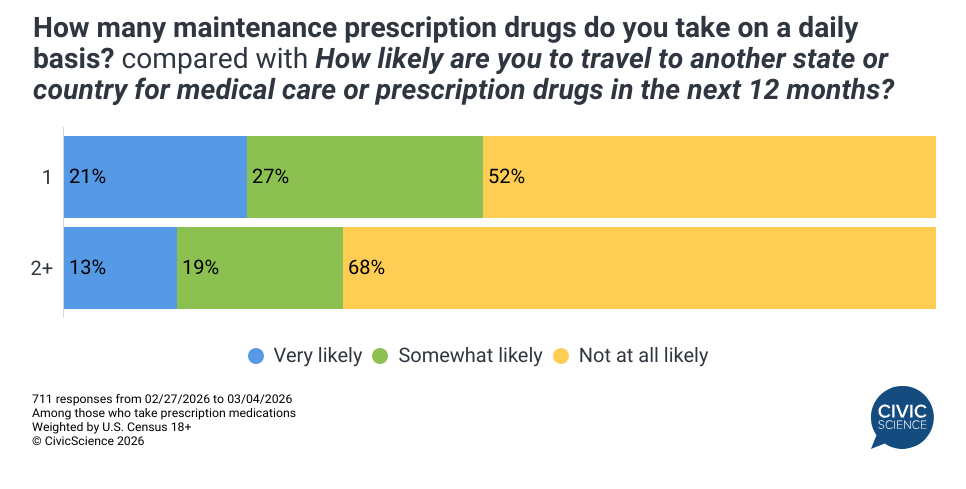
One possible avenue to manage healthcare and prescription costs is through interstate or even international medical travel. New CivicScience survey data finds 31% of U.S. adults overall are at least ‘somewhat’ likely to travel to another state or country for medical care or medications within the next year. Those taking a single prescription are by far the most likely to consider this pathway, likely having more budget leeway to cover travel costs than those managing multiple prescriptions.
The Prescription Catalyst: The High-Intent Insurance Switchers
In addition to traveling, many consumers are weighing insurance costs amid rising premiums this year. While the open enrollment period has come and gone for the year, a noteworthy share of Americans (38%) tell CivicScience they are at least ‘somewhat’ likely to switch or obtain health insurance within the next 12 months, including 14% who are ‘very’ likely to do so.
Consumer-reported data allows us to take a more granular view of which prescription medication users factor into insurance switching intent – here are the top three profiles likely to switch:*
- Daily Single-Prescription Users: 46% of those taking one prescription daily are at least somewhat likely to switch, outpacing those taking multiple (37%) and those not taking any (24%).
- Cost-Conscious Prescription Users: 42% of prescription medication users who are concerned about the cost of their medication are likely to switch. They are twice as likely as those unconcerned to say they are ‘very’ likely to switch.
- GLP-1 Intenders: 67% of those who say they are likely to start taking a GLP-1 in the future are likely to consider switching or obtaining health insurance within the year, compared to just 27% of non-GLP-1 intenders.
*CivicScience helps clients build precise audiences like these across any industry by providing access to over 165 million consumer profiles in brand-safe environments, enabling them to achieve superior marketing outcomes and deep strategic insights.
Overall, the data points indicate that pharmacy foot traffic is shifting, a growing share are willing to travel for better options, and insurance switching intent is up from last year. None of that happens in a vacuum, as people are paying attention to costs and acting accordingly. For brands in this space, that attention is an asset worth meeting as many consider adjustments in the months ahead.