CivicScience engages directly with consumers, collecting over one million survey responses daily, to turn real-time insights into high-performing advertising campaigns. See how leading brands use CivicScience to drive campaign performance here.
Recycling has been a part of the social consciousness for decades, and with Global Recycling Day taking place on March 18, this offers the opportunity to take the pulse of recycling across the U.S. With programs varying by state and region, how are Americans engaging–or opting out of–this process today?
Recycling Participation Stagnates
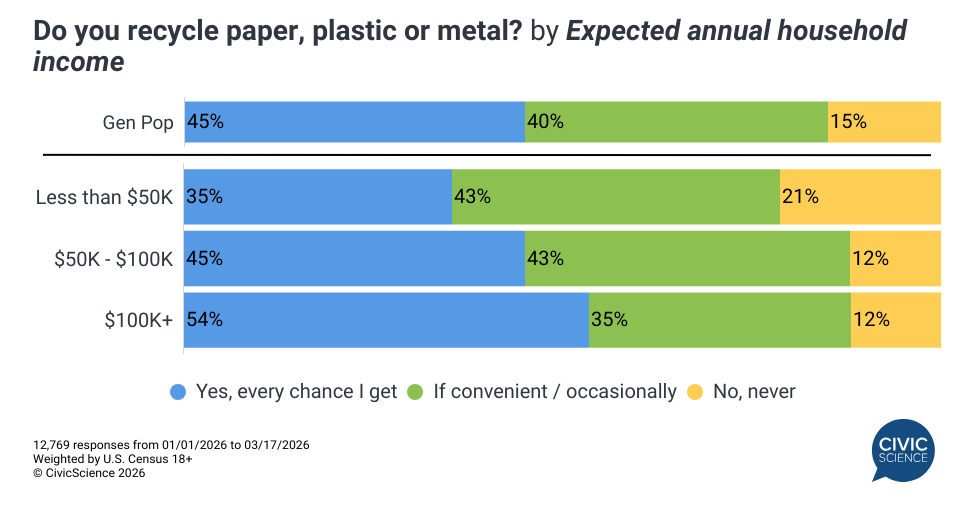
As recent CivicScience data show, nearly half (45%) of U.S. adults say they recycle ‘every chance they get,’ outpacing the 40% of those who recycle ‘if convenient.’ Conversely, 15% of Americans say they ‘never’ recycle. These figures have largely plateaued over the last five years.
Baby Boomers (65+) and households earning over $100K are the most likely to say they recycle ‘every chance they get.’ Meanwhile, Gen Z and households earning under $100K are most likely to recycle ‘when it’s convenient,’ with those earning under $50K specifically being the most likely to say they ‘never recycle.’ Millennials also slightly lead among those who report ‘never’ recycling.
Logistical and Emotional Barriers to Recycling
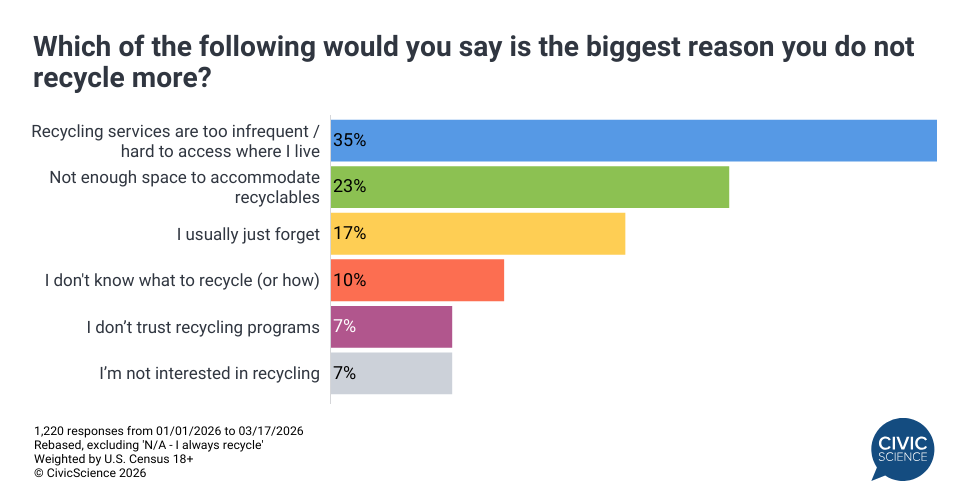
Recycling habits are often dictated by ease of use rather than intent. The leading obstacle is accessibility, with 35% of respondents reporting that current services are too infrequent or hard to reach. Physical constraints also rank high, as 23% of people claim they lack the space to accommodate bins. Beyond logistics, a lack of “how-to” knowledge and a small but notable 7% distrust of the system create further friction.
Barriers also shift by generation. Gen Z and Millennials (18-44) are most hindered by limited space and a lack of knowledge on what can be recycled. Conversely, Gen X and Baby Boomers are the groups most likely to express skepticism toward these programs or report a general lack of interest in participating.
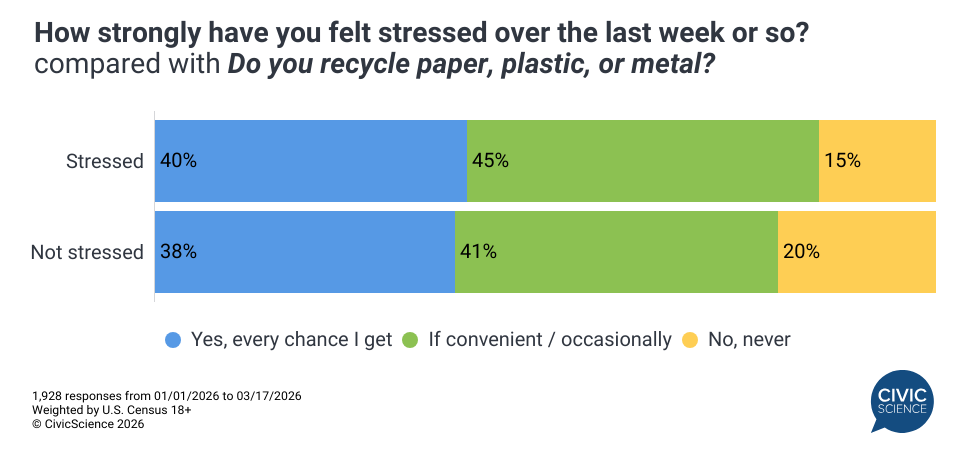
However, frequency of recycling is compounded by a variety of outside factors as well. For instance, those who reported feeling stressed in the last 365 days are not especially consistent recyclers – 45% say they recycle only when convenient, outpacing those who are not stressed by four percentage points.
Among reasons for not recycling more often, those who’ve felt stressed this year are most likely to report not doing so more frequently because they ‘don’t have enough space’ to accommodate their recyclables – simply put: it seems that stress makes the logistics of recycling more challenging.
Although those who always recycle show high levels of concern about climate change and gas and energy prices, their concerns extend beyond the environment, including strong concerns about the economy and job market, as well as the potential for a recession. This suggests that those who recycle most often are worried about a range of macroeconomic issues.
Despite the fact that the majority of Americans recycle to some degree, adoption is far from unanimous, with a variety of logistical and emotional factors likely playing a role. As stress levels remain elevated, how Americans continue to engage, or opt out of, recycling programs could shift in notable ways.