CivicScience clients and partners have access to our millions of daily survey responses, allowing them to generate actionable, forward-looking strategies. See what you’re missing here.
Generative Artificial Intelligence’s presence in American routines is noteworthy. In fact, new data show that just under one-quarter use these tools at least ‘a few times’ per week, including 9% of U.S. adults who turn to AI tools ‘every day’ and another 13% who use them a ‘few times a week’ for personal or work purposes. While 40% of Americans say they use AI at least a few times per year, that still leaves the majority who do not use AI, and that has implications on the overall view of the technology.
With this usage data in mind, how are Americans engaging with AI today, and what concerns do they have? The latest data offers insights into usage, tools, and sentiment.
Let Us Know: Do you think AI is crucial in pushing the US ahead in terms of global tech competition?
The State of AI
As it stands, women are six percentage points more likely than men to say they use generative AI tools ‘every day.’ While Gen Z is the most likely age group to be daily AI users, they only outpace Millennial users by two percentage points. Meanwhile, daily Gen X users lag just four percentage points behind Millennials, making it far from being just a young person’s tool. It’s also worth noting that those without a college degree are nearly twice as likely as those with an associate’s or bachelor’s degree to be daily AI users.

When it comes to which tools they’ve used in the past 30 days, OpenAI/ChatGPT leads the way, outpacing Google Gemini and Microsoft Copilot–the second and third runners-up–by six and 13 percentage points, respectively.
While self-reported usage of the top three gen AI tools has remained consistent throughout the year, Meta Llama has made the biggest monthly gains, increasing 8pp since April. Microsoft Copilot, Anthropic Claude, and Perplexity AI, respectively, have also seen positive growth.

Interest in AI Assistance is Changing with the Seasons
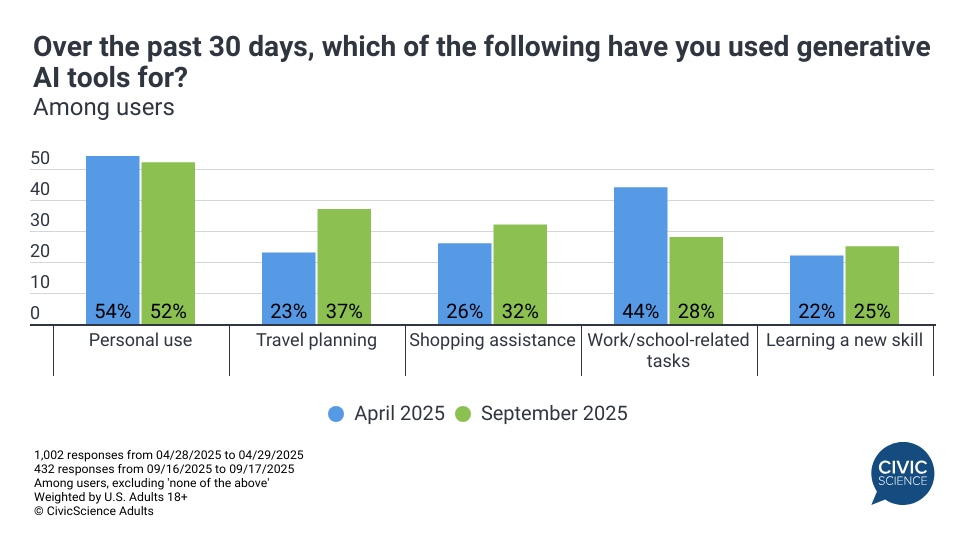
Despite a slight drop, personal use, such as entertainment and cooking, remains the top reason that Americans turn to generative AI tools. However, the data show a shakeup for second place, with travel planning overtaking work and school-related tasks for second, with a 14 percentage point increase since April. While shopping assistance remains in third place, this category has also seen a six percentage point increase over the same time frame.
This shift away from using AI for work and school-related tasks is worth taking note–especially as summer winds down–as it signals a new wave of interest and use-cases for AI heading into the holiday travel and shopping season.
AI Voice Assistants Are In Demand
As it stands, search engine result summaries lead as the most ‘helpful’ use for AI technology in everyday life, followed by language translation (36%) and digital assistants/smart home devices (29%). That said, nearly half of Americans (49%) are users of AI voice assistants, such as Amazon Alexa and Apple Siri. And although usage of digital assistants is more common among higher-income earners and Gen Z, the data show that overall usage of these devices has steadily increased since Q3 of 2024.
Additionally, the percentage of those who believe AI voice assistants will remain ‘niche’ has been on the decline, dropping to 32% in the third quarter of this year, down from 37% in Q3 2024.
AI Sentiment Is Becoming More Divided, While Workplace Concerns Are Widespread
With AI usage steadily becoming more and more pronounced amid a tightening job market, it may not be a surprise that one quarter of employed U.S. adults are ‘very’ concerned about the impact of AI on their career.
Concern is highest among those with technical jobs, with 40% of respondents in this field expressing their hesitation. However, those in business management and service professions are not far from similar levels of discomfort, demonstrating that the impact of AI can be felt across industries.
Beyond the impact on career, concern exists in general over the proliferation of generative AI tools, with more than three out of every four Americans at least ‘somewhat’ concerned. Despite discomfort with the technology dropping in July and August, the most recent data shows that sentiment is trending upward once more.
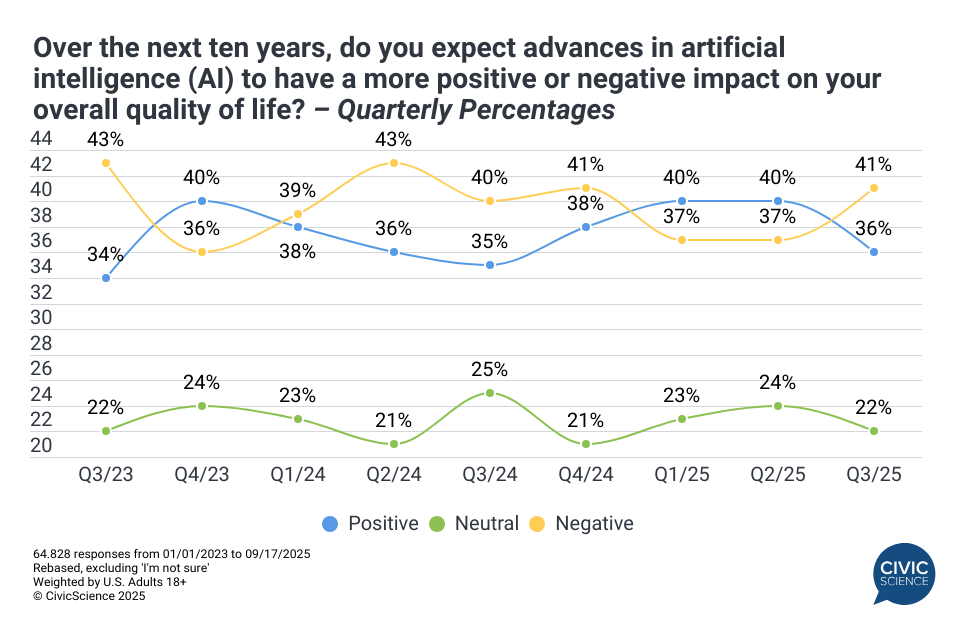
Notably, the percentage of those who believe AI will have a neutral impact on their overall quality of life has been decreasing since Q2 of 2025, while the percentage of those who believe the technology will have a positive impact dropped four percentage points from Q2 to Q3 (as of mid-September). Simultaneously, those who believe it will have a negative impact rose four percentage points so far this quarter. These shifts highlight that the growing foothold of AI in daily life is doing little to bridge divisions in sentiment around the technology.
Take Our Poll: To what extent do you support or oppose the use of AI in creative work?
When it comes to AI, it’s clear that this technology continues to be woven into the day-to-day experience, even evolving with the seasons, with increasingly divisive results. While the potential for a neutral impact on overall quality of life slips away and concerns over job security remain top of mind, what remains to be seen is whether the long-term impact of AI will help or harm in the ways we’ve anticipated, or whether an entirely different outcome will start to unfold.