CivicScience has the world’s largest proprietary database of real-time declared intent, allowing brands to activate high-performing advertising that drives up to 80% better performance. See how our partners achieve superior marketing outcomes here.
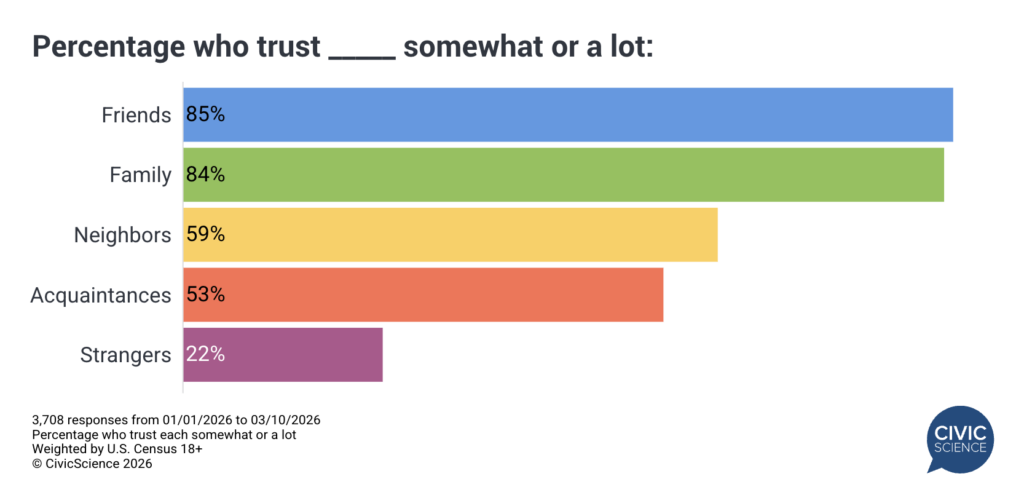
While institutional trust remains fragile, Americans continue to report high levels of trust in their friendships. CivicScience data show that 85% of U.S. adults trust their friends at least somewhat, making it the most trusted relationship in their lives, even surpassing trust in family (84%). This enduring confidence comes as Americans face a steady stream of heavy news, positioning “chosen” support systems as a central influence on how people engage with the world.
Personal support systems remain a key anchor for many Americans, but how people make and maintain friendships today paints a more nuanced picture. Here’s what CivicScience data shows:
Friendships remain rooted in real-world interaction and local social networks.
Today’s friendships continue to be rooted in real-world, in-person interactions. Two-thirds of Americans say they socialize with friends in person at least monthly, including 16% who report doing so daily, 31% weekly, and 19% monthly – figures that have remained relatively consistent over the last several years.
The composition of these social circles provides further insight into the landscape of modern connection. Local networks are centered largely on family ties (35%), with interest-based groups (17%) and proximity-based connections (14%) playing supporting roles. But they aren’t afraid to go it alone as well. Standing apart from these group dynamics are the 25% of Americans who report that they primarily pursue activities independently and prefer going solo.
These patterns also vary across generations. Gen Z adults (18-29) gravitate toward interest-based socializing, while Millennials (30-44) and Gen X (45-64) are more likely to pursue activities independently.

Communication and connection are increasingly digital.
While in-person socializing remains steady, communication is increasingly (and unsurprisingly) digital. The percentage of Americans who say they most frequently communicate with friends via phone calls has steadily declined year over year. Today, 29% say phone calls are their primary way of communicating with friends, down more than 10 points over the past decade. Meanwhile, the share who communicate most via SMS, text-based messaging apps, or social media (66%) continues to increase modestly.
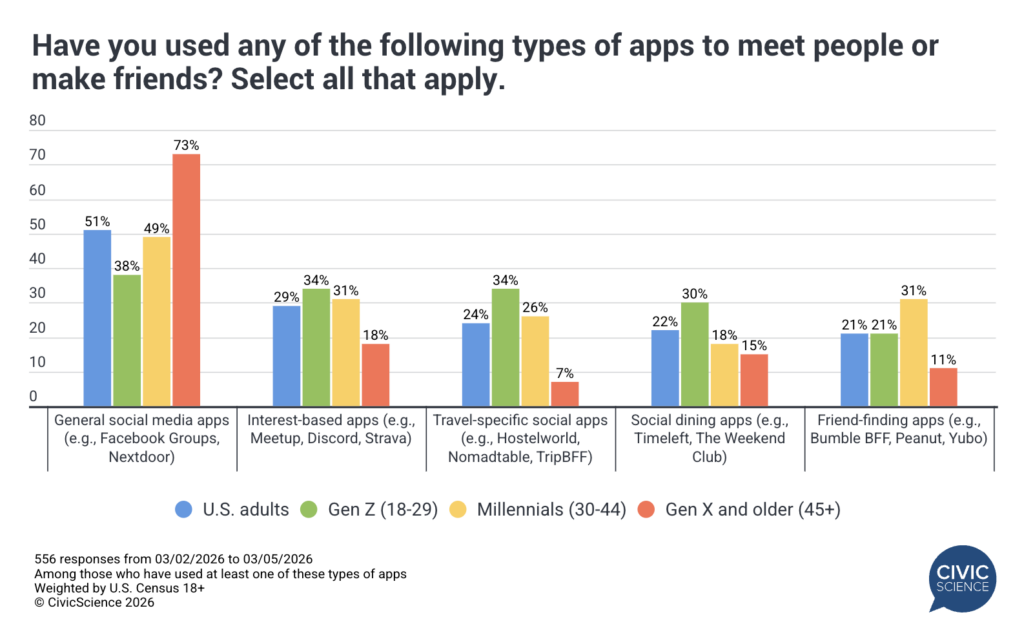
When friendships extend beyond local, in-person spaces, the platforms people rely on to connect and build communities are diverse. Many users turn to broad social platforms such as Facebook Groups or Nextdoor, while others gravitate toward interest-based communities like Meetup, Discord, or Strava.
Age and location also emerge as key predictors: older adults show a stronger preference for general social apps, while Gen Z and urban Americans are driving growth across interest-specific and dedicated friend-finding platforms.
Friends are a powerful source of influence.
Brands should not overlook friendships as they carry noteworthy weight in consumer purchasing decisions. CivicScience data show that 54% of Americans say their friends and social media contacts influence what they watch online, 49% say they influence what they buy, and 46% say friendships influence which music they listen to — with influence on music showing the largest YOY increase.
While the landscape of American socializing has become more complex, the fundamental role of friendship has not wavered. These relationships have proven resilient, adapting to new digital formats while maintaining a level of trust that exceeds that of many established institutions. As personal circles continue to facilitate the exchange of ideas and new interests, they remain the most significant force in how the public connects with the broader world.