Greetings from Minnesota.
I’m deep into the work part of my trip, visiting our many clients here. No area in the world has more consumer brands, pound for pound, than the Twin Cities. Correct me if I’m wrong.
Before heading to Minneapolis, we (Tara, Noelle, and I) spent four days on a lake in Wisconsin with my sister-in-law, our two nephews (6 and 8), and Tara’s Dad, Dave. It was a lot of pontoon rides, s’mores, and Jurassic-style mosquitoes.
Also, there was a ton of cribbage.
If you don’t know cribbage (and few do, I’ve found), it’s an old English card game, involving a peculiar board, pegs, and a head-spinning scoring system. If you know, you know.
I learned the game when I was a kid, watching my dad and uncles play for hours on end. By about 12 or 13, they finally let me join. I was hooked.
My dad and I probably played a thousand games together before he died. Once he was gone, I had no one to play with. My uncles live in Texas and Florida, and I haven’t spent time with them in years.
Amazingly, soon after my dad was gone, I discovered that Dave loves the game. I can’t remember how we stumbled on the topic, but he was as giddy as I was – he hadn’t had anyone to play with in years. In the decade or so since, every visit (his to Pittsburgh or ours to Minnesota) includes a few daily hours of cribbage. We played at least 25 games last weekend.
It helps that Dave and I are otherwise super-close. I’ve written before how I hit the in-law jackpot. He’s into music, sports, action movies, Bloody Mary’s, and his family. We’re birds of a feather. So, the games are filled with side banter, deep conversations, and more than a little shit-talking.
It’s not lost on me that Dave isn’t getting any younger. He’s a spry and sharp 78, but 78, nonetheless. It occurred to me this weekend that, someday, I’ll be without a cribbage partner again. It made me enjoy the games even more. It made me more present.
I saw a meme once about how on one nondescript day when we were all kids, we played outside with our friends for the final time, and we never realized it. I think about that a lot.
I don’t remember the last game of cribbage I ever played with my dad. He left without much warning.
But, whenever it happens, hopefully years from now, I promise myself I’ll remember my last game with Dave.
Here’s what we’re seeing:
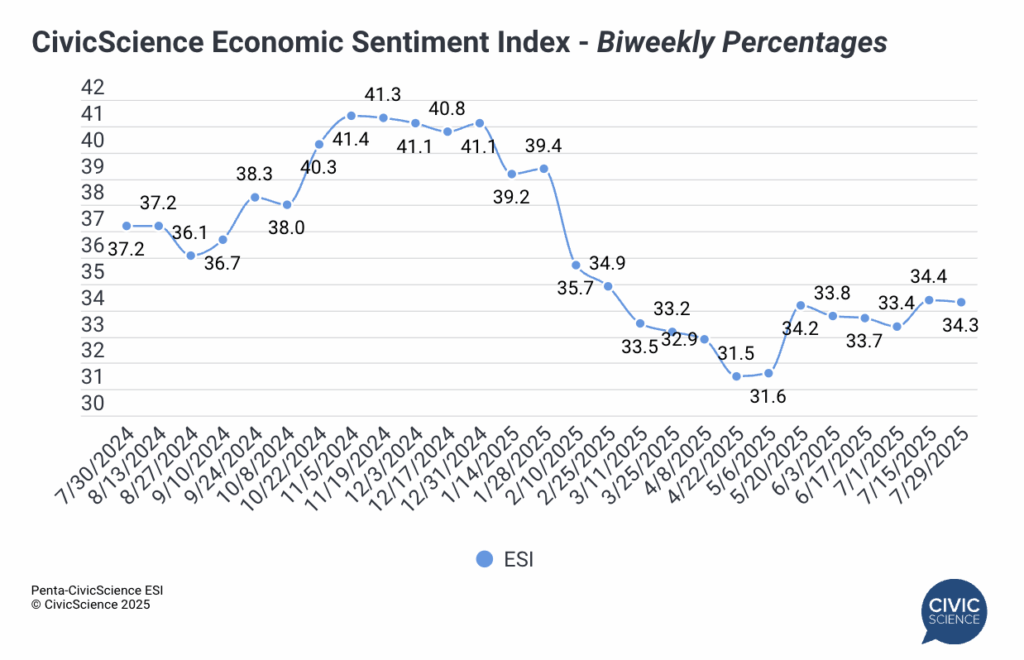
The early July resurgence in consumer confidence was short-lived. After a promising bump in the first half of the month, our Economic Sentiment Index levelled off (decreasing slightly, in fact) in the most recent reading. Long-term outlook for the U.S. economy is suffering the most, nearly offset by mildly improved views of the job market and personal finances. I don’t have a salient explanation – the Japan and EU tariff announcements came too late in the reporting period to have a major effect, one way or the other. The impact of those on consumer sentiment will become clearer in the coming weeks.
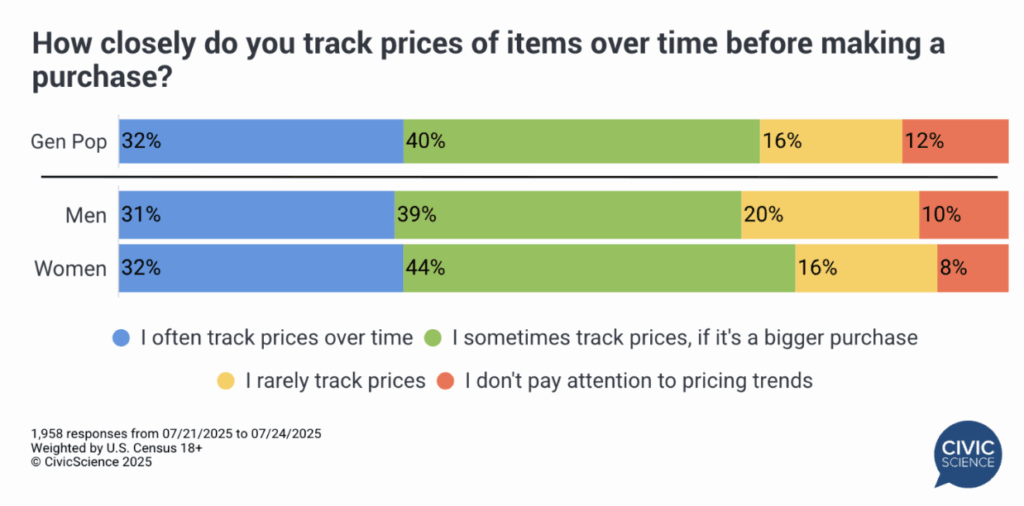
Not everyone pays attention to price. Our 3 Things to Know this week focused on a theme of price-seeking and promotional strategies among U.S consumers. We learned that less than one-third of shoppers closely track the prices of all the goods they buy over time, while a larger share does so only for larger purchases. Over 1 in 4 rarely or never monitor price changes of the things they buy. Related: people are very skeptical about products advertised as “on sale.” The one tactic that does seem to work, however, is “events” like “Christmas in July,” the popularity of which has grown by over 20% since 2023.
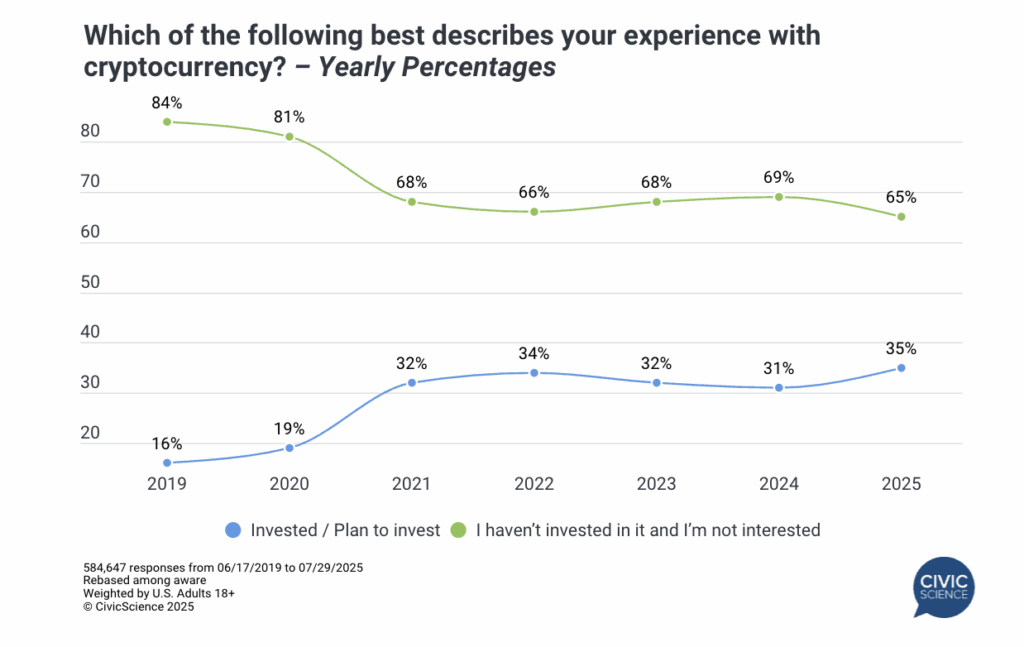
Interest in crypto investing is growing again. Cryptocurrency had a big moment in the sun during the pandemic, as millions of Americans (especially younger ones) took their stimulus checks and lockdown expense savings and wagered them on Bitcoin and the like. After sagging in popularity from 2022 to 2024, interest in crypto is accelerating again, with a larger percentage of higher-income investors viewing it as a long-term asset. One-third of current crypto investors say they’re at least somewhat likely to invest in newly regulated “stablecoins.” Even as new regulations take hold, however, legitimacy remains the biggest barrier to broader adoption. Over two-thirds of people familiar with cryptocurrency report little or no trust in it.
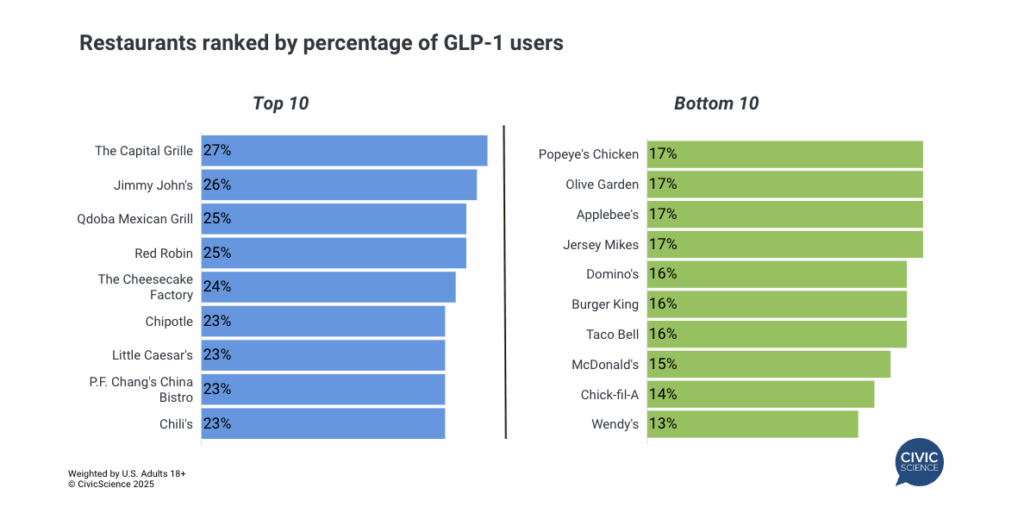
The (eventual, inevitable) mass proliferation of GLP-1 drugs is going to hit different restaurants harder than others. We published fascinating data this week on the prevalence of GLP-1 users across a variety* of restaurant brands’ customer bases. The numbers vary widely, while also reflecting the relative size of different chains. For example, Capital Grille has the highest ratio of users, and McDonald’s has one of the lowest…but a far larger portion of the U.S. population eats at the latter. Still, the data make it clear that as the costs of GLP-1s come down, insurers begin covering them, and broader segments of the country (particularly those where obesity is most concentrated) can access them, the impact across the restaurant industry will evolve dramatically. (*Note: We’re only sharing a small subset of the dozens and dozens of companies we track in this way.)
Economic uncertainty can cause skin cancer. Ok, that’s egregious clickbait, but hear me out. The percentage of Americans who report using sunscreen has fallen in recent years, as have the most common levels of SPF in the products people buy. Concerns over the toxicity, health effects, and overall effectiveness of sunscreen have all waned during the same period. But the financial influences can’t be ignored either – higher SPF sunscreens are more expensive and the decline in overall usage is clearly highest among lower-income households. Notably, the most frequent sunscreen users massively over-index as brand-centric shoppers.
Two weeks’ worth of more awesomeness from the InsightStore™:
- Even as consumers’ long-term economic outlook is shaky, current financial health continues its upward swing;
- The vast majority of Americans value time over money, but the numbers are slowly shifting and the implications for everything from work to eating out are significant;
- Last week’s 3 Things to Know: Rising price sensitivity among high-income consumers, concerns over lost government program benefits, and support for expanding the number of political parties in America;
- Here are five key and unexpected insights into reality TV viewers;
- Social influencers are reshaping the ways Gen Z consumes media;
- The majority of Americans still support DEI, and here’s how they shop;
- Join me on 8/7 for the last session of our Uncertainty Webinar Series;
- And don’t miss my next talk with idealis on AI at work.
The most popular questions this week:
How likely do you think it is that the Pittsburgh Steelers will make a deep playoff run with Aaron Rodgers at QB this season?
Whose side are you on in the Drake vs. Kendrick Lamar feud?
To what extent do you approve or disapprove of Congress cutting public broadcasting funds?
What is your opinion of ketchup on eggs?
Do you generally prefer the Summer or Winter Olympics?
Do you think it’s possible to “have it all” as a working parent?
Answer Key: Ugh – somewhat likely if he stays healthy; I couldn’t possibly care less; Strongly disapprove; I’m all for it; Tie; That’s way too deep for a survey question.
Hoping you’re well.
JD