CivicScience has the world’s largest proprietary database of real-time declared intent, allowing brands to activate high-performing advertising that drives up to 80% better performance. See how CivicScience partners achieve superior marketing outcomes here.
1. Inflation and homelessness are the top issues for Americans ahead of the 2026 midterm elections.
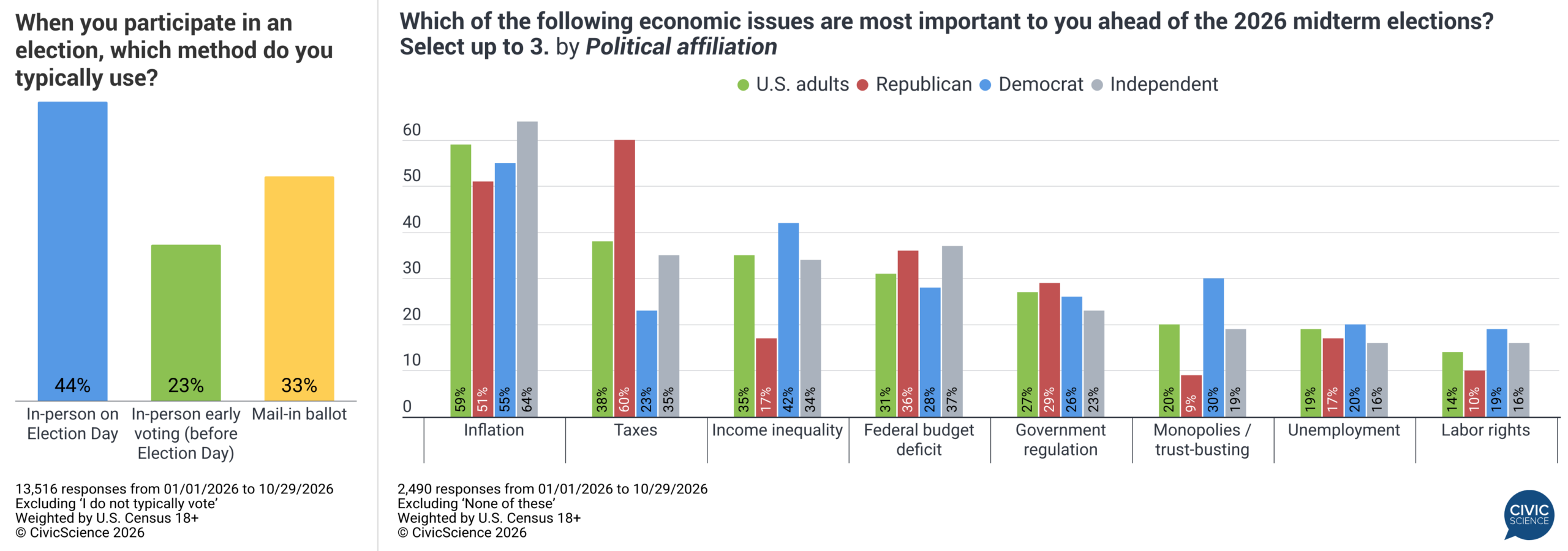
Ahead of the 2026 U.S. midterm election, CivicScience asked Americans how they plan to vote and what is driving their decisions. A plurality of U.S. adults say that they’ll be voting in person on Election Day itself (44%). One-third (33%) say they’ll be sending in ballots via mail and 23% plan to vote early in person. Self-identified Republicans strongly favor voting in person on Election Day (59%), while Democrats lean toward mail-in ballots (41%, vs. 20% of Republicans). Early voting has been strong this cycle, with over 54 million ballots cast as of November 2, according to the University of Florida’s Election Lab.
Among economic issues, nearly 3 in 5 adults say inflation is one of their top three issues at the polls this year, followed by taxes (38%) and income inequality (35%). Inflation is one of the few issues that cross party lines this year, with 51% of Republicans, 55% of Democrats, and 64% of Independents ranking it in their top three. However, taxes are a standout issue for Republicans (60% vs. 23% of Democrats), and Democrats are more focused on income inequality (42% vs. 17% of Republicans).
Homelessness / food insecurity top the list of social issues overall (43%), led by Independents (44%) and Democrats (40%), with Republicans trailing (34%). Crime shows the largest split between the parties. It’s a top issue for Republicans at 65% compared to only 19% of Democrats and 34% of Independents. For their votes, Democrats are most focused on gun violence (43%), racism / discrimination (37%), and reproductive rights (37%). Similar to the Democrats, Independents are voting based on issues such as racism / discrimination (40%) and gun violence (34%).
2. Holiday shoppers lean toward an even mix of online and in-store shopping in most categories.
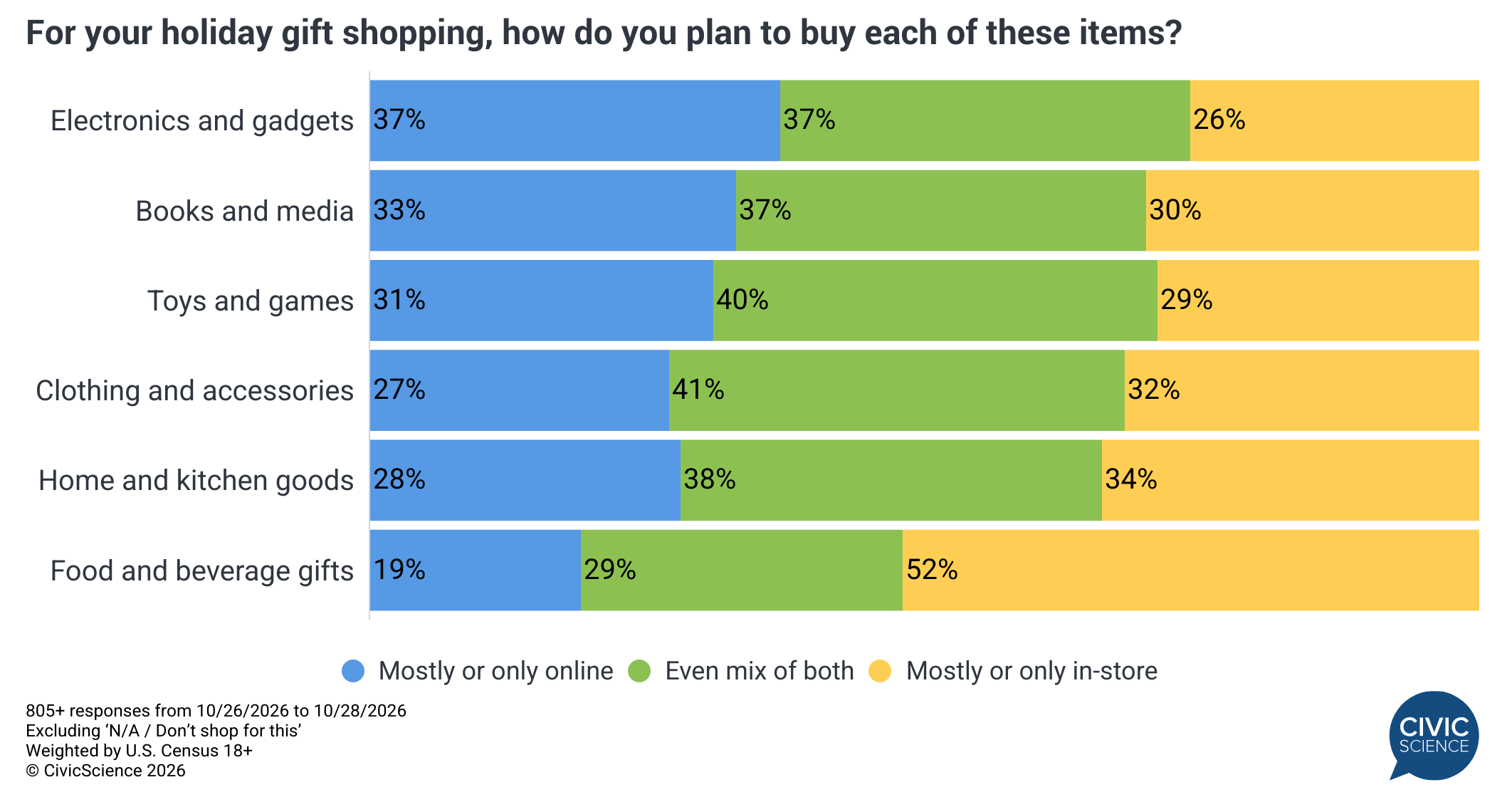
As more Americans get an early start on their holiday shopping, the latest data from CivicScience show that an even mix of online and in-store purchases is the most common plan in nearly every gift category studied. Clothing and accessories (41%), toys and games (40%), and home and kitchen goods (38%) make up the top three for an even-split shopping plan this season. Electronics lead all categories for ‘mostly or only’ online shopping (37%, matching the share who plan an even mix), followed by books and media (33%). Food and beverage gifts are the only category where a majority of gifters (52%) plan to buy ‘mostly or only’ in-store.
Take Our Poll: Are you planning to do most of your holiday shopping online or in person this year?
3. Young adults living with parents are optimistic about their finances but hold back on new spending.
According to a May 2026 Federal Reserve study, the share of adults under 30 living with their parents has increased by six percentage points since 2022. New CivicScience data among adults aged 18 to 34, those living with a parent or guardian narrowly are the most likely to say they’ve become at least ‘slightly’ price sensitive over the past year (37%, vs. 36% of renters and 33% of homeowners). They’re also the most optimistic about their finances: 54% expect their finances to improve over the next six months, compared with 48% of renters and 38% of homeowners. Renters are the most likely to expect things to get worse (17%).
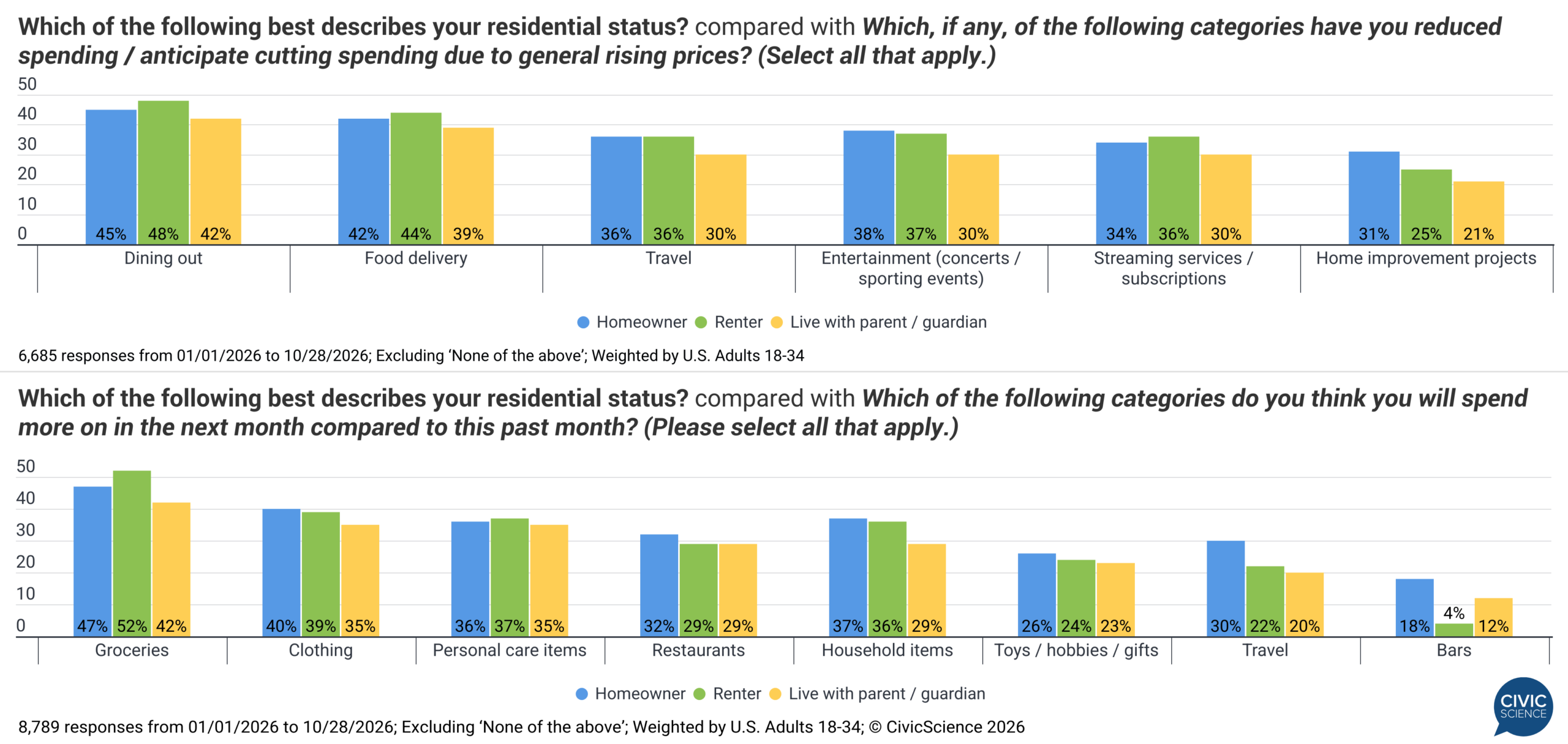
That optimism may reflect fewer financial obligations. Young adults living with a parent or guardian select fewer categories on both sides of the budget. They’re less likely than renters and homeowners to report cutting back due to rising prices, including on entertainment (30%, vs. 37% and 38%) and dining out (42%, vs. 48% and 45%), and less likely to plan on spending more next month in most categories. Renters lead in expected grocery spending (52%), while homeowners lead in travel (30%).
Let Us Know: Do you save more than you spend or spend more than you save?