CivicScience has the world’s largest proprietary database of real-time declared intent, allowing brands to activate high-performing advertising that drives up to 80% better performance. See how CivicScience partners achieve superior marketing outcomes here.
One of the biggest weekends in retail is now just a little over a week away. After Thanksgiving meals are eaten and visiting is complete, Americans turn their attention to the best deals from Black Friday through Cyber Monday. Take a sneak peek at the latest CivicScience data about Black Friday shoppers’ plans before the weekend starts.
Black Friday Leads as the Most Popular Shopping Day of Thanksgiving Weekend, Though Thanksgiving Day Gains Ground
While shoppers are a bit further along on their holiday shopping than last year, new CivicScience data show Thanksgiving weekend shopping intent generally aligns with last year — 54% plan to shop at least one day between Thanksgiving Day and Cyber Monday, up from 53% last year. Among these planned shoppers, 3 in 5 (60%) say they’ll be looking for deals specifically on Black Friday (BF). Cyber Monday shoppers come in second, at 39%, closely followed by Saturday, when most shop Small Business Saturday, during Thanksgiving weekend, at 36%.
While overall shopping intent has remained largely unchanged, both Thanksgiving Day and the Sunday of Thanksgiving weekend have seen an uptick in intended shoppers. At this time last year, 20% planned to shop on Thursday and Sunday, now up to 25% and 23%, respectively. Cyber Monday shopping plans have fallen slightly, down two percentage points from 41% last year.
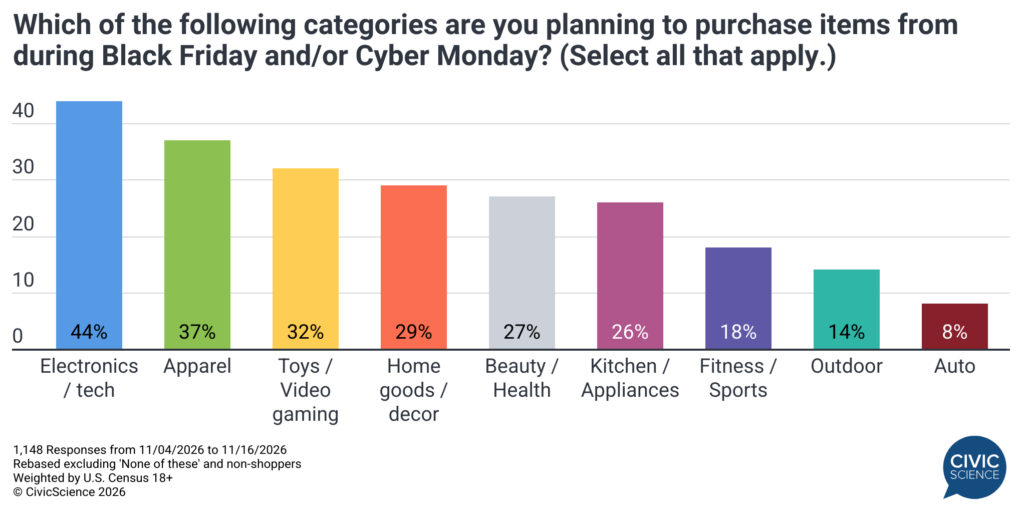
For shoppers, tech and electronics are the most important part of their plans, with 44% intending to buy in this category. Apparel (37%) and toys / video games (33%) are also top categories this year, with home goods / decor (29%) and beauty / health (28%) in the middle of the pack. Auto is the least popular category this season, with only 9% of Americans planning to shop for it.
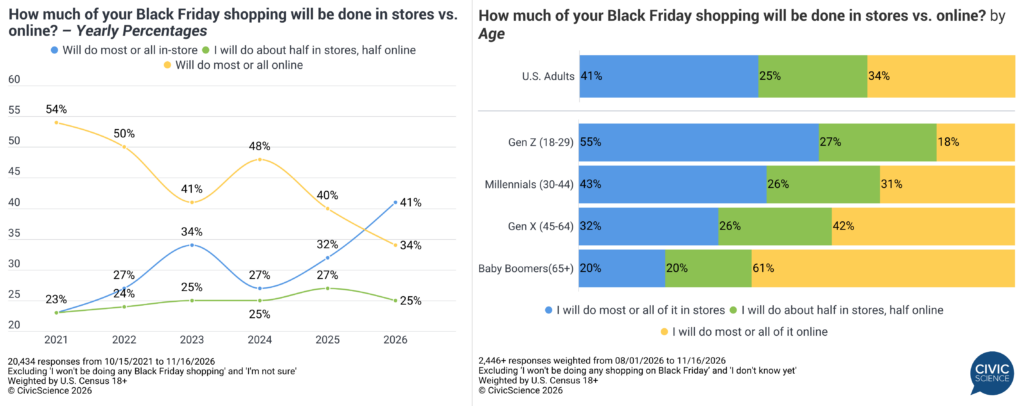
Gen Z Plan To Shop In-Store Over Black Friday
On Black Friday itself, many Americans plan to do ‘most’ of their shopping in-store rather than entirely online or even a mix of both. Two in five BF shoppers say they’ll shop mostly in-store, compared to 34% who are planning to buy mostly online. A little over one-quarter (26%) say they’ll be doing a mix of both. This is the highest rate of in-store Black Friday shopping since CivicScience began tracking in 2014, with ‘most or all in-store’ climbing eight percentage points since 2025. Those planning to shop online dropped six percentage points from 2025 and declined further relative to 2024, when 48% intended to do most of their shopping online.
Gen Z adults aged 18-29 are primarily driving this in-store shopping trend, with 55% planning to shop in stores compared to 20% of Baby Boomers (65+). In line with recent CivicScience holiday shopping data, Boomers are the most likely to shop online (59%), followed by Gen Xers (45-64) at 42%. Those planning to do a mix of shopping are a relatively even split, with Gen Z leading the way at 28%, Gen X and Millennials (30-44) tying at 26%, and Boomers coming in at 20%. Notably, just 18% of Gen Z say they plan to do most or all of their shopping online.
What Makes Black Friday Shoppers Stand Out
CivicScience’s consumer-declared data also provides a deeper look at these Black Friday shoppers, highlighting how they stand out compared to the average consumer. These insights highlight the value Black Friday shoppers bring and ways to engage them well beyond Thanksgiving weekend.
- Store Shopping Plans: Black Friday shoppers are less likely to spend the most at big-box stores on their holiday shopping overall this year (41% vs. 44% of Gen Pop). But they outpace Gen Pop in spending at department stores (19% vs. 15%) and slightly on shopping at specialty stores (12% vs. 10%).
- AI Experience: Black Friday shoppers are more likely to be AI users than their Cyber Monday counterparts (47% vs. 37%). They also lead in plans to use an AI chatbot or agent to assist with their holiday shopping this season (22% vs. 17%).
- Nostalgia Influence: Nostalgia plays a larger-than-average role in product purchasing for BF shoppers, as 26% say nostalgia influences them ‘a lot’, compared to 18% of Gen Pop.
- Early adopter: 48% of Black Friday shoppers say they try new products before others do, 13 percentage points higher than Gen Pop (35%).
- 2027 Income Outlook: BF shoppers have a rosier picture than average when it comes to their income expectations in 2027. 33% of Black Friday shoppers say they expect to have ‘more’ disposable income in 2027, compared with 25% among Gen Pop.
Early Black Friday Sales Garner Increasing Interest, Led by Middle-Income Shoppers
Just as holiday shopping timelines are shifting earlier, so too are the Black Friday deal hunting. Early shopping is already underway, as 10% say they have already shopped some of the sales and another 21% are ‘very’ likely to make some purchases before the weekend officially kicks off. Americans making under $100K are the most likely to shop early sales. Middle-income shoppers making $50K-$100K lead, as 12% have already shopped, and those earning under $50K are the next most likely, at 11%. Middle-income earners, however, lead in intent to shop early sales, as nearly half (49%) are at least ‘somewhat’ likely. Parents also outpace Gen Pop for shopping early, with 14% having already shopped and another 27% ‘very’ likely.
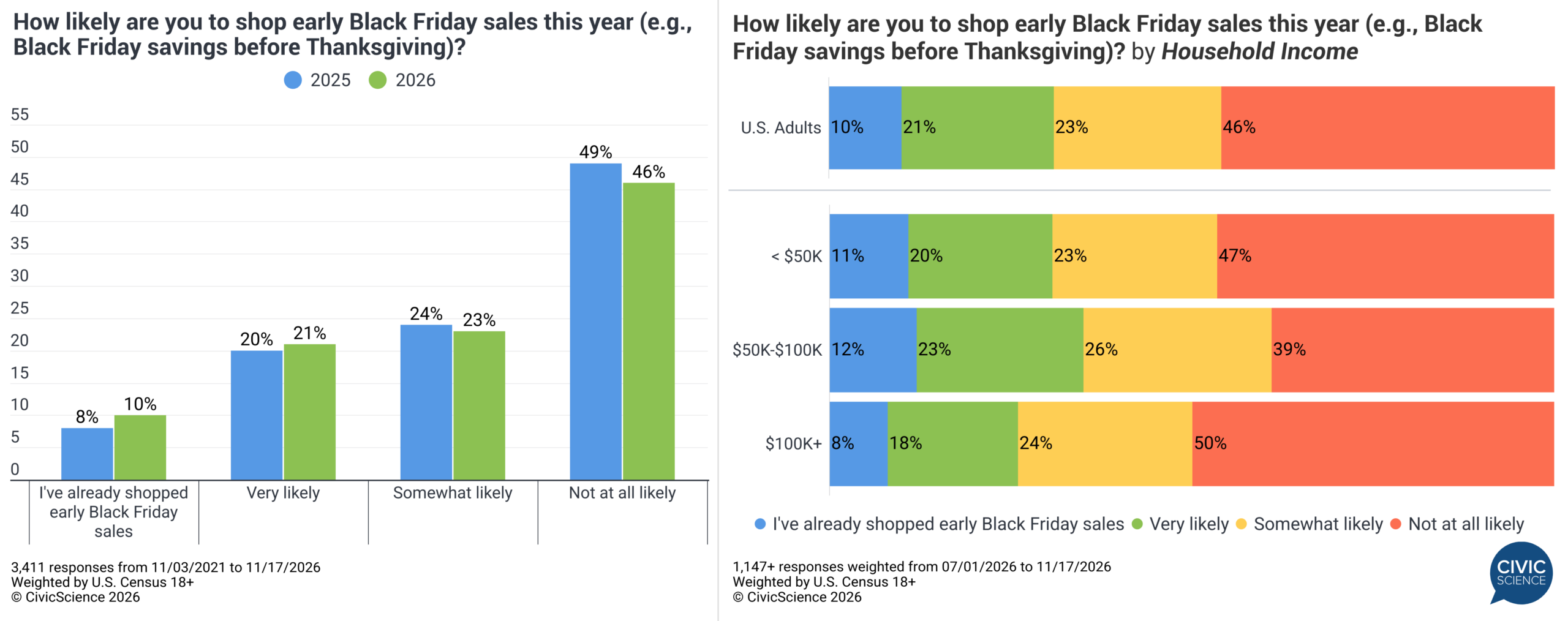
Although Black Friday remains the most popular shopping day over Thanksgiving weekend, shoppers don’t intend to stop there. Increasing interest in early sales and shopping on secondary days gives brands and retailers more opportunity to reach their target audience. Given their optimistic outlook on their personal income, early adopter mindset, and comfort using AI to shop, Black Friday shoppers are ones to watch year-round, not just over Thanksgiving.