CivicScience has the world’s largest proprietary database of real-time declared intent, allowing brands to activate high-performing advertising that drives up to 80% better performance. See how CivicScience partners achieve superior marketing outcomes here.
How Americans perceive their personal financial health can offer valuable insight into shifting consumer spending patterns. For businesses looking to stay ahead of changing audience priorities, understanding these perceptions can help reveal how financial sentiment may influence purchasing decisions. The CivicScience Consumer Financial Health Index (CFHI) provides an always-on view of these attitudes through real-time, consumer-reported data, giving brands a clearer picture of how consumers feel about their financial futures.
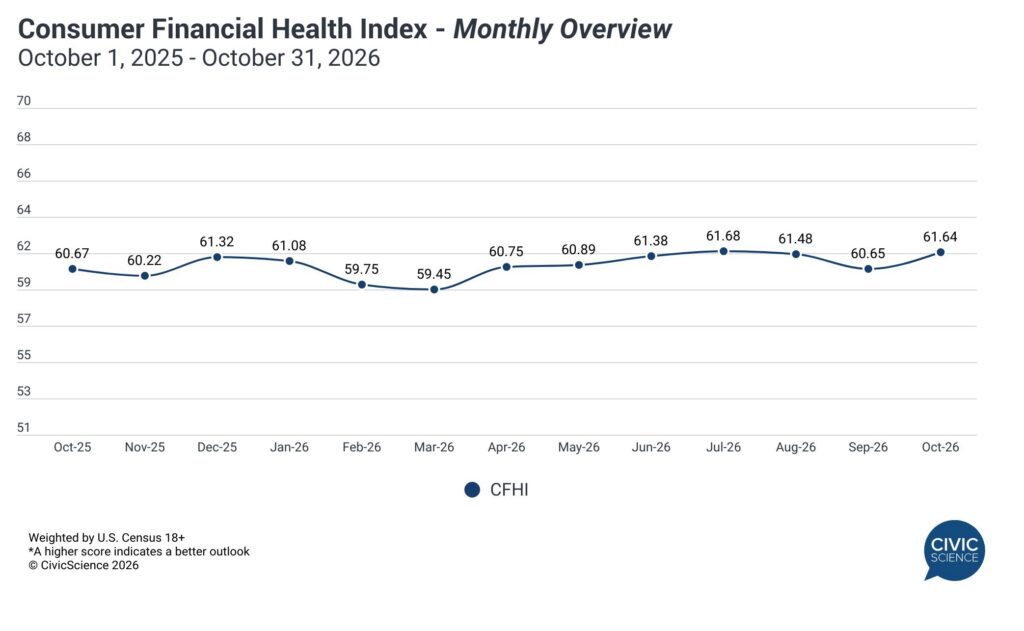
The latest reading of the CFHI shows a reversal of its recent two-month downtrend in the lead-up to the midterm elections. Through the end of October, the Index rose 0.99 points from September to 61.64, landing it 0.97 points higher than in October 2025.
Very early indications from the first 10 days of November, a period spanning the midterm elections and their immediate aftermath, suggest this upward trend may continue. So far this month, the CFHI is up a further 1.04 points, standing at 62.68 as of November 10. Consumer mindset can, and often does, change fast, which means the full November reading will be one to watch. (For more on how Americans feel about the election results, see CivicScience’s initial post-midterm data.)
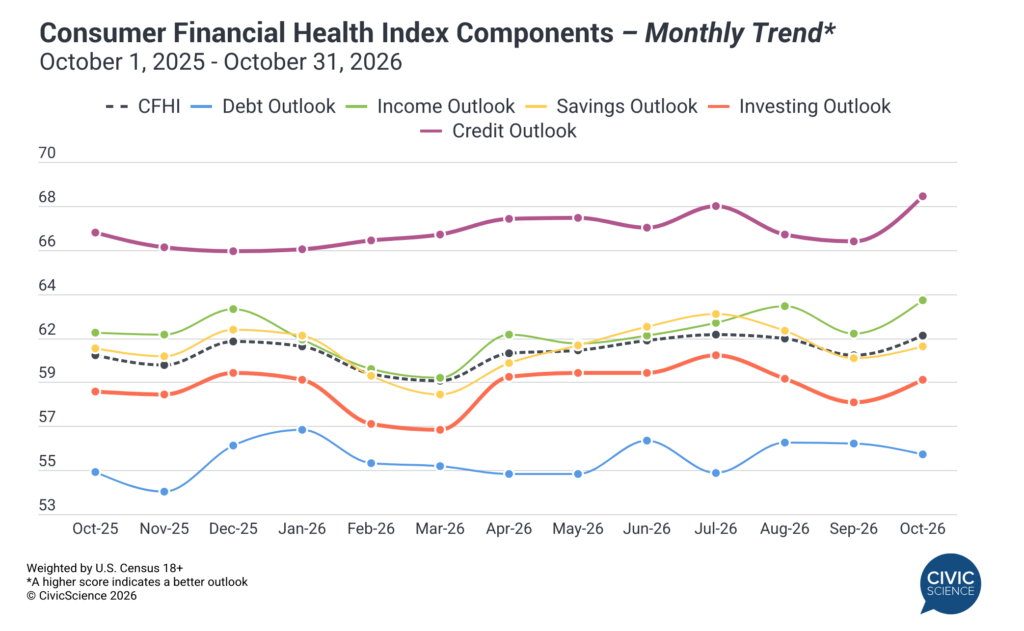
A closer look at the CFHI’s individual components shows that four of the five measured components increased month over month through October, led by credit outlook (up 2.08 points). Income outlook also rose substantially (up 1.59 points), followed by investing outlook (up 0.96 points) and savings outlook (up 0.41 points). Debt outlook, meanwhile, was the only component to decline in October, slipping by 0.50 points, marking it as something to watch as the peak holiday shopping season arrives.
Following two consecutive months of declines, October marked a noteworthy uptick heading into the midterm elections. With the holiday shopping season ramping up in the midterm’s aftermath, whether this trend continues is particularly relevant for businesses seeking to understand how consumers may approach spending, saving, and purchasing decisions in the months ahead.
Financial confidence is not static, and neither are consumer priorities. By tracking these shifts in real time, the CFHI helps businesses identify emerging audience trends and better understand the financial attitudes shaping how consumers spend. For brands looking to make informed decisions ahead of the height of the holiday season and into 2027, applying insights like these to a specific audience can make all the difference.