CivicScience has the world’s largest proprietary database of real-time declared intent, allowing brands to activate high-performing advertising that drives up to 80% better performance. See how CivicScience partners achieve superior marketing outcomes here.
It’s now been a week since the midterm elections that saw Democrats make significant gains at all levels of government across America. While not all counting has officially been completed yet as of this writing, the broader result is clear: Democrats will regain control of the House and Senate. How exactly are Americans feeling about this result, and how might it impact spending, if at all? Here’s what new CivicScience data show:
A Majority of Americans Express Satisfaction With Midterm Outcome, Led by Boomers 65+
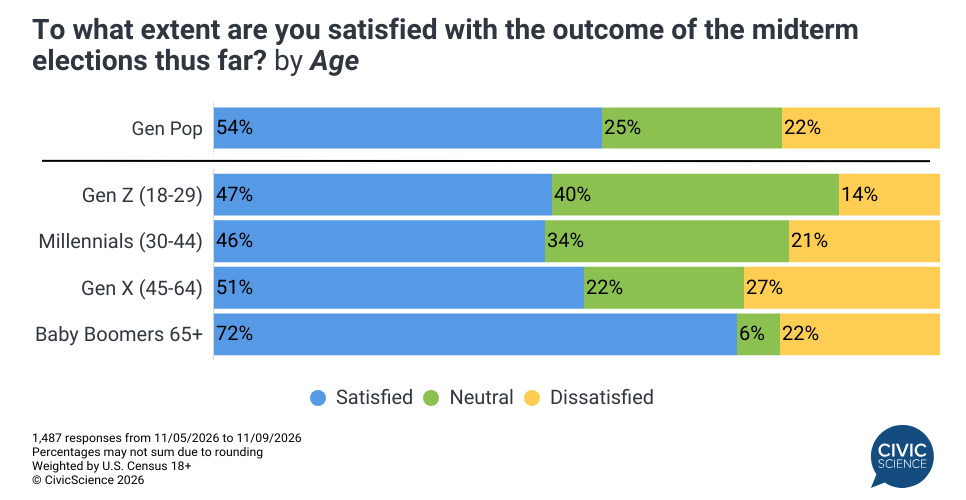
First and foremost, CivicScience data show more Americans are happy with the results of this year’s midterms than they were immediately following the 2022 elections. This year, 54% of U.S. adults say they are ‘satisfied’ with the midterm results, compared with 43% who said the same in 2022. One-quarter (25%) feel neutral about the outcome, while just 22% are ‘dissatisfied.’
This positive sentiment is led by Baby Boomers aged 65+, 72% of whom say they’re ‘satisfied’ with the result. Gen Xers, meanwhile, are the most likely to be ‘dissatisfied,’ while Gen Z is the most likely to be neutral and the least likely to express dissatisfaction.
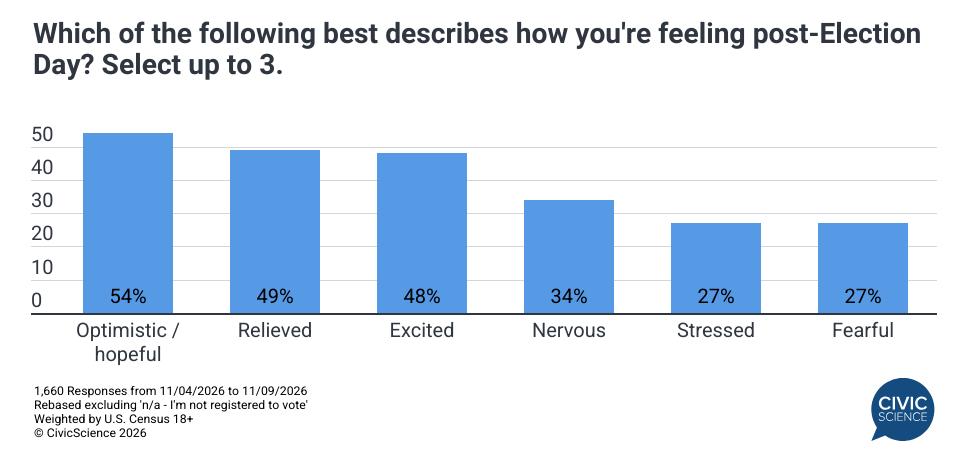
But the positive vibes don’t stop at satisfaction. More than half of self-reported registered voters tell CivicScience they’re feeling ‘optimistic/hopeful’ post-Election Day, while nearly half are ‘relieved’ or ‘excited.’ This, of course, doesn’t mean negative feelings have vanished, as 34% report feeling ‘nervous’ and 27% either feel ‘stressed’ or ‘fearful.’ This positivity is especially strong among Americans 65+, with 69% feeling ‘optimistic’ or ‘relieved’ and 65% feeling ‘excited,’ both far higher than in any other generation.
The results provide clarity on congressional control. But with that certainty come new questions. How will the Trump administration move forward? Can a divided government address the issues that ultimately drove the election outcome? Perhaps this uncertainty is playing a part in keeping most Americans cautious with their wallets despite their overall positivity in the election’s aftermath.
Most Americans’ Spending Plans Lean Cautious, While Hispanic Americans Are More Balanced
CivicScience data show that most U.S. adults (59% to 62% across the six categories below) say the midterm results will not impact their spending at all. Those who expect an impact, however, lean toward cutting back. Planned pullbacks outweigh planned increases in five of the six categories, led by entertainment and leisure (24% plan to spend less vs. 14% who plan to spend more) and dining out (25% vs. 16%). Health and wellness is the lone exception, with 20% planning to spend more and 18% planning to spend less.
That spread looks a bit different among Hispanic Americans, who played a key role in the Democrats’ victories nationwide. In addition to health and wellness (28% plan to spend more vs. 20% who plan to spend less), Hispanic Americans lean toward spending more on investing (29% vs. 24%) and clothing and apparel (25% vs. 22%). Even in the categories where Hispanic Americans lean toward cutting back, the margin is far narrower than it is among U.S. adults overall or non-Hispanic adults.
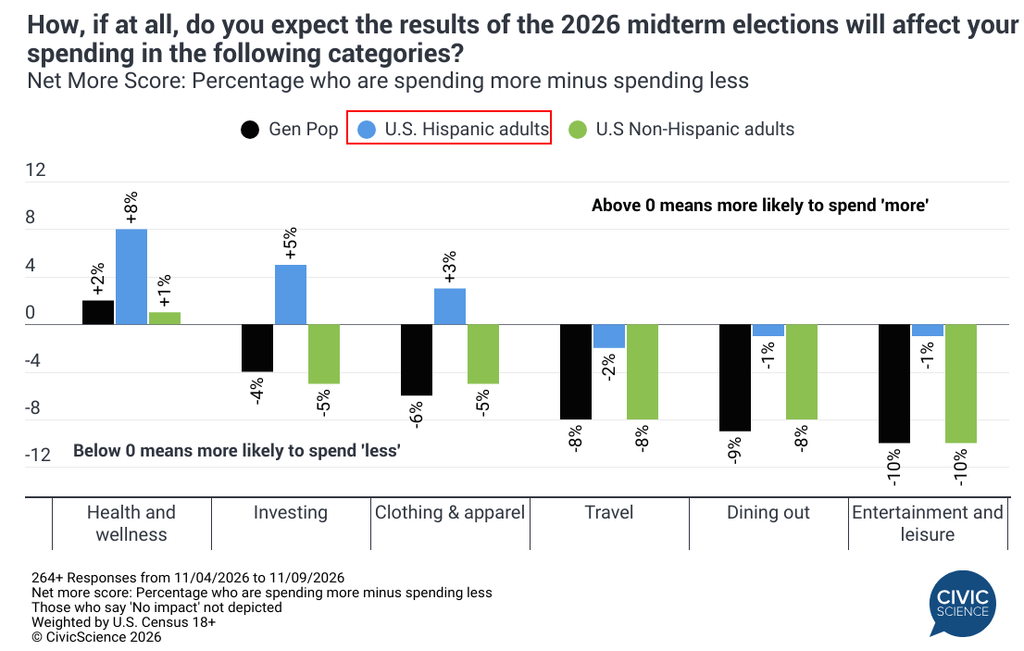
A week after the midterms, Americans’ satisfaction with the results contrasts with their spending outlook. Their optimism has yet to translate into widespread plans to spend more, although Hispanic consumers show a more balanced near-term spending outlook. The bigger test comes in the months ahead when the new Congress is seated in the new year, and it becomes clearer how much will actually change.