CivicScience has the world’s largest proprietary database of real-time declared intent, allowing brands to activate high-performing advertising that drives up to 80% better performance. See how CivicScience partners achieve superior marketing outcomes here.
1. Americans are split on support for automated license plate readers, but are in favor of bolstering oversight.
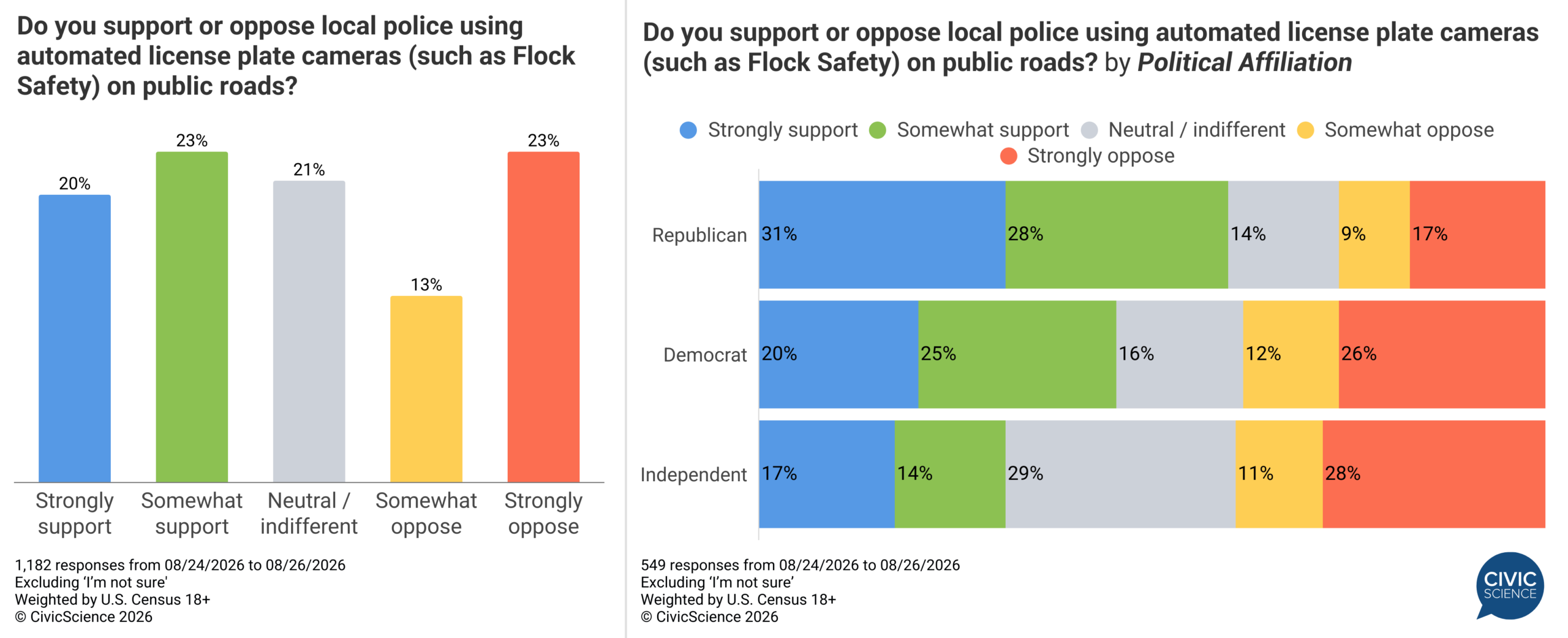
Amid a storm of scrutiny online, the latest data from CivicScience show that, overall, 43% of U.S. adults at least ‘somewhat’ support automatic license plate readers, such as Flock Safety, compared to 36% who oppose it (13% ‘somewhat’, 23% ‘strongly’). Politically, self-described Republicans show the highest backing at 59% combined support, far higher than Democrats at 45%. Meanwhile, Independents lean more hesitant, with 39% opposed and 29% remaining neutral.
Americans were asked about proposals to strengthen oversight of these tools. Among U.S. adult respondents with an opinion, a majority (52%) support requiring case numbers for all automated license plate reader-driven searches. Shortening data retention from 30 to 7 days and canceling contracts entirely over privacy concerns tie at 43% support, while 41% support blocking data access for federal agencies (excluding ‘not sure’ and ‘does not apply’).
Take Our Poll: How comfortable are you with the increasing use of surveillance cameras in public spaces?
2. Privacy concerns are growing across the board.
But automated license plate readers aren’t the only privacy concern Americans have. In recent years, concern over consumer privacy as a whole has steadily grown, reaching a peak of 51% who report feeling ‘very’ concerned in 2026 – up seven percentage points from 44% in 2022. An additional 38% remain ‘somewhat’ concerned, leaving only 11% completely unconcerned about how their personal data is handled.
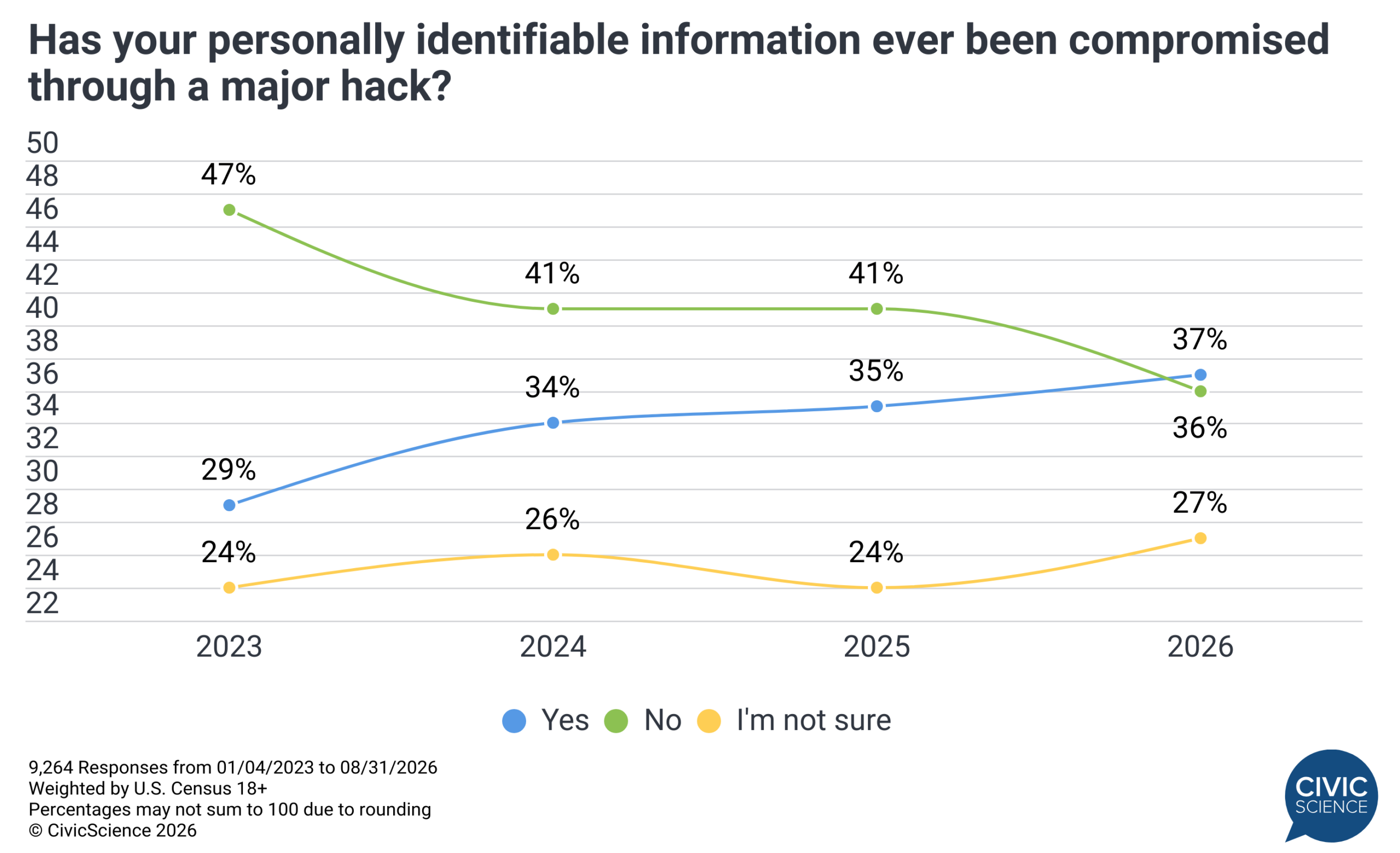
Whether it’s stored in a fast-food app, a bank account, or on a social media platform, personal data is everywhere online, meaning there’s a vast array of potential opportunities for hackers to take advantage of it. Companies from Chick-fil-A to Canvas have had significant data breaches in just the past six months. Given news like this, it’s no surprise that for the first time in CivicScience tracking, the share of consumers who say their data has been compromised has overtaken those who say it hasn’t. Those who haven’t had their data compromised in a major hack have dropped by 11 percentage points since 2023, while those who say it has increased steadily year-over-year, reaching an all-time high of 37%.
Biometric data collection – including fingerprints, facial recognition, and voiceprints – is also a significant pain point for consumers. More than 4 in 5 U.S. adults (83%) express being at least ‘somewhat’ concerned regarding biometric data collection. Although it’s a pretty even split across generations, Gen X pulls ahead by five percentage points with the highest overall level of concern (84% combined).
3. Gen Z lead the way in Substack usage and awareness.
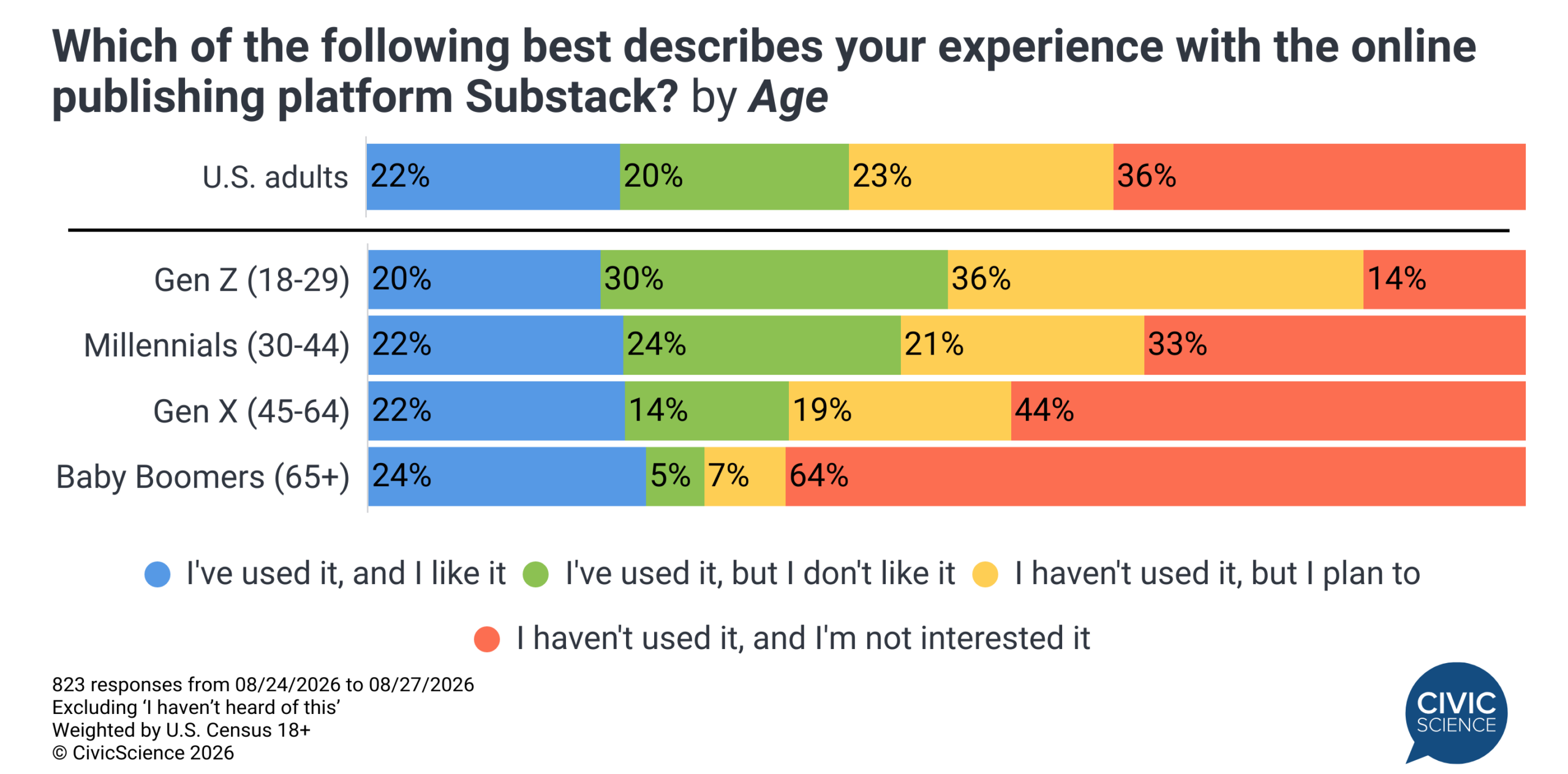
From journalists to movie reviewers to musical artists, Substack continues to be a sleeper hit platform for those looking to write. More than half of U.S. adults (58%) report they are familiar with the online publishing platform. Among those who are aware, 22% actively use and enjoy it, while an additional 23% intend to try it in the future.
Gen Zers set the pace among Substack users, with 20% reporting that they like using the platform and another 36% saying they intend to use it in the future. While Boomers are the least interested overall, those who do use it are the most likely to report they enjoy it.
Let Us Know: Are you a paid subscriber to any newsletters on Substack?