CivicScience has the world’s largest proprietary database of real-time declared intent, allowing brands to activate high-performing advertising that drives up to 80% better performance. See how CivicScience partners achieve superior marketing outcomes here.
1. Americans are increasingly concerned about rising utility bills, and their outlook could shape holiday spending.
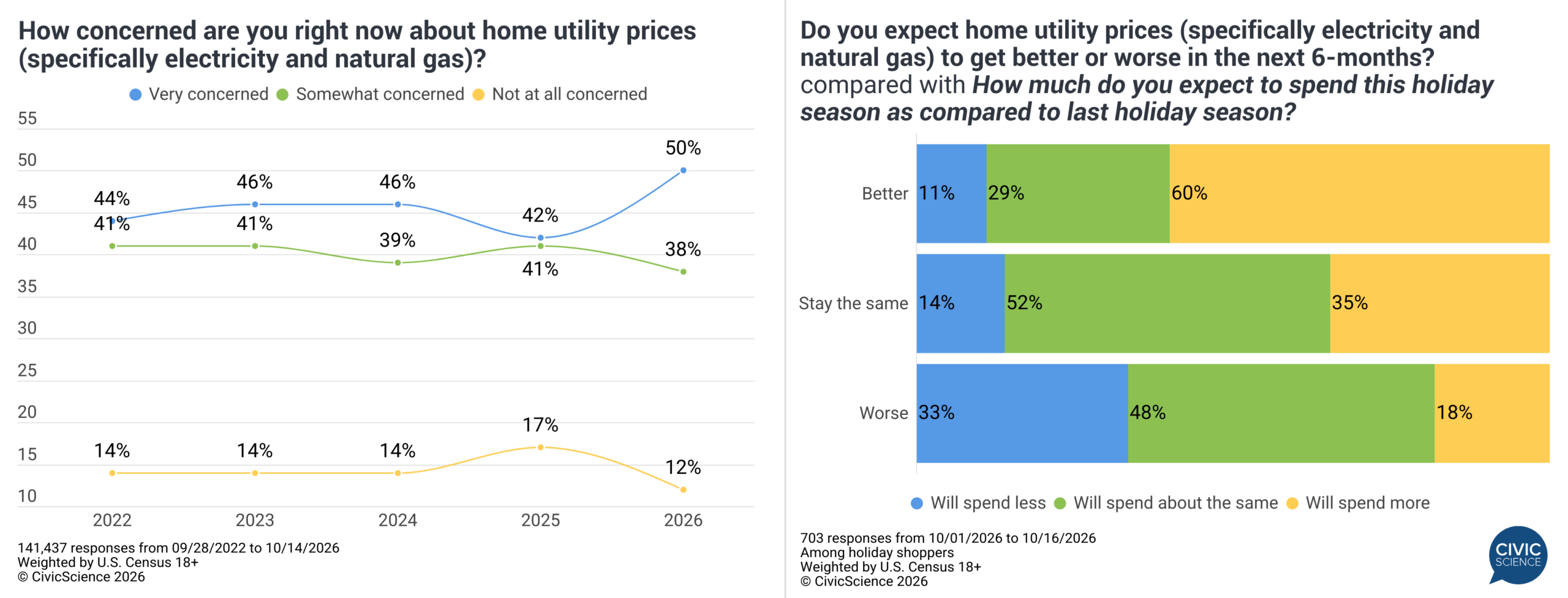
Amid rising gasoline prices, the war with Iran, and a larger-than-expected increase in inflation in September, Americans are growing more worried about the cost of their home energy bills. The latest consumer-reported data from CivicScience show that half (50%) of U.S. adults say they are ‘very’ concerned about home utility prices, specifically electricity and natural gas. That’s an eight-percentage-point increase from 2025, when the share dipped to 42%, and the highest level since tracking began in 2022. Only 12% of respondents say they are ‘not at all’ concerned about utility prices.
Americans are also bracing for things to get worse, with 55% expecting home utilities to become more expensive in the next six months, up from 48% in 2025. That’s still below the 60% who expected prices to worsen in 2022, the highest share CivicScience has recorded, but it reverses three straight years of improvement. Holiday shoppers who expect utility prices to rise are three times as likely as those who expect improvement to say they’ll spend less this holiday season (33% vs. 11%). Still, nearly half of those expecting higher prices (48%) plan to spend about the same as last year. Among holiday shoppers who expect prices to improve, 3 in 5 plan to spend more.
Let Us Know: How concerned are you, if at all, about the rising cost of utilities?
2. Nearly 7 in 10 U.S. adults now prepare frozen entrees at least once per week, led by Gen Z.
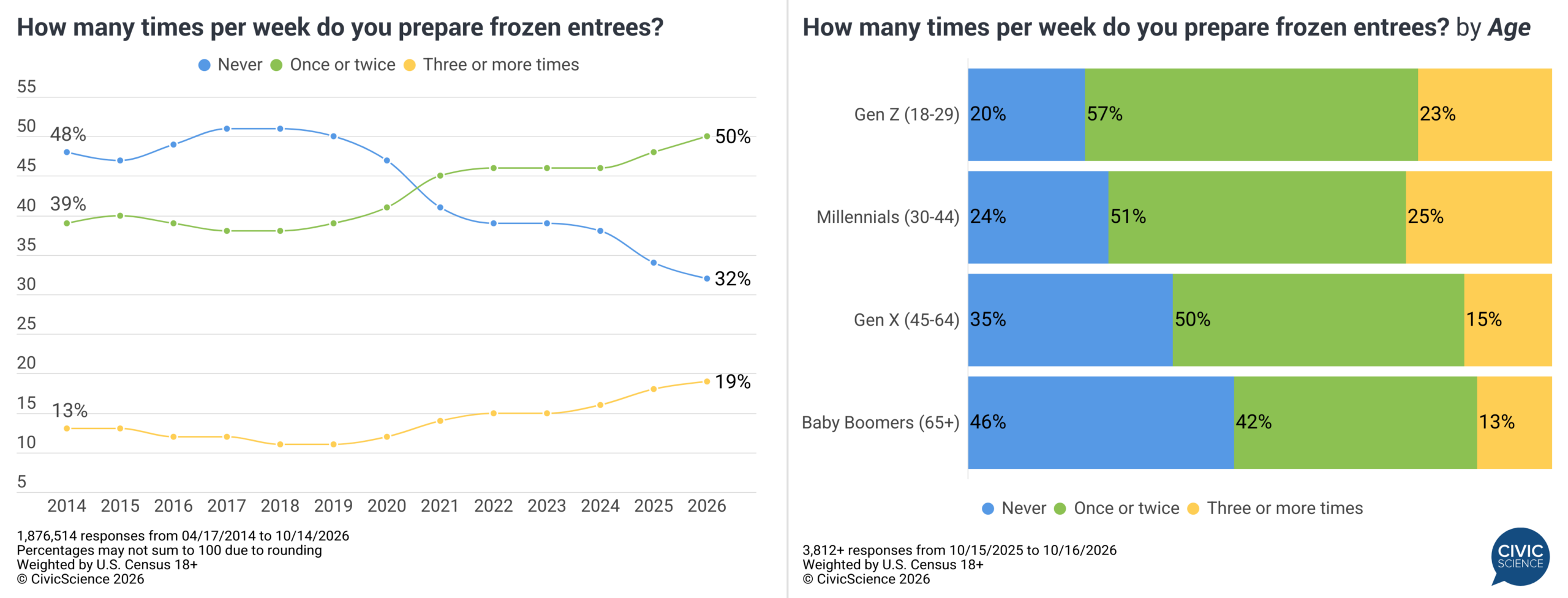
Americans are preparing frozen entrees more often than at any point since CivicScience began tracking in 2014. Today, 69% of U.S. adults say frozen entrees make it to the table at least once a week, up three percentage points from 2025 and 17 percentage points from 2014. The share preparing them three or more times a week has also climbed six percentage points from 2014. The shift in frequency accelerated during the pandemic and, amid rising grocery prices, began picking up again last year. Meanwhile, the share of consumers who ‘never’ prepare frozen entrees has fallen to 32%, down from 48% in 2014.
Lower- and middle-income households are the most frequent consumers. Fewer than one-third of those earning under $50K (28%) and $50K-$100K (27%) say they ‘never’ prepare frozen entrees, compared to 44% of households earning $150K+. Gen Zers (18-29) prepare frozen entrees most often, with 4-in-5 doing so at least once a week. Millennials (30-44) are the most likely to prepare them three or more times a week, at 25%, followed closely by Gen Z at 23%. Baby Boomers (65+) are the least likely to prepare frozen entrees, as 46% say they ‘never’ do.
Take Our Poll: What do you think of frozen restaurant meals?
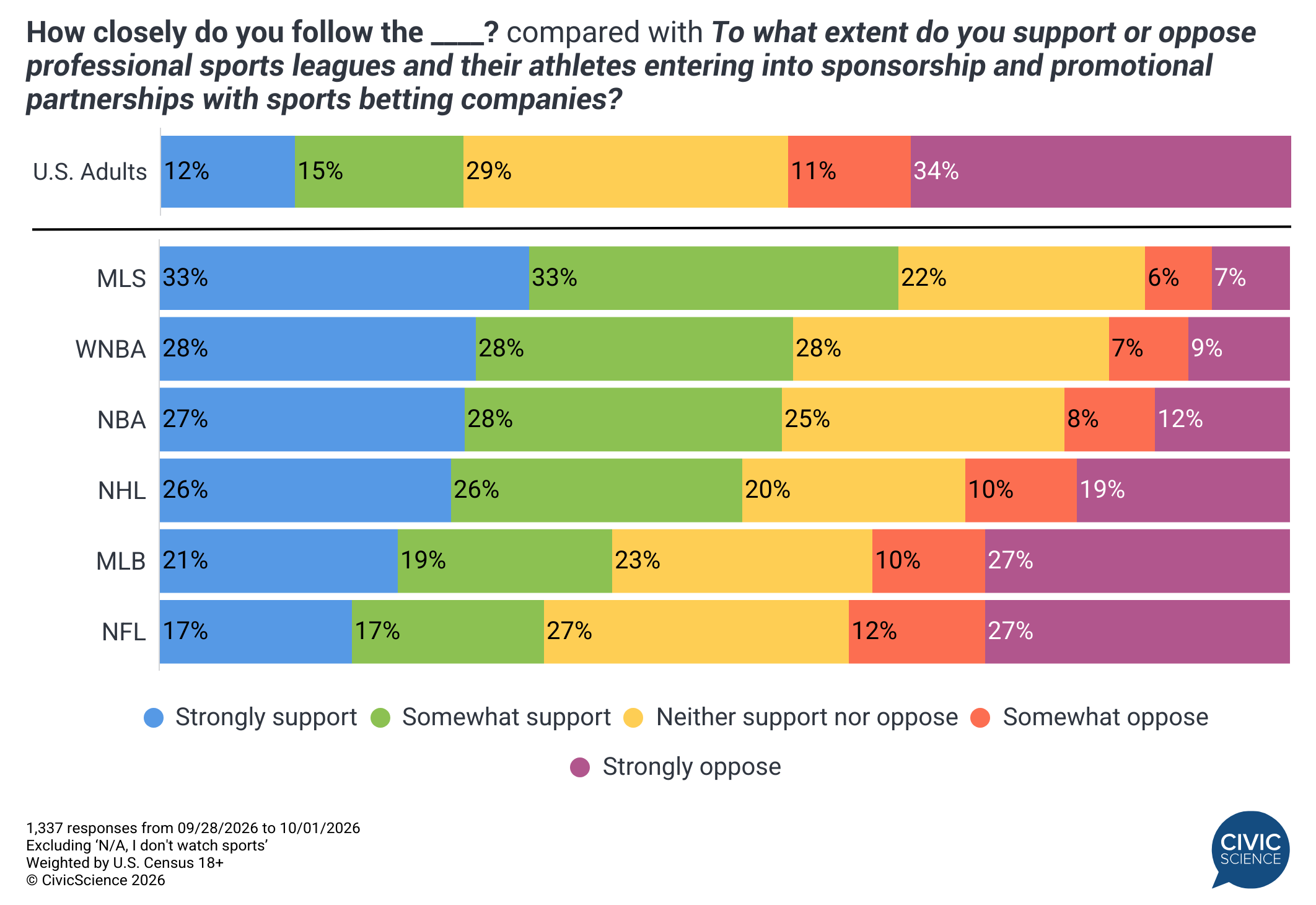
3. NFL fans are split on whether or not they support athletes and leagues partnering with sports betting companies, but MLS and NBA fans are in support.
Since a 2018 Supreme Court decision cleared the way for states to legalize sports betting, wagering has become a regular part of watching sports. After high-profile betting scandals in both the NBA and MLB made headlines late last year and as the fall sports slate heats up, 45% of sports fans say they at least ‘somewhat’ oppose professional leagues and their athletes partnering with sports betting companies. Roughly a third (34%) ‘strongly’ oppose these partnerships, compared to just 12% who ‘strongly’ support them.
Opinions vary by league, however. Two-thirds of Major League Soccer (MLS) fans at least ‘somewhat’ support these partnerships. Basketball fans are also supportive, with more than half of WNBA (56%) and NBA (55%) fans in favor. NFL fans, meanwhile, are the least supportive of any league studied, with more opposing these partnerships (39%) than supporting them (34%).