CivicScience has the world’s largest proprietary database of real-time declared intent, allowing brands to activate high-performing advertising that drives up to 80% better performance. See how our partners achieve superior marketing outcomes here.
How consumers feel is inseparable from purchasing and lifestyle habits. Well-being in today’s 24-hour news cycle can change on a dime, meaning it’s more important than ever to have a real-time source of truth directly from the consumers themselves.
That’s where the CivicScience Well-Being Index (WBI) comes in, using consumer-declared data to shed light on the emotional state of American adults on an ongoing basis. By quantifying the collective mood and ever-evolving state of mental health, the WBI stays on the pulse of shifts that often signal larger consumer changes.
Well-Being Dips for the First Time Since April
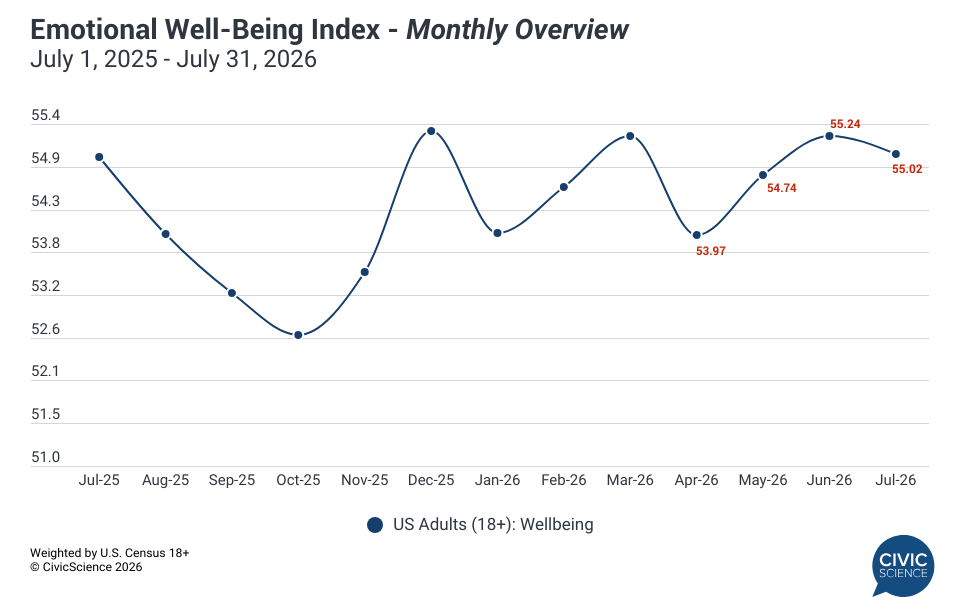
The most recent reading, through the end of July, shows that after two months of consecutive increases, well-being among U.S. adults dropped slightly, by 0.22 percentage points, to land at 55.02. The drop was led by adults aged 35-54 (-0.55 points) and by adults aged 18-34 (-0.29 points). Meanwhile, adults aged 55+ saw a slim 0.1-point increase, suggesting that emotional sentiment shows some divide along generational lines. Although this dip presses pause on the Index’s recent continuous upward trajectory, the WBI remains very slightly (0.04 points) higher than July 2025 (54.97).
Negative Emotions Pull Ahead to Lower the WBI
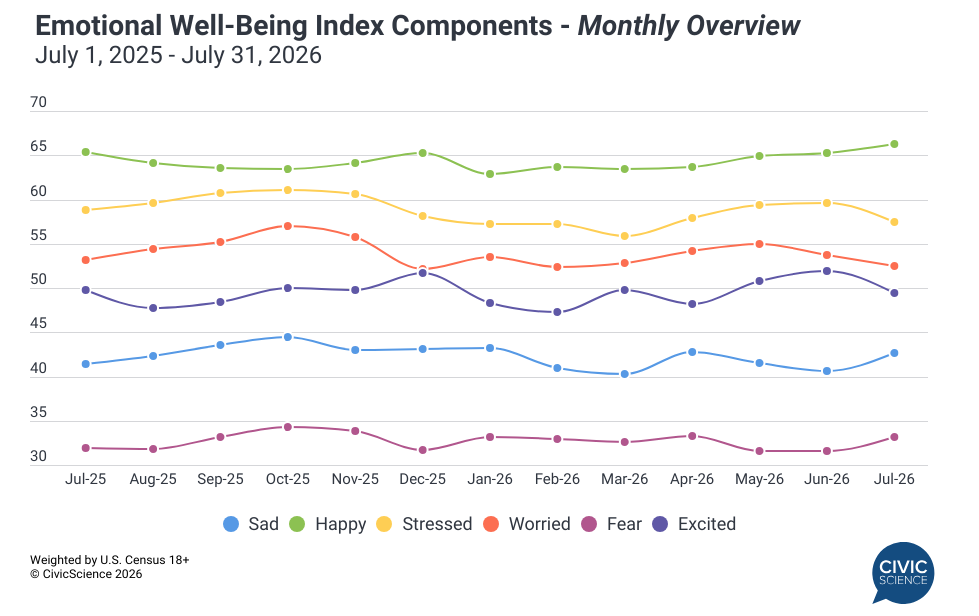
The individual WBI components offer insight into the conflicting forces that led to the overall decrease in well-being. Among positive emotions, the 1.03 point increase in happiness wasn’t enough to overcome the substantial 2.53 point decrease in excitement. The data among negative emotions are similarly mixed. Despite substantial declines in stress (-2.22 points) and worry (-1.36 points), increases in sadness (+1.98 points) and fear (+1.48 points) ultimately drove the WBI to finish lower than the month before.
In July, well-being fell for the first time in two months, led by adults under 55. The decline, driven by increases in sadness and fear and a substantial decrease in excitement, came amid an intense month for the country on the world stage. While the WBI doesn’t isolate which specific events moved the needle, the shifts in sadness and fear line up with a news cycle that included the end of the World Cup, a re-escalation of the conflict with Iran, and severe weather impacting residents nationwide. For businesses ready to stay sharp in a changing landscape, CivicScience’s real-time insights empower smarter, more agile decisions to reach consumers where they are at the exact moment they’re ready to buy.