A version of this article originally appeared in ROAR Forward as part of a collaboration with their quarterly ROAR Report. CivicScience has the world’s largest proprietary database of real-time declared intent, allowing brands to activate high-performing advertising that drives up to 80% better performance. See how our partners achieve superior marketing outcomes here.
As brands map out their 2027 strategies, winning over the 55+ consumer requires a modern playbook. While legacy media remains foundational, digital touchpoints are taking on a powerful new role in shaping purchase decisions. Recent consumer-declared data from CivicScience reveal how older consumers’ habits are shifting and where brands can find the highest-impact opportunities.
Traditional Advertising Is Still the Most Trusted, but Digital Advertising Is Gaining Influence
When CivicScience asked Americans 55 and older which type of ads they find to be most trustworthy, print ads (e.g., newspaper, magazine, direct mail, etc.) and TV ads were by far the most commonly cited (excluding those who don’t trust any ads). About 3 in 10 cited either, while the next closest options were a distant third and fourth – radio ads (10%) and search engine result ads (9%). Older audiences naturally favor familiar legacy formats, even as their definition of what “watching TV” actually means evolves.
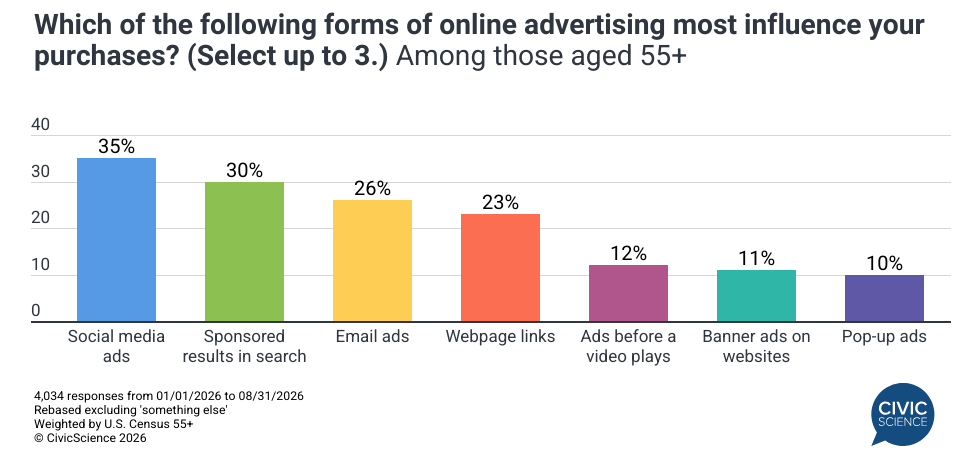
However, recent CivicScience data show that a growing share of Americans 55+ say their purchases are shaped by digital advertising. Forty-two percent now say they’re influenced by at least one of the digital ads studied in the chart below, representing an increase of six percentage points since 2024. Over the same time frame, social media ads have risen to overtake ads in search engine results for the top spot as the most influential among 55+. Email ads round out the top three (down four points from 2024) while pre-roll video ads gained four percentage points to overtake banner and pop-up ads over that same period.
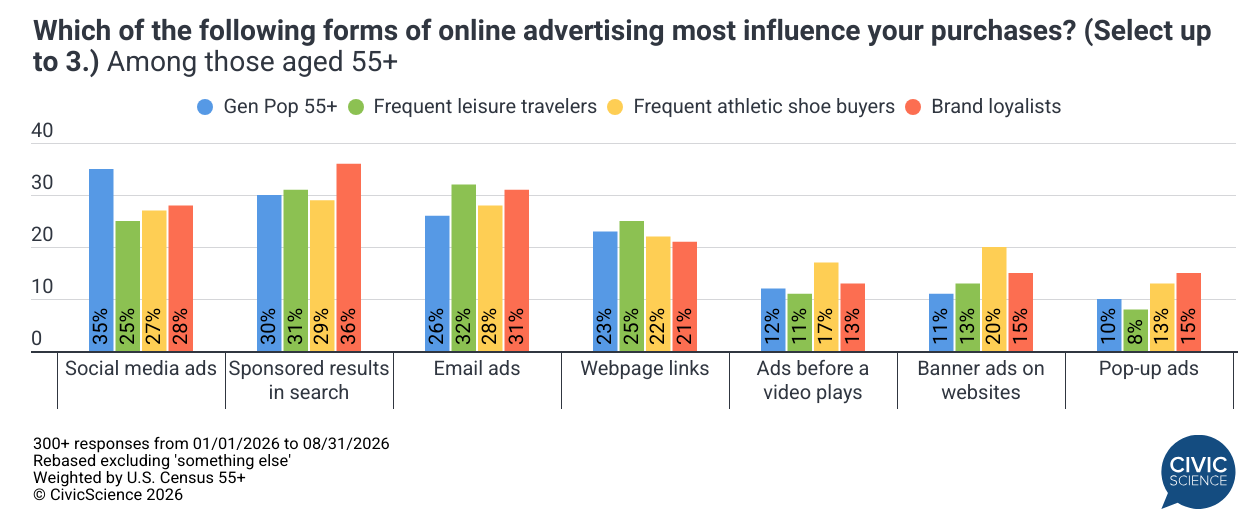
That being said, advertising is not, and shouldn’t be, considered one-size-fits-all. Noteworthy differences emerge when looking through the lens of custom CivicScience audiences among Americans 55+. Older consumers who travel for leisure three or more times per year are most likely to be swayed by links on websites and email ads. Those who buy athletic shoes multiple times per year, meanwhile, skew towards banner and pre-roll advertisements. Finally, consumers who are at least ‘somewhat’ loyal to their favorite brands are the most likely to cite search result ads.
What Builds Trust in Advertising Among Those 55+
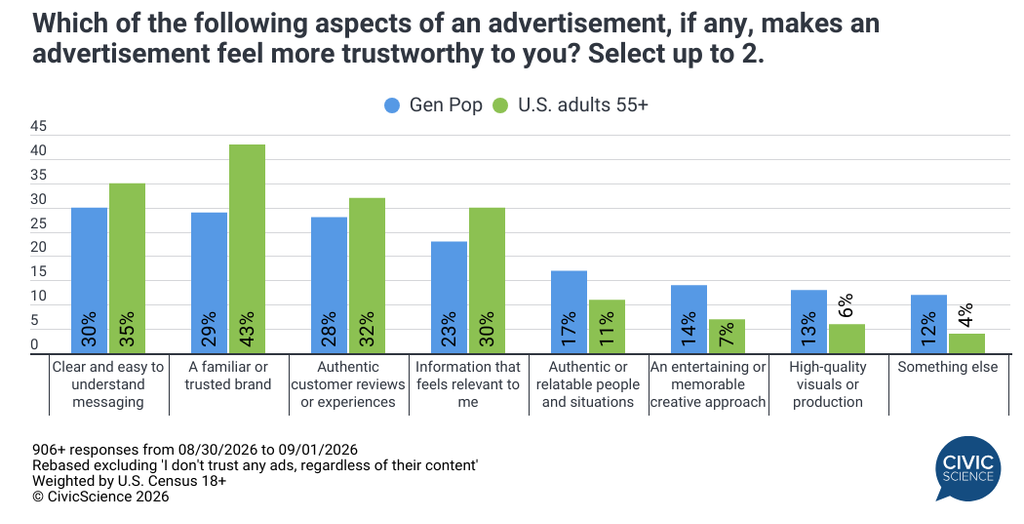
CivicScience data have already emphasized that representation in marketing is key to building loyalty and connection with consumers, but what are other ways a given advertisement can establish trust? For older Americans, brand familiarity goes a long way, but so does emphasizing clear, easy-to-understand messaging rather than focusing on being memorable or super creative. The 55+ consumer also tends to prefer ads that feature authentic customer reviews and places a notably higher value on relevancy.
Older Americans Are Increasingly Influenced by Social Media
As shown above, social media ads set the pace for digital advertising among Americans aged 55 and older. Part of the equation may simply be that the 55+ demographic is spending more time on social media overall. Through the end of August, one-quarter (25%) of U.S. adults 55+ said they spent 2+ hours on social media per day, a 39% increase from 18% in 2023.
But advertisements are just one piece of the puzzle when it comes to the growing sway of social media. In fact, just under one-third (31%) of Americans 55 and older report that their friends and other contacts on social media influence the products they buy at least ‘a little.’ This figure is up five points since 2024 and represents the highest yearly percentage observed in more than a decade of ongoing CivicScience tracking.
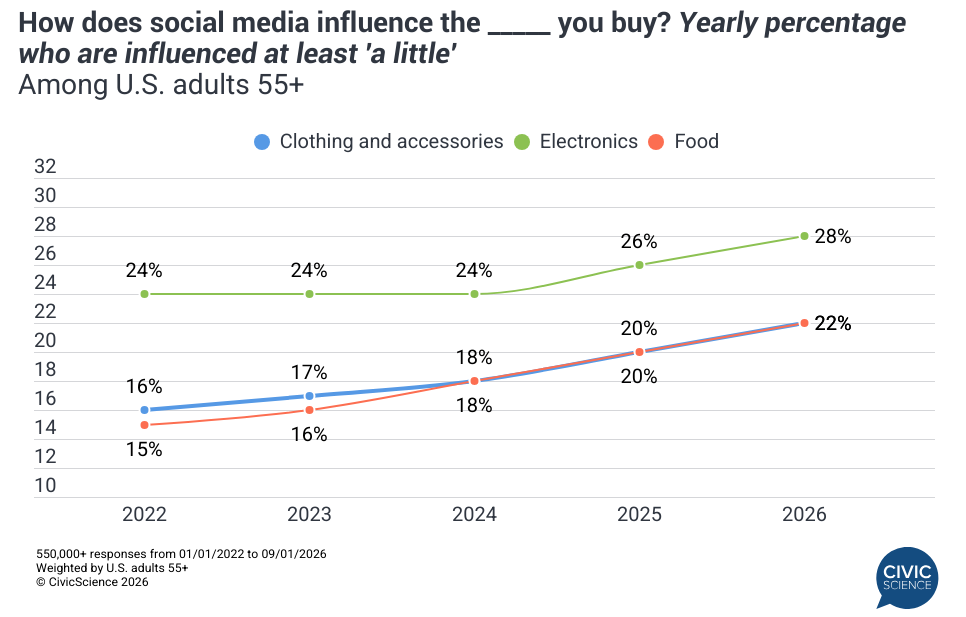
A granular look at specific categories also reveals a general year-over-year trend of rising social media influence, with social media having the strongest impact on electronics purchase decisions. The sway of social media on clothing and food purchase decisions also follows nearly identical growth trajectories.
The 55+ Consumer Is Showing Increased Responsiveness to Influencers
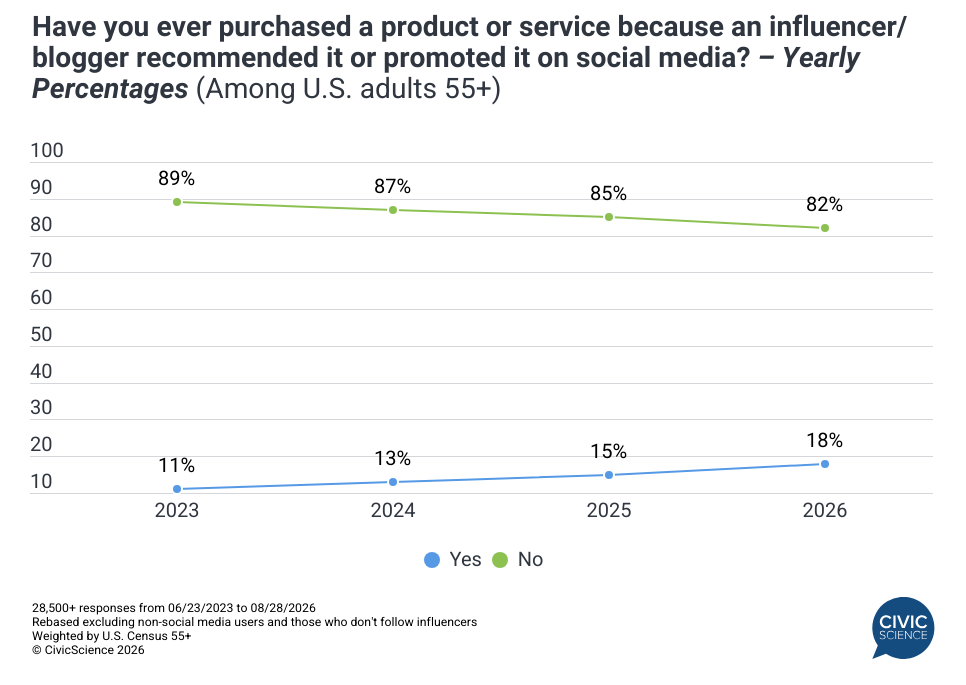
While content creators have plenty of room to expand their reach among the 55-and-older market, consumer habits are shifting. Just 18% of influencer-following adults in this age group have bought something based on a creator’s recommendation, though this figure is up from 11% in 2023.
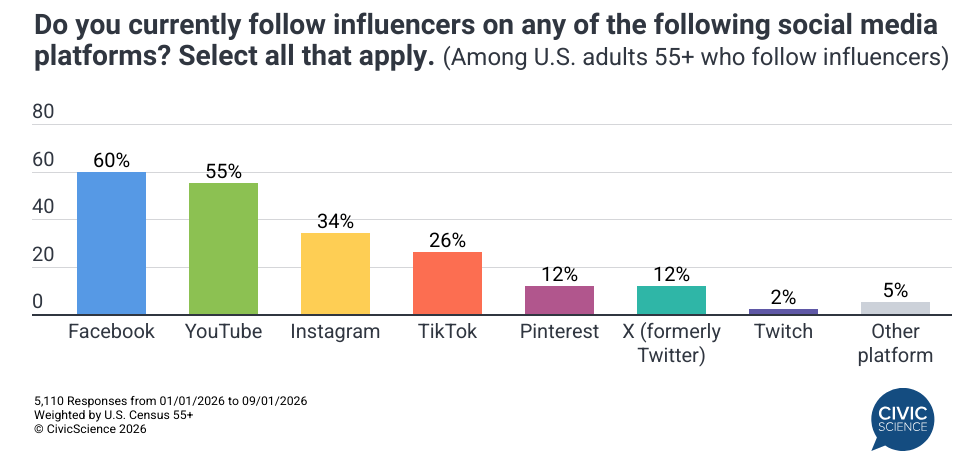
Additional data show that 34% of adults 55 and older report following social media influencers so far this year – hinting at likely continued growth. For brands planning creator strategies, data suggest Facebook and YouTube offer the highest concentration of those 55+ who follow influencers. While Instagram and TikTok are less popular among this age group for following influencers, more than a quarter still use each platform for this purpose.
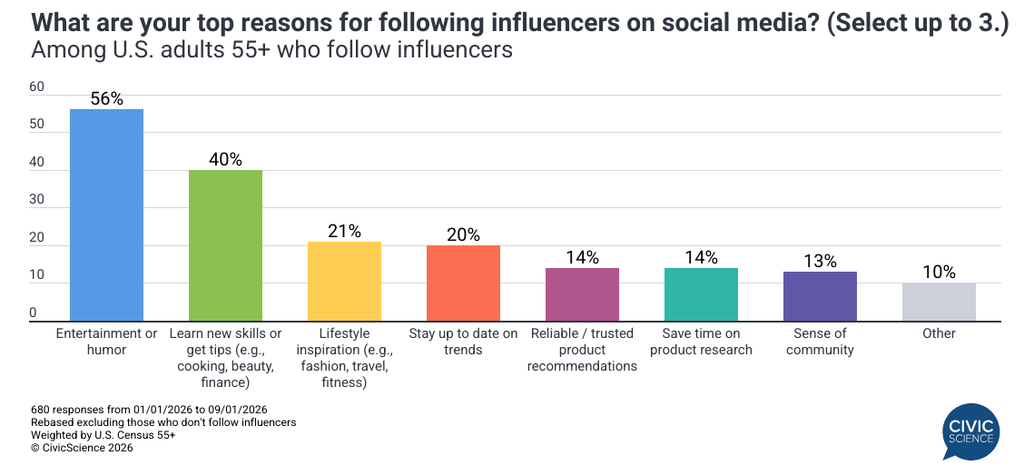
For brands exploring influencer marketing, the key will be to align efforts with why their audience follows influencers in the first place. CivicScience survey data show that influencers are most likely to serve as either a source of entertainment or as a way to get tips and learn new skills among those 55+. Lifestyle inspiration and keeping up with the latest trends serve as second-tier motivators. Other reasons, including product recommendations and research, are notable but much less common. Campaigns that mismatch with these reasons risk falling flat with the 55+ audience.
The 55+ demographic is proving to be far more digitally agile than many traditional media plans account for, creating a prime opportunity for forward-thinking marketers. The focus for 2027 should be on creating smooth pathways from initial digital discovery to final purchase, using clear messaging that strips away unnecessary noise. Brands that take a nuanced approach to these shifting habits today will build a strong competitive advantage while others are still catching up.