CivicScience has the world’s largest proprietary database of real-time declared intent, allowing brands to activate high-performing advertising that drives up to 80% better performance. See how CivicScience partners achieve superior marketing outcomes here.
1. Today’s news consumers are placing trust in individual reporters rather than news organizations.
Although local TV news remains the source Americans trust the most for unbiased coverage, an increasingly fragmented audience across formats and platforms is finding news it trusts in new ways. The latest consumer-reported data from CivicScience show that more Americans now place their trust in individual journalists than in the specific outlets they report for. Nearly 2 in 5 U.S. adults (38%) at least ‘slightly’ prefer getting news from specific journalists, compared to 29% who say they prefer to receive news from organizations.
This divide in preference follows age closely. The majority (55%) of Gen Z (18-29) and 46% of Millennials (30-44) prefer individual journalists. Among Baby Boomers (65+), 54% prefer news organizations, including 42% who ‘strongly’ do. Gen X is the most evenly split, with almost equal thirds preferring individual journalists (31%), news organizations (33%), and having no opinion (36%).
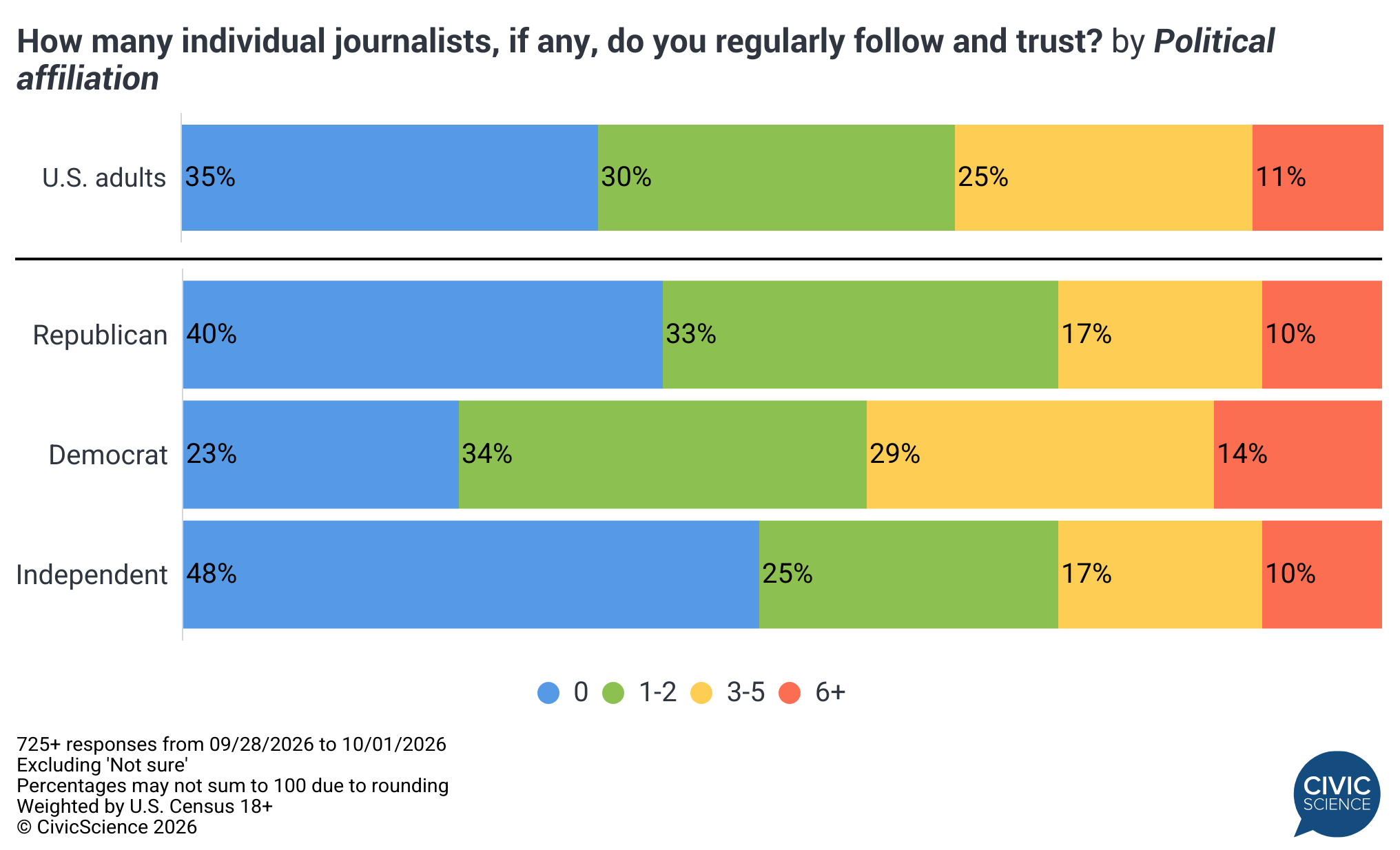
Additionally, two-thirds (66%) of Americans regularly follow and trust at least one individual journalist, while 35% follow none. Political affiliation plays a significant role in these habits, as self-reported Democrats are the most likely to follow multiple journalists, with only 23% saying they don’t follow any. Independents are the least likely to follow individuals, as nearly half (48%) report following and trusting zero. This gap may suggest that trust in the news media is fragmenting along party lines.
Let Us Know: How much do you generally trust the news and reporting of the mainstream media in the United States?
2. Most Americans wait until symptoms are severe or lingering before seeing a doctor.
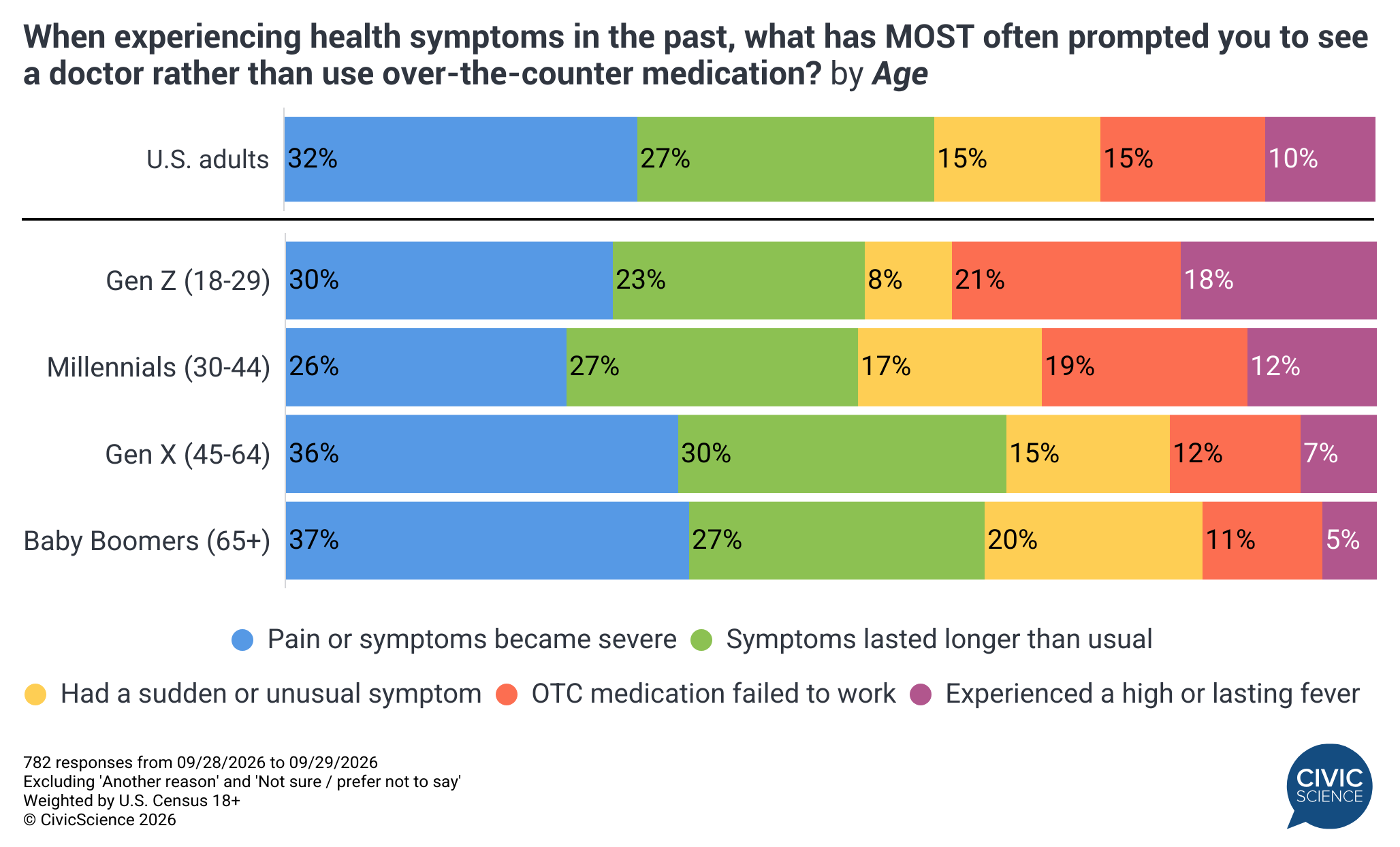
With healthcare premiums on the rise and more Americans switching insurance policies, seeing a doctor can be a complicated and costly endeavor. For many Americans, a doctor’s visit comes only after symptoms become hard to ignore. Nearly one-third (32%) of U.S. adults say pain or symptoms becoming severe is what most often prompts them to see a doctor, followed by their symptoms lasting longer than usual (27%). Secondary triggers like ineffective over-the-counter (OTC) medication, sudden symptoms, or high fevers play a much smaller role overall.
While it is true for the 45+ crowd, it’s only a small gap to Millennials. Gen Zers (aged 18-29) are more inclined than their older counterparts to seek care when OTC medications don’t work or when running a fever, but rarely do so for a sudden or unusual symptom. Conversely, Baby Boomers (65+) are the most likely age group to react to sudden symptoms, yet the least likely to seek care for a high fever.
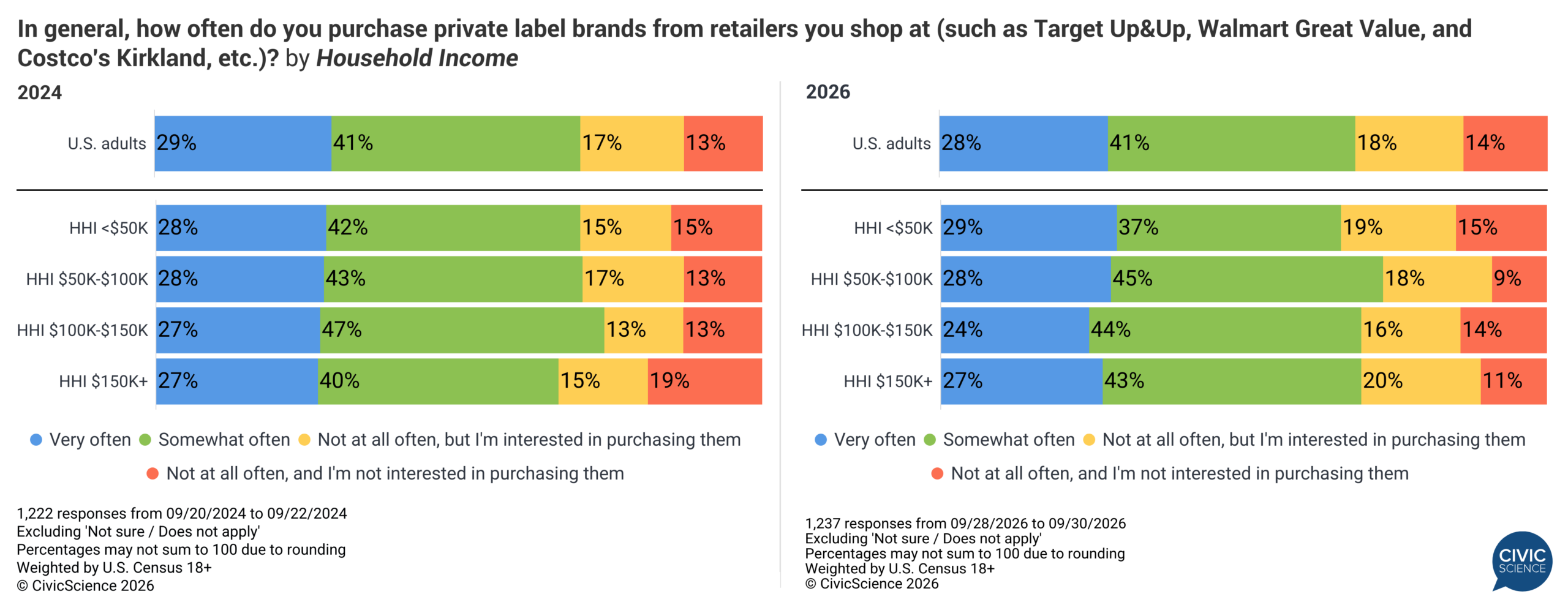
3. High-income households are more likely to buy private label brands than they were two years ago.
Private label brands remain an important part of Americans’ grocery shopping habits, accounting for nearly a quarter (24%) of consumer packaged goods and fast-moving consumer goods sales in the United States. While the share of U.S. adults buying private labels in 2026 was nearly unchanged from 2024 (69% vs. 70%), the split among household income levels shifted.
Notably, shopping among high-income households (those earning $150K+) grew in the past two years, as the share shopping private label brands at least ‘somewhat’ often rose three percentage points. he data also suggest rising interest, with 20% of high-income adults now saying they don’t buy private labels but are interested in purchasing them, up five percentage points from 2024. Middle-income shoppers ($50K-$100K) lead overall adoption at 73%, while buying among lower-income households (<$50K) declined from 70% to 66%.
Take Our Poll: To what extent do you typically shop for private label brands instead of brand name products?