CivicScience has the world’s largest proprietary database of real-time declared intent, allowing brands to activate high-performing advertising that drives up to 80% better performance. See how CivicScience partners achieve superior marketing outcomes here.
Well-being is more than a measure of how consumers feel — it can offer a valuable window into shifting consumer behaviors and priorities. As ongoing CivicScience data continue to show, changes in how consumers feel can influence how they spend, engage, and make decisions. For businesses navigating an uncertain economic landscape, understanding these shifts can provide valuable context for what comes next.
The CivicScience Well-Being Index (WBI) tracks these changes over time, providing insight into the evolving state of American well-being and what those shifts may mean for consumers and businesses across industries.
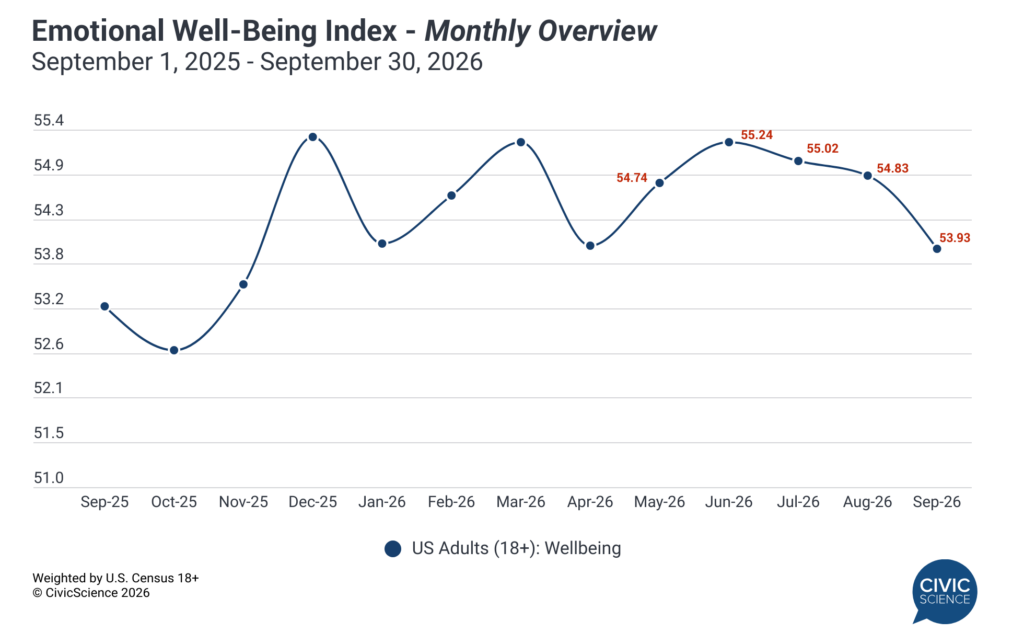
In September, well-being among U.S. adults 18+ has continued its downward slide for the third month in a row, landing at 53.93 — the lowest score reported this year. Although a low point for 2026, it is worth noting that this ranks 0.79 points higher than this time last year.
Adults aged 35-54 led the way in this most recent decline, with a 1.18-point drop (from 51.84 to 50.66). Not far behind were adults aged 55 and older, who saw a 0.99-point drop. Although less dramatic, adults aged 18-34 rounded out the decline with a decrease of 0.31 points.
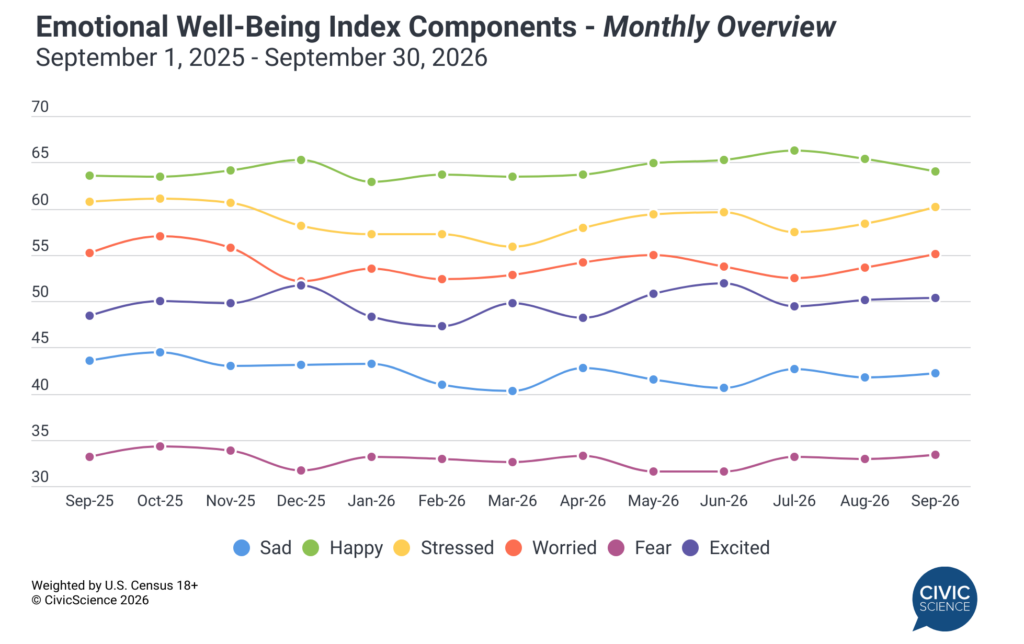
Well-being is made of many components, all of which help paint an increasingly precise picture of the American consumer and their ever-shifting behaviors. Last month, CivicScience polling revealed that feelings of stress and worry reached their highest levels of 2026, jumping by 1.74 points and 1.46 points, respectively. Fear increased by a more modest 0.48 points, with sadness not far behind at a 0.47 point increase. In turn, happiness saw a 1.33-point drop, marking its second consecutive monthly decline.
Hispanic American Well-Being Trails Gen Pop but Gains Ground
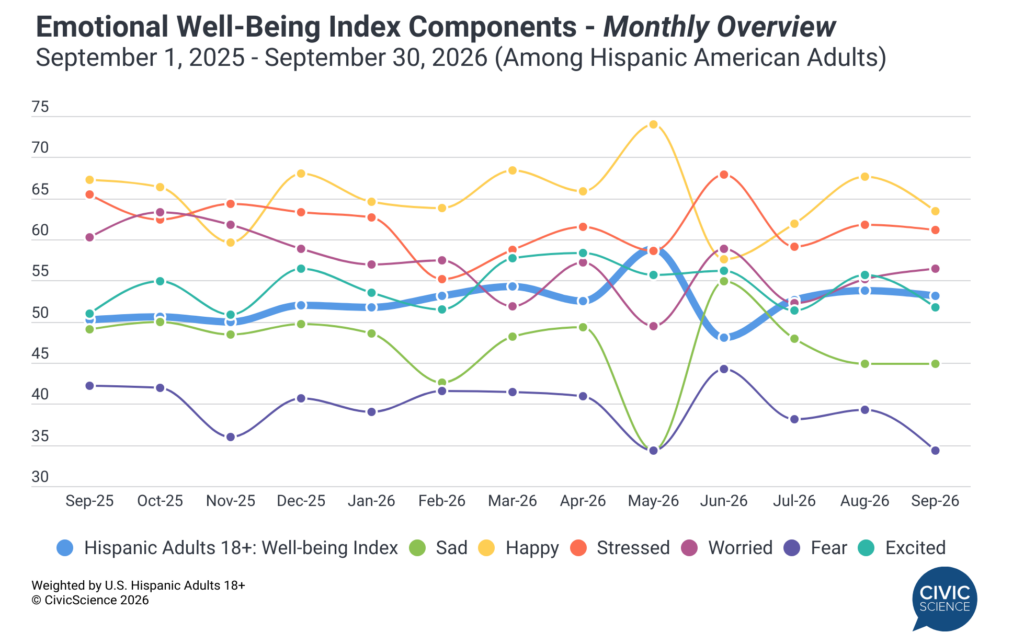
As Hispanic Heritage Month enters its home stretch, Hispanic Americans’ well-being stands out for its progress. The group’s WBI has climbed 2.84 points since September 2025 to 53.08, more than triple the gain among Gen Pop, though it still sits 0.85 points below the general population.
Much of that improvement comes from easing negative emotions. Fear, in particular, has dropped 7.89 points over the past year to 34.27, its lowest level in that span. Even so, Hispanic respondents still report more stress, worry, sadness, and fear than Gen Pop, with sadness showing the widest gap, at 44.86 compared with 42.24.
Excitement is the one emotion where Hispanic respondents outpace Gen Pop in a positive direction, at 51.78 compared with 50.34. CivicScience data on the holidays tell a similar story, with nearly half (48%) of Hispanic American adults saying they’re looking forward to them more than usual, compared with 34% of Gen Pop. So while stress and sadness are higher among Hispanic Americans, so is their excitement about the season ahead.
In September, well-being declined once again, driven largely by rising levels of stress and worry. And while the well-being of Hispanic Americans currently trails that of the broader U.S. population, the underlying components reveal a more nuanced story — one that continues to shift alongside consumer attitudes and priorities. For businesses navigating an ever-changing consumer landscape, CivicScience’s real-time insights provide the clarity needed to understand not only how consumers are feeling, but what those feelings may mean for their next move.