CivicScience has the world’s largest proprietary database of real-time declared intent, allowing brands to activate high-performing advertising that drives up to 80% better performance. See how CivicScience partners achieve superior marketing outcomes here.
With Thanksgiving just three weeks away, momentum is building for this food-focused holiday. After all, with so much to organize, whether it’s cooking a feast or simply showing up to enjoy it, now is the time to start making a plan.
With 82% of Americans planning to celebrate Thanksgiving and 81% considering the holiday ‘somewhat’ or ‘very’ important, both in line with last year, understanding the mindset of the 2026 Thanksgiving celebrator is key for brands that want to stand out amid the holiday rush. Here’s what new consumer-reported CivicScience data reveal about how Americans intend to celebrate Thanksgiving this year.
1. Many Americans Plan to Celebrate With Immediate Family, but Intent to Hold Large Gatherings Rises
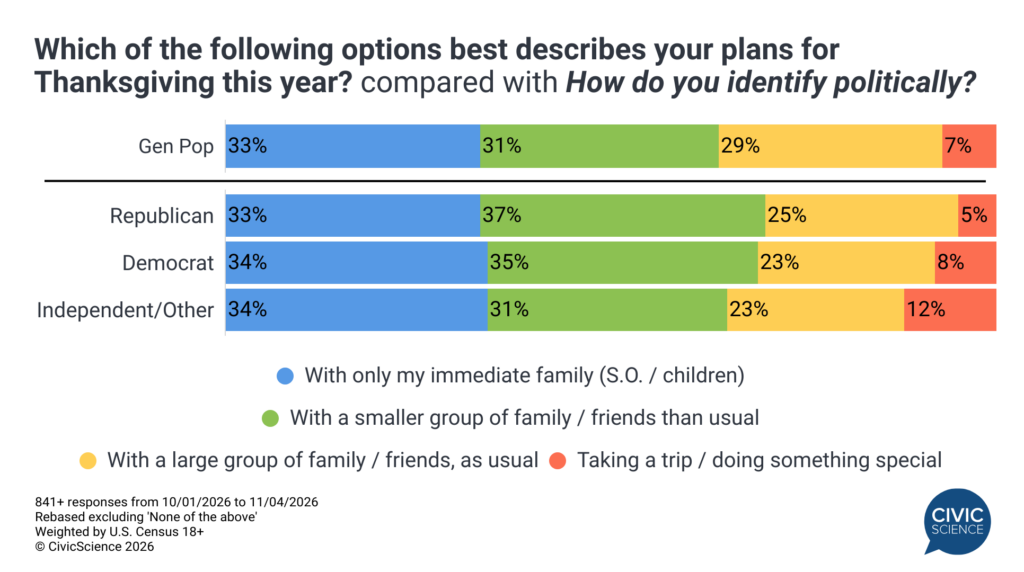
The largest share of Americans (33%) plan to celebrate with just their immediate family, narrowly outpacing the 31% who will gather with a smaller group of family and friends than usual. However, larger gatherings aren’t a thing of the past just yet: 29% of Thanksgiving celebrators plan to spend the day with a large group of family and friends, up from 24% last year.
Americans earning less than $50K annually are just as likely as those earning more than $100K to plan a larger gathering. Divisions also emerge along political lines. Self-identified Republicans lean toward smaller-than-usual gatherings, Democrats are split between smaller gatherings and immediate family, and Independents are most likely to keep it to immediate family. Notably, Independents are more than twice as likely as Republicans to take a trip or do something special for the holiday.
But Thanksgiving itself isn’t the only occasion Americans are gathering for. Additional CivicScience data show that 21% of U.S. adults have either hosted or attended Friendsgiving festivities this year, or are planning to, up from 18% in late October 2025. This percentage jumps to 38% among Gen Z (18-29) and 26% among Millennials (30-44).
2. Politics is Increasingly Likely to Come up at the Table
Heading into the holiday after the midterm elections, an increasing share of Americans plan to talk politics over Thanksgiving. Twenty-one percent say ‘yes;’ they plan to discuss politics during the holiday, the highest share since tracking began in 2019 and five percentage points higher than in 2024. Another 27% say ‘maybe.’
3. Turkey Still Leads Thanksgiving Lists, While Plant-Based Meat Nearly Doubles Since 2024
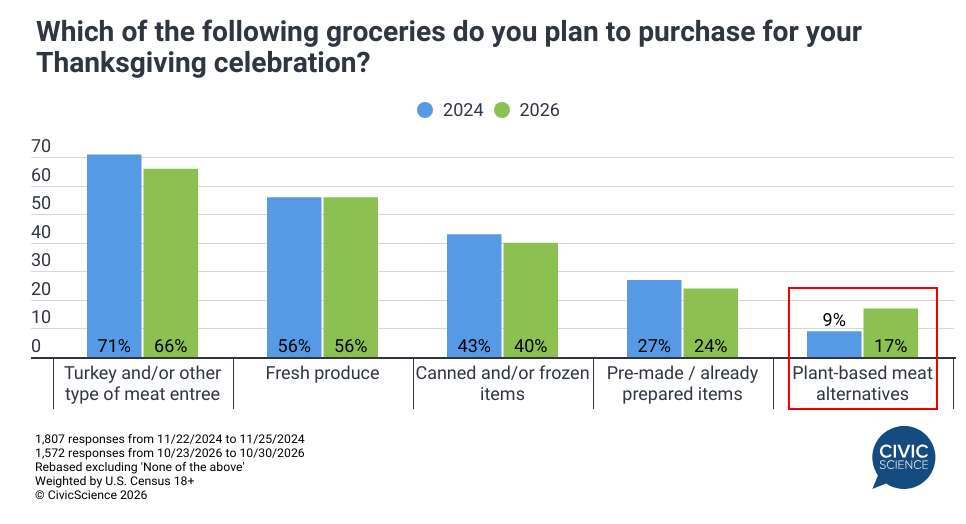
When purchasing ingredients, turkey or another type of meat entrée is unsurprisingly the most popular item on Americans’ Thanksgiving grocery lists (66%). Fresh produce follows at 56%, while canned or frozen items are on the list for 40% of shoppers. Although less common, pre-made items (24%) and plant-based meats (17%) are also likely to appear on some Thanksgiving tables.
Compared with 2024, most traditional shopping priorities have held steady or softened slightly. Plans to purchase fresh produce are unchanged, while canned or frozen items and pre-made items each dipped three percentage points. Turkey or another meat entrée saw a larger decline of five percentage points, though it remains the clear front-runner. The biggest shift is in plant-based meats: purchase intent nearly doubled, from 9% to 17%, as plant-based meat consumption gains momentum among Americans overall.
4. Convenience Creeps Into More Thanksgiving Plans
What shoppers buy is only part of the story. Americans are also weighing how much time and effort they want to put into preparing the meal. Cooking everything from scratch remains the most common plan at 43%, though that’s down from 46% in 2024. It ticked up one percentage point from last year after dipping to 42% in 2025. Another 39% will combine home-cooked dishes with pre-made items, slightly below the 41% recorded in both 2024 and 2025.
The steadiest movement is toward full convenience. Eighteen percent now anticipate an entirely pre-made Thanksgiving spread, up from 17% last year and 13% in 2024, a five-percentage-point gain over two years.
Scratch cooking still has a firm hold on the holiday. However, the gradual rise in fully pre-made meals suggests that convenience is becoming an increasingly accepted part of Thanksgiving for a growing share of Americans.
5. Thanksgiving Shoppers Remain Split on Delivery Apps for Groceries
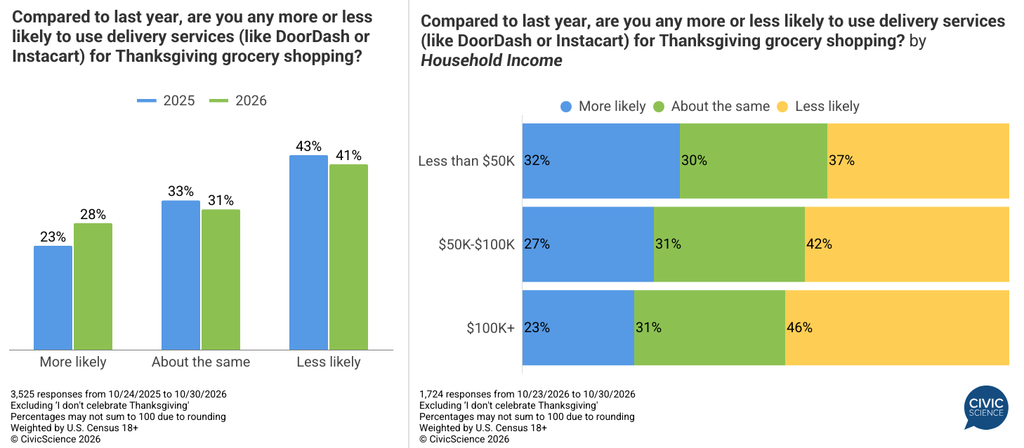
The pull toward convenience extends to how Americans shop for the meal itself. More than a quarter of U.S. adults (28%) say they’re more likely to use delivery apps like DoorDash and Instacart for Thanksgiving groceries this year, up five percentage points from 2025. Still, 31% expect their usage to stay the same, and 41% are less likely to use these apps.
Enthusiasm is strongest among lower earners. Thirty-two percent of those earning less than $50K are ‘more’ likely to use delivery apps, compared with 27% of those earning $50K-$100K and 23% of those earning $100K or more. Nearly half of higher earners (46%) are ‘less’ likely to use them. For grocers and delivery platforms, the takeaway mirrors the broader holiday picture: many Americans still want a hands-on Thanksgiving, but a growing share are open to handing off part of the work.
6. Takeout On Thanksgiving Eve Appeals, Especially to Younger Consumers
With all the prep required for Turkey Day, some Americans are giving themselves a break the night before. CivicScience data show that 46% of respondents are at least ‘somewhat’ likely to order takeout or delivery for dinner on the night before Thanksgiving, up three percentage points from last year.
These plans vary considerably by age. Nearly two-thirds of Gen Z adults (66%) say they’re ‘somewhat’ or ‘very’ likely to order takeout the night before the holiday, compared with just 20% of Baby Boomers (65+).
Thanksgiving traditions remain firmly in place, but the data point to a holiday that’s becoming easier to pull off. Fully pre-made meals, delivery apps, and Thanksgiving Eve takeout are all gaining ground at the same time that more Americans plan large gatherings, and that appetite for convenience runs strongest among younger and lower-income consumers.
For brands across the grocery, food, restaurant, and delivery sectors, these overlapping trends create more opportunities to reach holiday shoppers, from the grocery list to the night before the big meal. Real-time consumer insights can help brands understand not only what Americans are planning, but how those plans translate into purchases.