CivicScience has the world’s largest proprietary database of real-time declared intent, allowing brands to activate high-performing advertising that drives up to 80% better performance. See how our partners achieve superior marketing outcomes here.
When it comes to purchasing and lifestyle decisions, how consumers feel plays a major role in their approach to discretionary spending. Given the fast-paced nature of today’s 24-hour news cycle, it’s increasingly important to have real-time insights directly from the consumers themselves.
That’s where the CivicScience Well-Being Index (WBI) comes in, using consumer-declared data to shed light on American adults’ emotional states on an ongoing basis. The WBI quantifies the collective mood and ever-shifting state of mental health to stay on the pulse of monthly changes that signal broader consumer trends.
Well-Being Falls Again, With Older Consumer Driving the Drop
The most recent reading, through the end of August, shows a continuation of last month’s decline, with well-being among U.S. adults once again dropping slightly by 0.19 percentage points to 54.83. The drop was led by adults aged 55 and older (-0.45 points) and adults aged 35-54 (-0.34 points). Meanwhile, adults aged 18-34 saw a slight 0.38-point increase, suggesting that the emotional factors positively affecting younger adults may not always carry over across generational lines. Although this dip continues last month’s downward shift, the WBI remains 0.88 points higher than August 2025 (53.95).
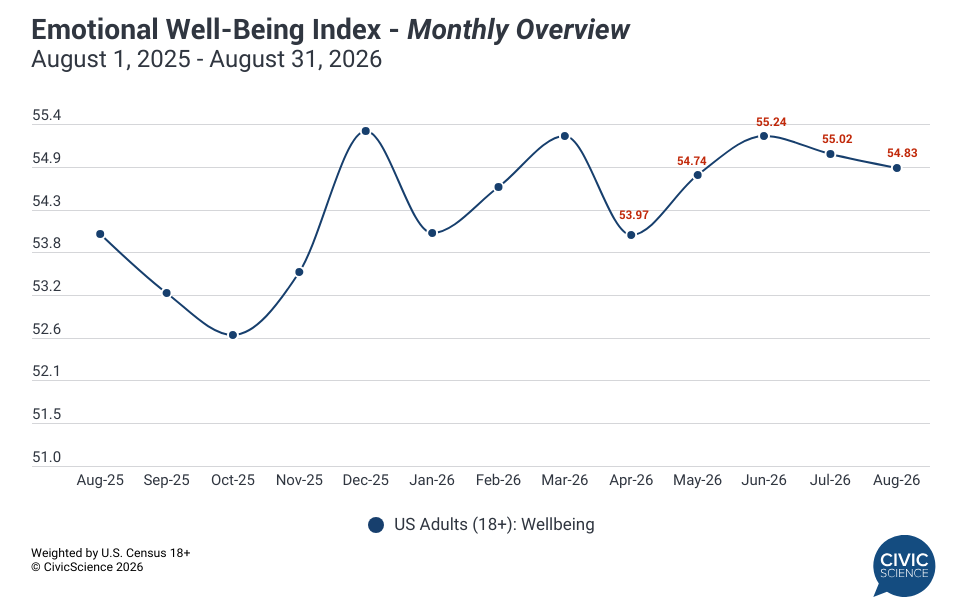
Happiness Declines For the First Time in Months as Worry and Stress Climb
The individual WBI components offer insight into the nuanced factors that led to the overall decrease in well-being. For the first time since March, the leading component of happiness fell. The 0.91-point month-to-month drop in happiness was enough to offset a 0.69-point gain in excitement. The data on negative emotions are similarly mixed. Despite a 0.90-point decrease in sadness and a 0.30-point decrease in fear, increases in worry (+1.09 points) and stress (+0.91 points) ultimately resulted in the WBI ending lower than the previous month.
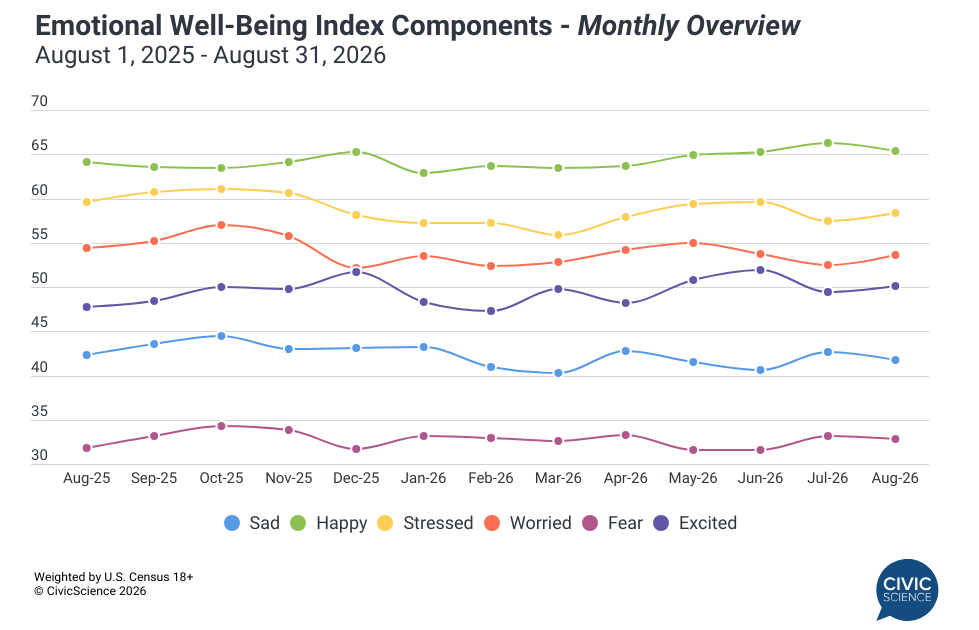
August’s dip breaks from the recent pattern. This time, a rare dip in happiness, the WBI’s leading component, is driving the decline alongside climbing worry and stress, rather than sadness or fear. Although the WBI does not pinpoint the impact of specific events, the decrease in well-being aligns with escalating tariff-related concerns, ongoing conflict with Iran, and evolving immigration policies. While individual news events rarely tell the whole story, leveraging CivicScience’s real-time insights to track shifts in consumer sentiment helps businesses make smarter decisions, refine their tone, and reach audiences with clarity as mindsets evolve.