CivicScience has the world’s largest proprietary database of real-time declared intent, allowing brands to activate high-performing advertising that drives up to 80% better performance. See how our partners achieve superior marketing outcomes here.
National Volunteer Month (observed in April) serves as a timely reminder of a quieter, more positive trend currently unfolding across the country. Amid a constant stream of high-stakes headlines and economic uncertainty, Americans are increasingly turning their attention toward their local communities and the causes they champion. Far from being a background activity, volunteering has reached a new peak.
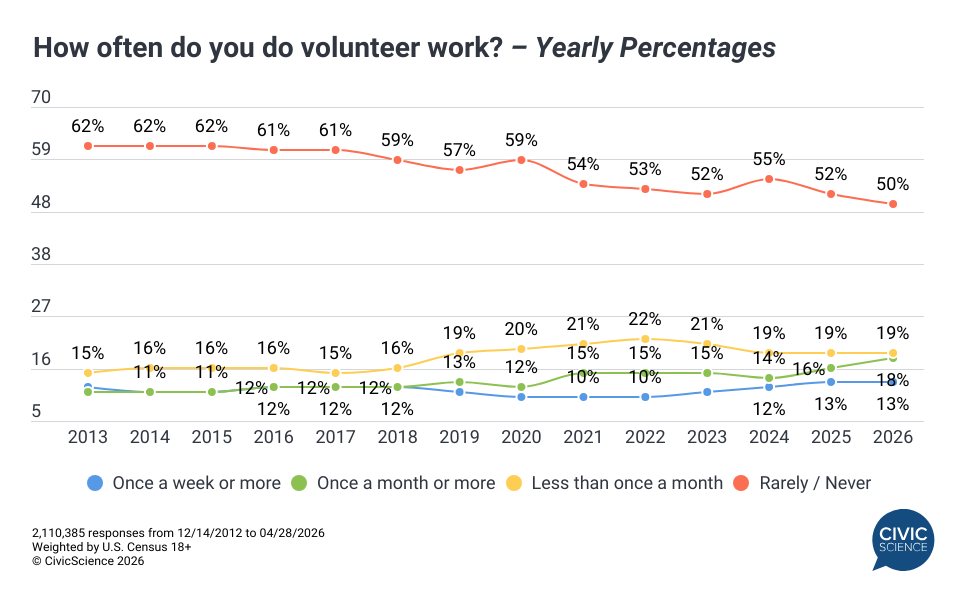
New CivicScience data shows that participation is at an all-time high, with 50% of Americans now reporting that they volunteer. This figure marks a 12 percentage-point increase since CivicScience began asking Americans about volunteering in 2013 and a two percentage-point increase since last year. The data also show that it’s not just participation that’s rising, but also frequency, with weekly and monthly volunteering also reaching highs in 2026.
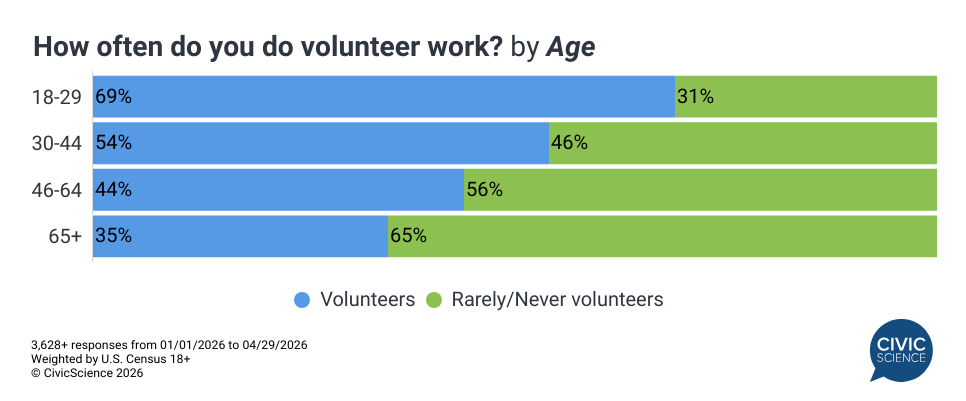
Currently, Gen Z leads in participation, with 69% of U.S. adults aged 18-29 identifying as volunteers (up from 57% in 2024). Millennials come in second, as just over half (54%) volunteer. Gen X and Baby Boomers show lower participation, with 44% and 35% volunteering, respectively.
Americans Are Motivated by Both Personal Values and Community Impact
Among volunteers, the top reason for volunteering is to ‘support a cause I feel strongly about.’ This is followed by the desire to help people and communities, while the desire to socialize and work with others rounds out the top motivations. Other motives, such as learning new skills or religious reasons, are less popular—each cited by 4%. Overall, these motivations point to a mix of personal values and community connection driving the rise in volunteering.
Purpose and Impact Shape Giving Behavior
The same conviction that drives volunteerism appears to carry over into charitable giving. This year, more than half of Americans (55%) say they have donated about the same amount to charities as they did last year, with 15% increasing their donations year-over-year. Among the many motives for donating, the largest percentage (44%), unsurprisingly, reports doing so because they align with and want to support a charity’s mission. The positive impact and charitable feelings that donors experience (38%) and a personal connection or experience (36%) also rank high as key reasons for donating.
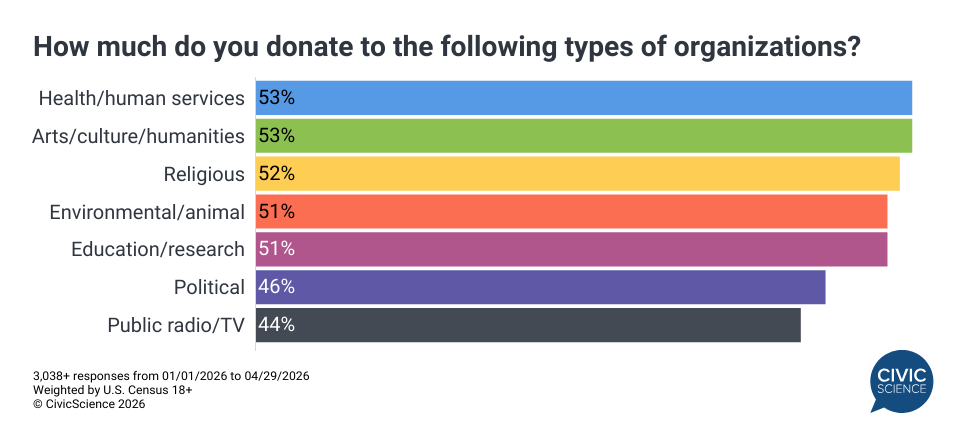
In terms of where these contributions typically go, Americans prioritize health and human services alongside arts, culture, and humanities organizations in a dead heat. Religious nonprofits also command significant support, while environmental, animal, educational, and research organizations round out the top tier of donor favorites. Even the categories with the narrowest reach, political groups and public radio or TV, still attract donations from more than 40% of the population, underscoring the sheer breadth of American philanthropy.
As National Volunteering Month winds down, the data hit a hopeful note. The increase in volunteering and sustained donation rates suggests that despite the ongoing uncertainty in the world at large, Americans continue to value – and support – causes that matter, with both their time and with their wallets.