CivicScience has the world’s largest proprietary database of real-time declared intent, allowing brands to activate high-performing advertising that drives up to 80% better performance. See how our partners achieve superior marketing outcomes here.
The 2026 FIFA World Cup will be well underway in one month, at the time of this writing. The premier global soccer event, featuring the national teams of 48 countries, will be held in Mexico, Canada, and the United States. CivicScience has been asking Americans about their interest for more than a year now, and the latest consumer-declared data delivers a glimpse into the likely audience.
World Cup Interest Jumps, Fueled by Millennial Surge and Growing Interest in Professional Soccer Leagues
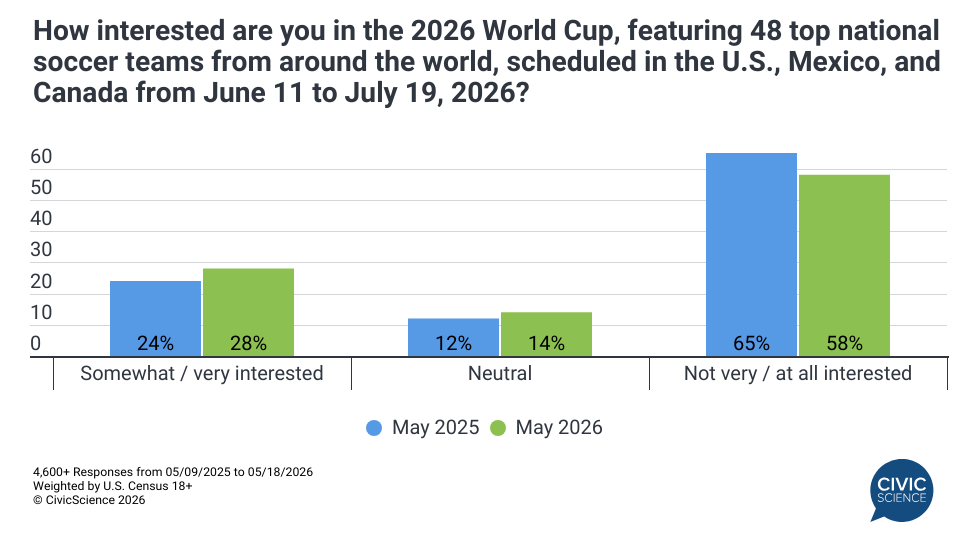
Back in May of last year, roughly one-quarter of U.S. adults told CivicScience they were at least ‘somewhat’ interested in the 2026 World Cup, including 10% who were ‘very’ interested. Today, that percentage is up to 28% (13% are ‘very’ interested). This interest is primarily being driven by younger adults, with Gen Z ages 18-29 (41%) leading the way, followed by Millennials 30-44 (35%), with interest among Millennials spiking from 24% in May of 2025. Conversely, the percentage interested stands at 18% and 13%, respectively, among Gen X (45-64) and Baby Boomers and older (65+).
This growing excitement isn’t just because the tournament is a few weeks away. CivicScience data show that interest in American professional soccer leagues is expanding as well, with more Americans reporting that they follow Major League Soccer (MLS) and the National Women’s Soccer League (NWSL) this year. The percentage of U.S. adults who follow the MLS at least ‘a little’ closely has jumped seven points from 2025, now at 32%, while NWSL fandom is up five points to 27%.
World Cup Viewership Is a Fragmented Landscape
Sixteen percent of U.S. adults tell CivicScience they are ‘very’ likely to watch World Cup games this year. Among those planning to watch, just over two-thirds (68%) report they’ll most likely be watching from their own home. Much like how Americans watch TV overall, World Cup viewership methods are fragmented – 30% of viewers will tune in via traditional cable or satellite, 23% will watch on a streaming platform, and 15% will watch via digital antenna.
Eleven percent of those planning to watch say they’ll watch from someone else’s home, and 7% will go to a bar or other public place. An additional 11% say they’ll either just watch highlights (7%), follow along on social media (4%), or through an ‘other’ method (3%).
The “Why” Driving Americans to Watch Is Just as Fragmented, Especially Among Younger Viewers
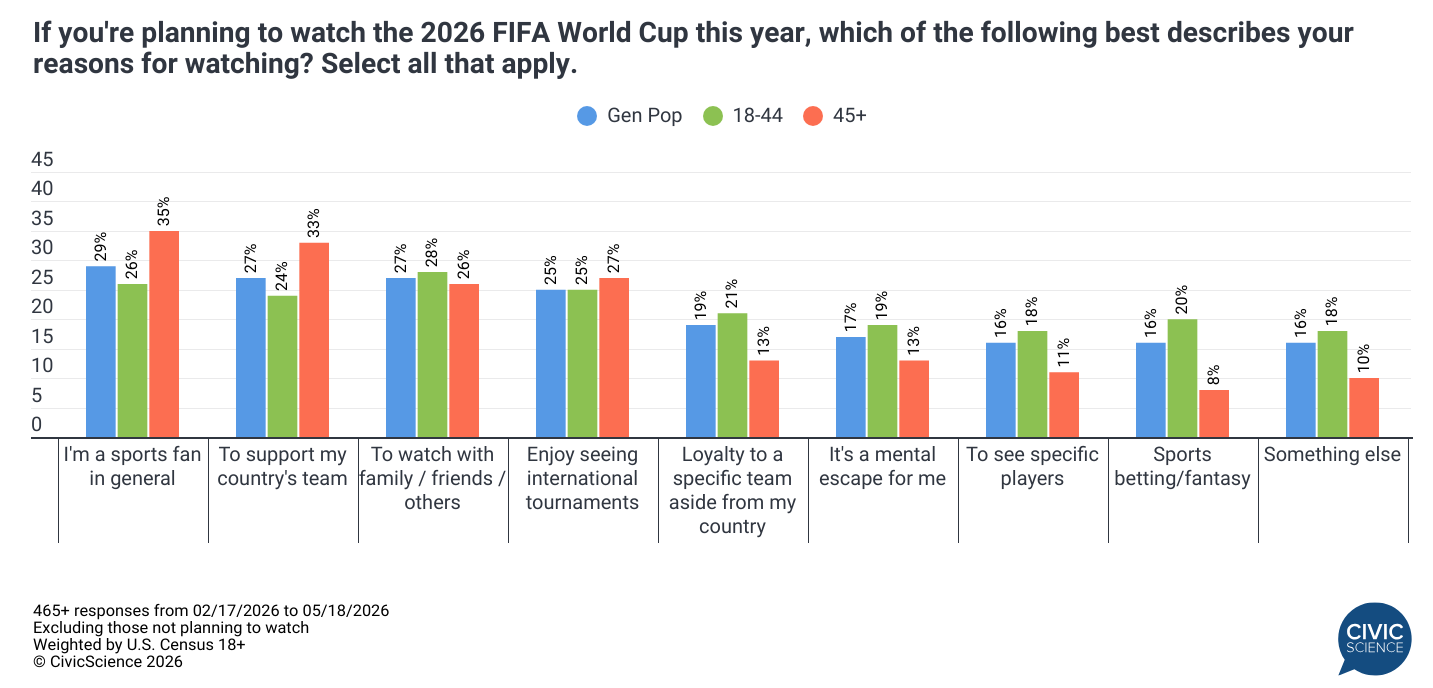
Sports fandom in general, pride for one’s national team, and social viewing are the top reasons for watching among the average viewer, but as the data highlight, viewership motivations are not one-size-fits-all. Older viewers are most concentrated as general sports fans and/or driven by national pride. Viewers under 45, on the other hand, outpace their older counterparts in a variety of reasons for watching, most notably betting and seeing teams beyond their home country. They are also more drawn to narratives and attention around specific players, and nearly one in five will tune in simply because it’s a mental escape for them.
Additionally, in an encouraging sign for World Cup advertisers, 42% of those planning to watch and rooting for a specific country say they will continue watching the tournament even if their team is eliminated. Another 41% say they’ll stop watching matches, but continue to follow scores and highlights. Just 17% say they will stop watching and following altogether if their preferred team is eliminated.
What’s Next: Consumer Signals to Watch Among World Cup Viewers
World Cup viewers remain highly valuable to brands long after the final match in July. Across everyday lifestyle trends and forward-looking intent, CivicScience’s consumer-reported data shows that these viewers outpace the average American in multiple categories.
- Relocation: Likely WC viewers are soon to be in transition, as they are more than twice as likely as the average American to say they plan on moving to a new residence within the next year.
- Hosting Social Gatherings: More than half of WC viewers host social gatherings at their place at least twice per month, outpacing Gen Pop by 30 points (54% to 24%).
- Drinking Beer: A full one-quarter of WC intenders aged 21+ drink beer twice per week or more, more than double the 12% among Gen Pop (21+). They’re also four points more likely than average to say they’ve tried and like non-alcoholic beers (20% to 16%).
- AI For Shopping: Those likely to watch are more than twice as likely as the average adult to say they use AI specifically to support shopping and product research ‘every time they shop online.’
- Types of Ads: Emotional ads are much more likely to resonate with WC viewers than with the Gen Pop (26% to 16%, respectively). Informative ads are also slightly more likely to resonate with WC intenders (34% vs. 31%). That said, humorous ads are less common among WC viewers than in the average American audience (31% to 43%, respectively).
This is just the tip of the iceberg of the data CivicScience delivers to clients, allowing them to build audiences and lookalike audiences across industries and reach them where they are, at the right moment.
Now just under one month away from the kick-off of the 2026 FIFA World Cup, interest is up, soccer league fandom is growing, and younger generations are engaged in ways that go well beyond traditional sports viewership. Brands and advertisers paying attention to those signals now will find no shortage of insight into who this audience is and how to reach them well after the final whistle.