CivicScience has the world’s largest proprietary database of real-time declared intent, allowing brands to activate high-performing advertising that drives up to 80% better performance. See how our partners achieve superior marketing outcomes here.
In a persistently volatile market, how Americans perceive their personal financial health is critical data for key decision-makers striving to stay ahead of changes in consumer spending. With this in mind, the CivicScience Consumer Financial Health Index (CFHI) provides insight into this constantly evolving arena, helping clients across industries reach the right consumers at the right time.
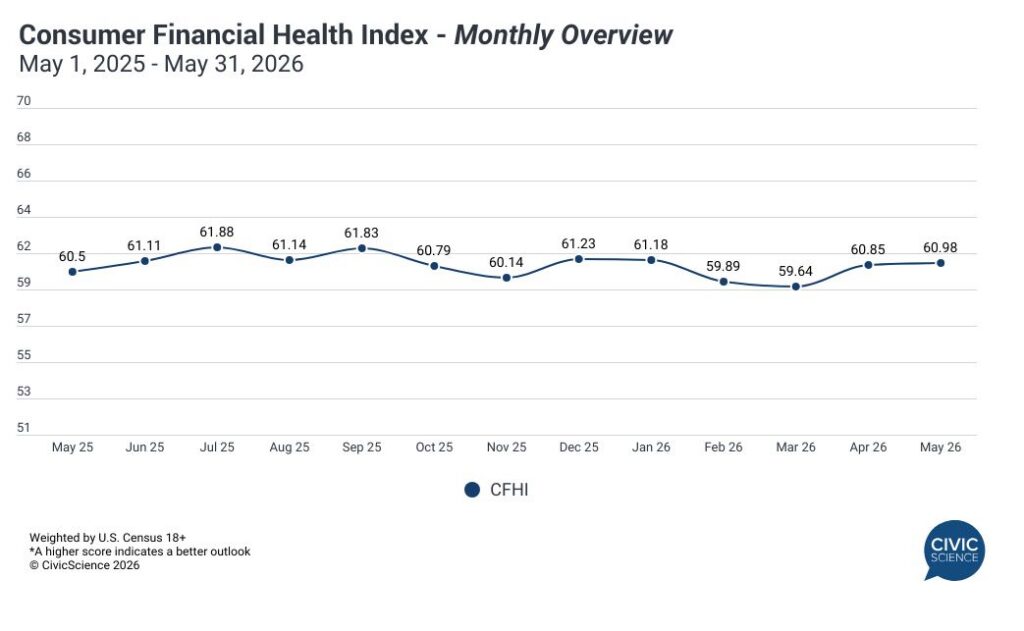
The latest reading of the CFHI through the end of May 2026 showed a small but meaningful increase of 0.13 points, settling at 60.98. This uptick, which means the CFHI is now 0.48 points higher than this time last year, builds upon the larger leap seen in April, inching closer to the high not seen since January.
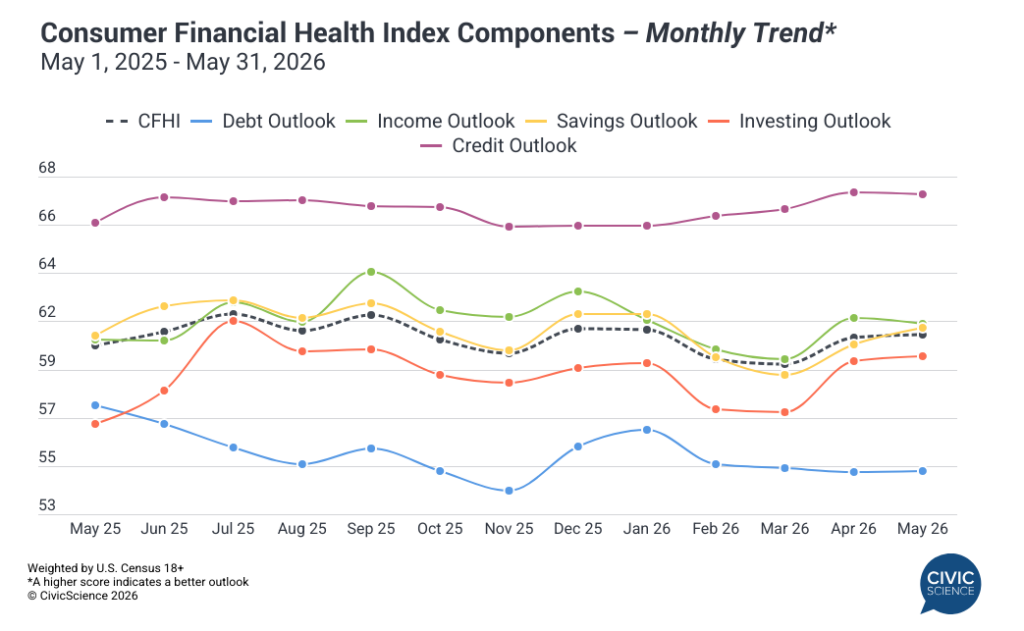
An analysis of the CFHI’s individual components reveals May’s increase was driven by slight improvements in savings outlook (+0.76 points), followed by investing outlook (+0.14 points), and debt outlook (+0.05 points). These gains were enough to offset a dip in income outlook (-0.3 points) and a rare, but slight, slip in credit outlook. Zooming out on the wider year-long view, four of the five CFHI components finished May up from where they stood in May of 2025, most significantly in investing outlook (+3.05 points) and credit outlook (+1.28). Conversely, in less positive news, debt outlook is down 2.79 points from this time last year, and could be primed to fall as more Americans look to take on debt for summer travel.
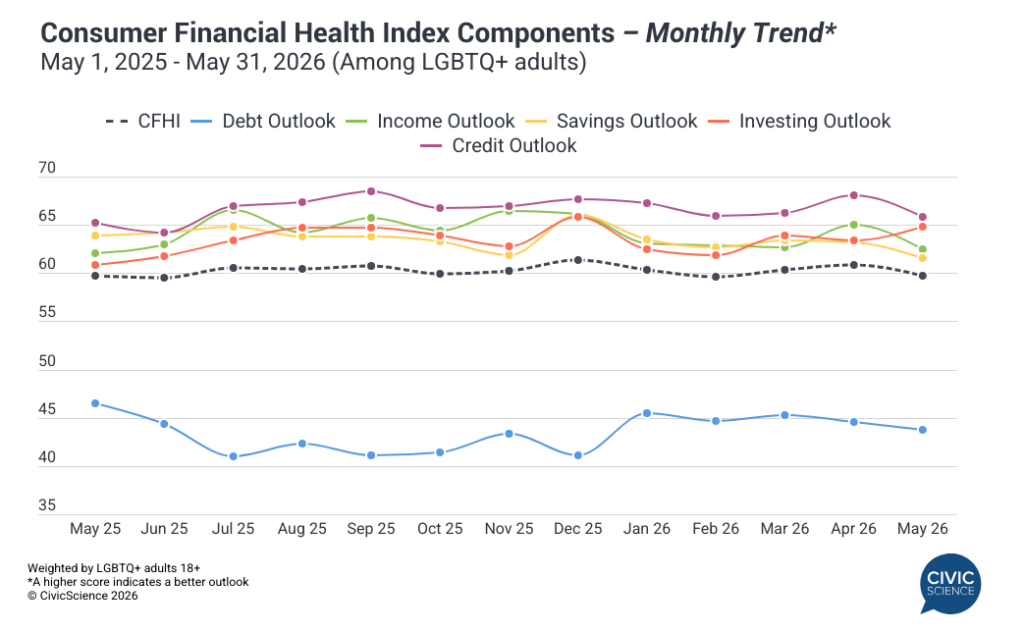
However, self-perceived financial health is not a one-size-fits-all. And with Pride Month well underway, it’s important to note how the LGBTQ+ community rates its financial health in comparison to the Gen Pop. The data show that the LGBTQ+ community’s CFHI is 1.3 points below that of Gen Pop. The discrepancy is driven by debt outlook, which is 11.18 points below average, and credit outlook, which is 1.33 points below average.
However, the LGBTQ+ community does outpace Gen Pop in all other components, led by investing outlook (4.83 points), followed by income outlook (0.99 points), and savings outlook (0.21 points). So while overall CFHI may be lower, these Americans are more optimistic than average in in key categories. But is this optimism enough to offset the significant pessimism when it comes to debt?
After April’s increase, May continued the CFHI’s positive (if only slight) momentum with a small but notable push upwards. But whether these gains will withstand the financial pressures of summer vacations and the ever-evolving global news cycle is yet to be seen. Pessimism about debt also continues to linger, which could prove a formidable roadblock amid persistent inflation. In the face of uncertainty, CivicScience clients leverage this level of insight to stay ahead of shifts in spending and remain one step ahead of the ever-evolving economic climate.