As Women’s History Month is here and International Women’s Day approaches, CivicScience data offers a clear-eyed look at what American women are carrying right now — and how they’re taking care of themselves.
Sixty-two percent of American women 18+ tell CivicScience they’ve felt stressed in the past week. That’s eleven points higher than men, and a gap that has held steady, quarter after quarter, for years.
So, are women okay?
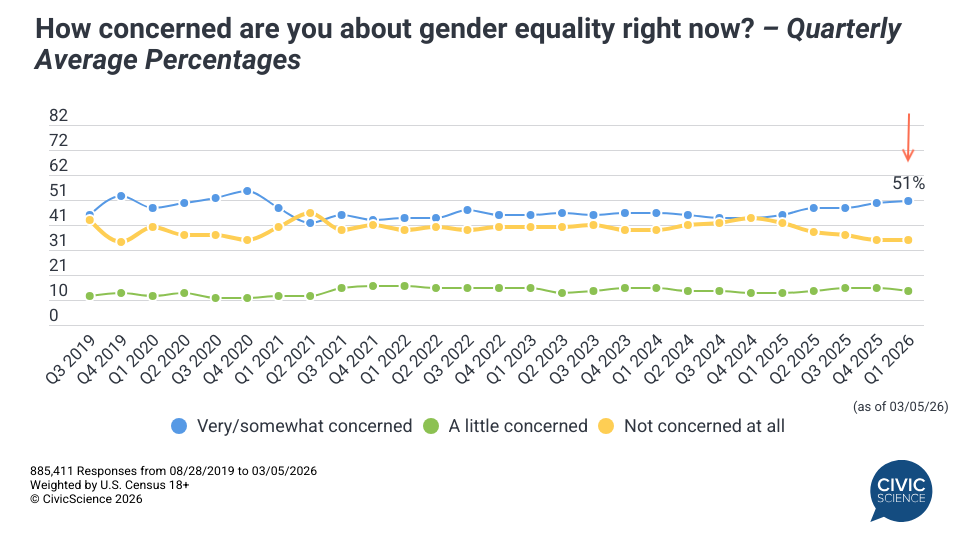
The cultural backdrop has been heavy. High-profile revelations about powerful men and institutional failures have reinforced what many women have long felt. The conversation around gender equality concerns — which dipped to its lowest point in years in late 2023 — is on the rise again. Women are navigating economic uncertainty and absorbing a daily news cycle that ranges from exhausting to alarming.
The answer the self-reported data gives us is nuanced: women are managing, but they are carrying a measurably heavier load than men, and they know it. Here’s what that looks like, and how they’re managing it today.
Act 1: The Weight Women Are Carrying
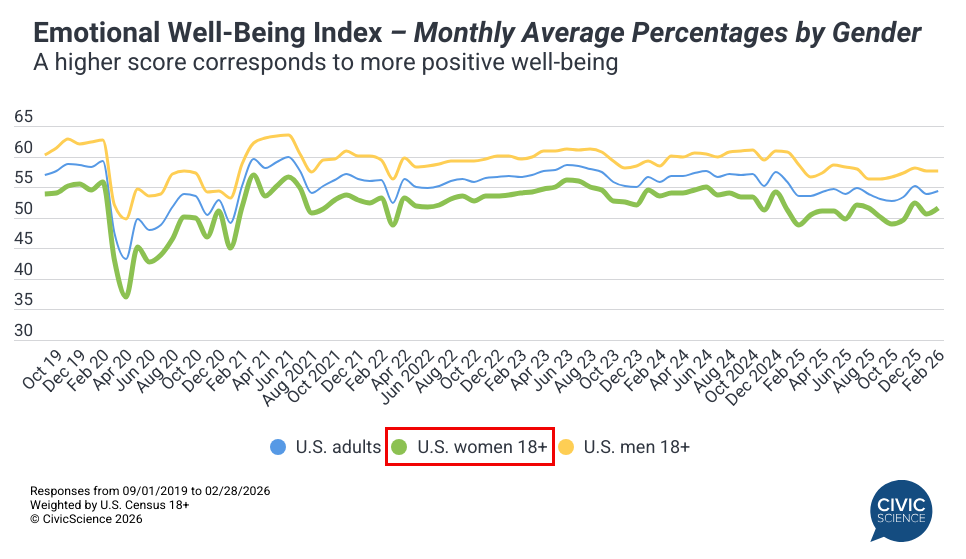
CivicScience has tracked American well-being since 2019. A lot has changed, but one thing hasn’t: women’s scores on the Well-Being Index have never caught up to men’s. Not during the pandemic or its recovery. Not now, when the gap sits at nearly six points.
The stress data shows an even wider gap.
Sixty-two percent of women report feeling stressed in the past week. That compares with 51% of men — an 11-point gap that has held steady quarter to quarter. And that number climbs to 68% among women with children, who balance systemic stressors alongside the relentless logistics of parenthood.
What’s driving it? When asked to name their major sources of stress, the picture that emerges is one of pressure from all directions at once:
- Money and finances top the list at 47% — five points higher than men
- Current events and the news follow at 38%
- Health or safety concerns are stressors for 34% of women
- Family and relationships add pressure for 29%
- Work and daily life each weigh on about 26% of women
That second item — current events as a stress driver — is worth pausing on. At 38%, it ranks higher than work or daily chores for women. The news cycle isn’t something women are passively observing. It is actively adding to their cognitive and emotional load.
Overall, women are experiencing a complex environment heading into International Women’s Day: more financially vulnerable than men (nearly 1 in 5 women has no emergency savings at all), more worried about job security, and more likely to be carrying concerns about gender equality (which has climbed back to 55% after dipping in 2023 and 2024).
All of that is the weight. But it’s only half the story.
Act 2: What Women Are Doing About It
Here’s what the data also shows: women are actively finding ways to help them feel better.
More than three-quarters of American women say they practice self-care — 36% do so very often, and another 41% say they practice it but want to do more. Only a small fraction say they have no time or interest. For women, self-care is less of a luxury and more of a baseline coping strategy.
Seventy-seven percent of women say they practice it or wish they did so more often. And what they’re actually doing might surprise you. No elaborate rituals. No expensive routines. The methods women reach for most are grounded, accessible, deeply human:
- Sleep leads the list at 61%. For a group that reports higher stress levels than their male counterparts, rest itself is a form of resistance.
- Spending time with friends and family accounts for 54%. Women are turning toward connection, not away from it.
- Eating something enjoyable is cited by 53% — a simple, low-barrier act of pleasure.
- Being in nature resonates with 42% of women.
- 36% of women use mindfulness, meditation, or relaxation practices.
- Salon, spa, or aromatherapy rounds out the list at 24%.
There’s something worth noting in the shape of that list. The top methods — sleep, connection, food, and nature — are the most fundamental human restorative practices. These practices top the list for men, too, but women use all of them at a higher rate for coping with stress.
The desire to do more self-care is also striking. Across every age group, the second-most-common answer is ‘yes, but I want to do more.’ That aspiration-reality gap is largest among women in their 30s and 40s — arguably the cohort most likely to be carrying the heaviest load of work, parenting, caregiving, and financial pressure. They know what they need; the challenge is carving out the time and space actually to do it.
The Short Answer: Are women okay? Not exactly.
There’s no denying the data: for women, the well-being gap isn’t closing, stress keeps climbing, financial pressure is hitting harder, and overall concerns about gender equality are growing.
But the data also shows something else: women are unflinching about what they’re carrying and intentional about how they restore themselves. They are prioritizing sleep, connection, eating well, going outside, and making time for the things that sustain them — even when everything else is pressing in.
That’s not a small thing. This International Women’s Day, it might be the most honest thing the data allows us to say: women are under pressure, they see it clearly, and they are doing something about it. The question worth sitting with is: what can the rest of us do to make that job a little easier?