CivicScience has the world’s largest proprietary database of real-time declared intent, allowing brands to activate high-performing advertising that drives up to 80% better performance. See how our partners achieve superior marketing outcomes here.
Monitoring the pulse of the American consumer has never been more critical as financial confidence continues to fluctuate. While a variety of factors impact how Americans assess their personal financial health amid an ever-changing economic landscape, the CivicScience Consumer Financial Health Index cuts through the noise to deliver data that helps decision-makers anticipate how consumers will continue to spend.
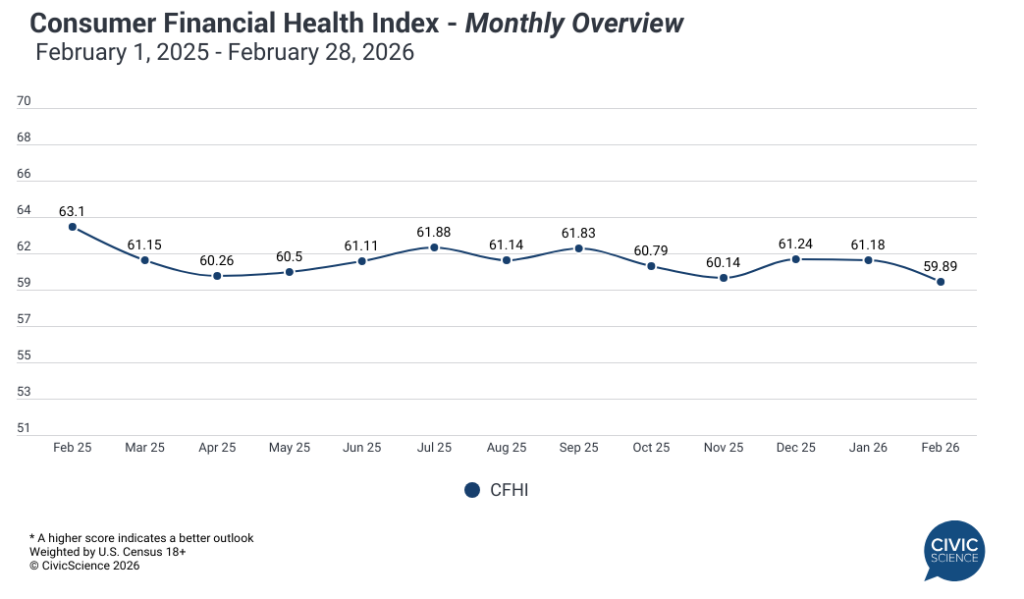
What started as a slight dip in January has become a much more pronounced drop in February, in which the index fell 1.29 points to 59.89. While a February dip occurred in 2025 as well, the current figure highlights a deeper erosion of perceived financial health, remaining 3.28 points lower than at this point last year.
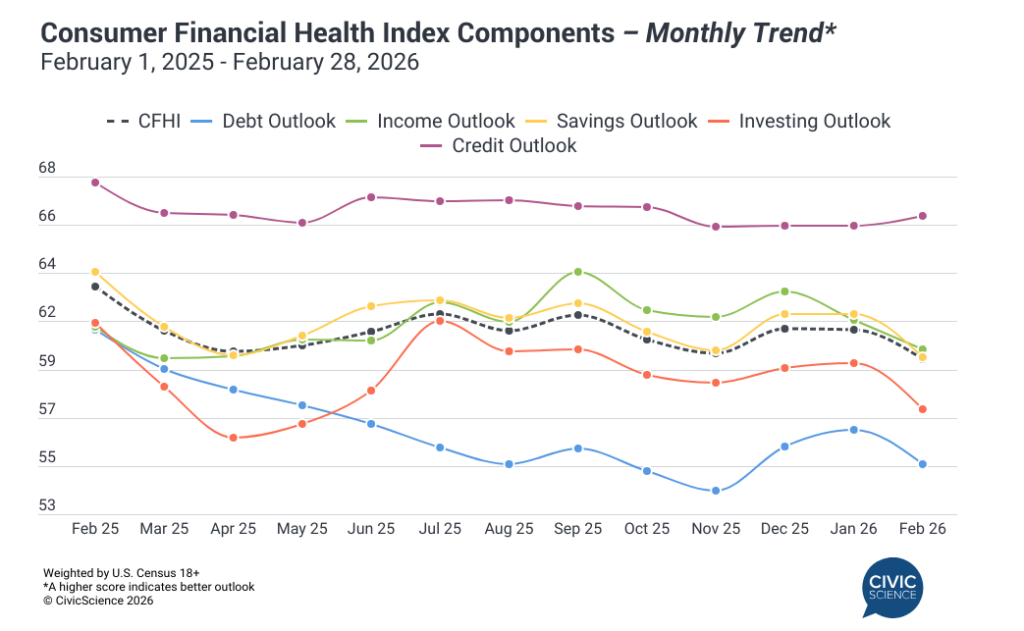
A closer look at the CFHI’s individual components reveals a near uniform decline in February, led by investing outlook (2.03 points) and savings outlook (1.93 points). After two months of increases, consumer debt outlook fell 1.55 points, surrendering nearly all of its recent gains, while income outlook rounds out the component decreases (1.29 points). Conversely, there was a marginal increase in credit outlook in February, but it wasn’t enough to offset the compounding negative direction of the other components.
As the CFHI continues to decline in the second month of 2026, Americans’ mindset signals growing economic uncertainty that will likely shape spending decisions in the months ahead. CivicScience clients across industries rely on insights like these to anticipate shifts in spending and uncover the nuanced factors driving purchasing priorities.