CivicScience has the world’s largest proprietary database of real-time declared intent, allowing brands to activate high-performing advertising that drives up to 80% better ad performance. See how our partners achieve superior marketing outcomes here.
Consumer spending patterns are particularly prone to change, making Americans’ perceptions of their personal financial health an important indicator for decision-makers seeking to anticipate shifting priorities. The CivicScience Consumer Financial Health Index (CFHI) offers an always-on view of these perceptions through real-time, consumer-declared data, helping businesses understand how financial sentiment evolves and what those changes could mean for how consumers spend.
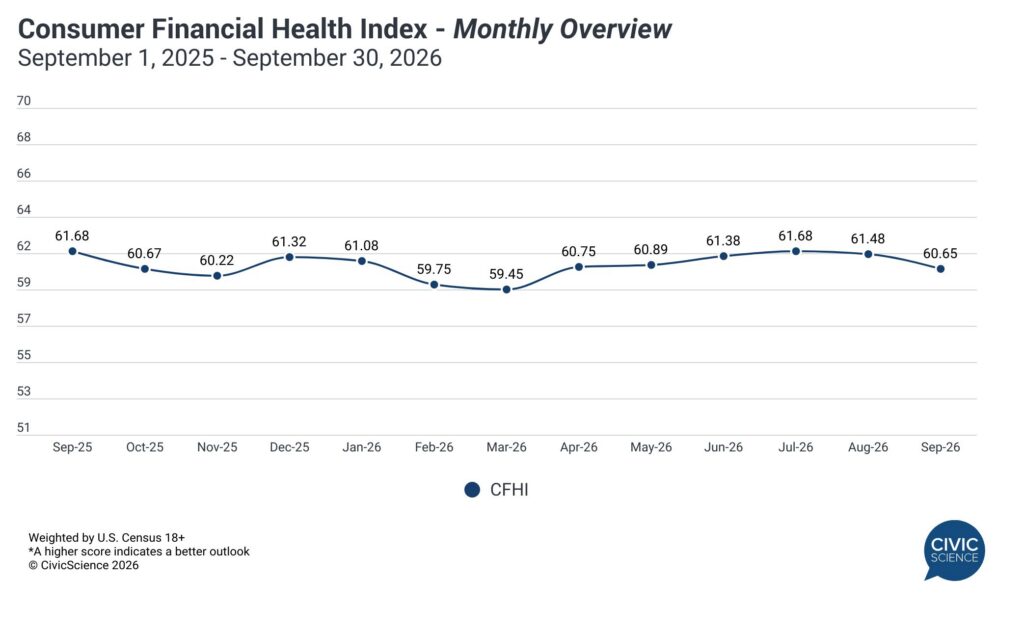
The latest CFHI reading, through the end of September 2026, marks a second consecutive monthly decline. The Index fell 0.83 points to 60.65, landing 1.03 points below its September 2025 reading.
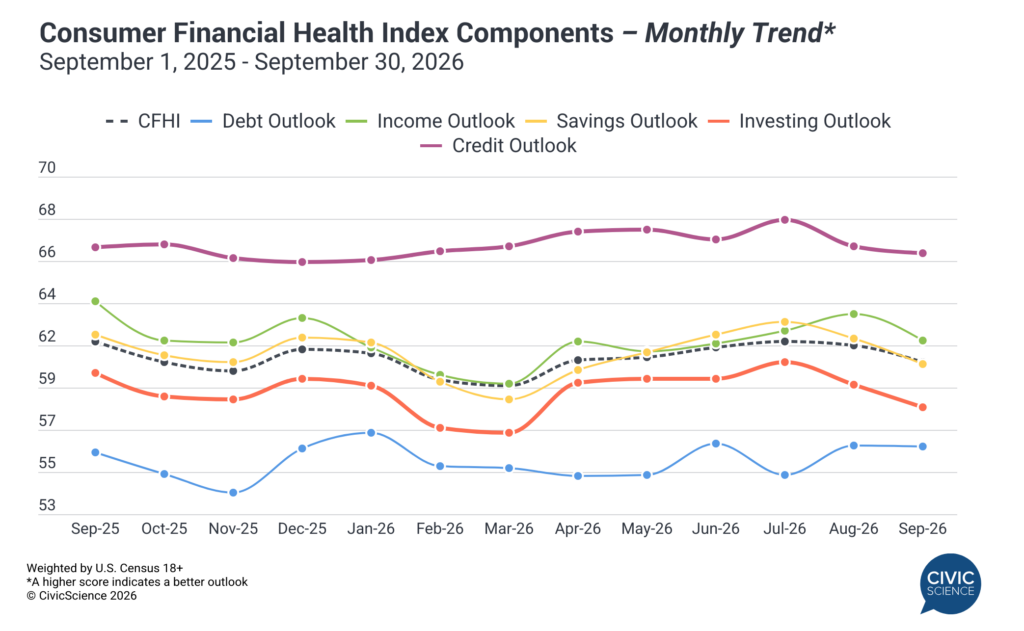
A closer look at CFHI’s individual components shows that all five declined month over month. Income outlook (-1.33 points), savings outlook (-1.32 points), and investing outlook (-1.12 points) led the overall drop. Credit and debt outlooks also fell, but by much smaller amounts (-0.34 and -0.03 points, respectively). Even with September’s small dip, debt outlook finished 0.32 points above its September 2025 level, a modest positive as the holiday shopping season approaches.
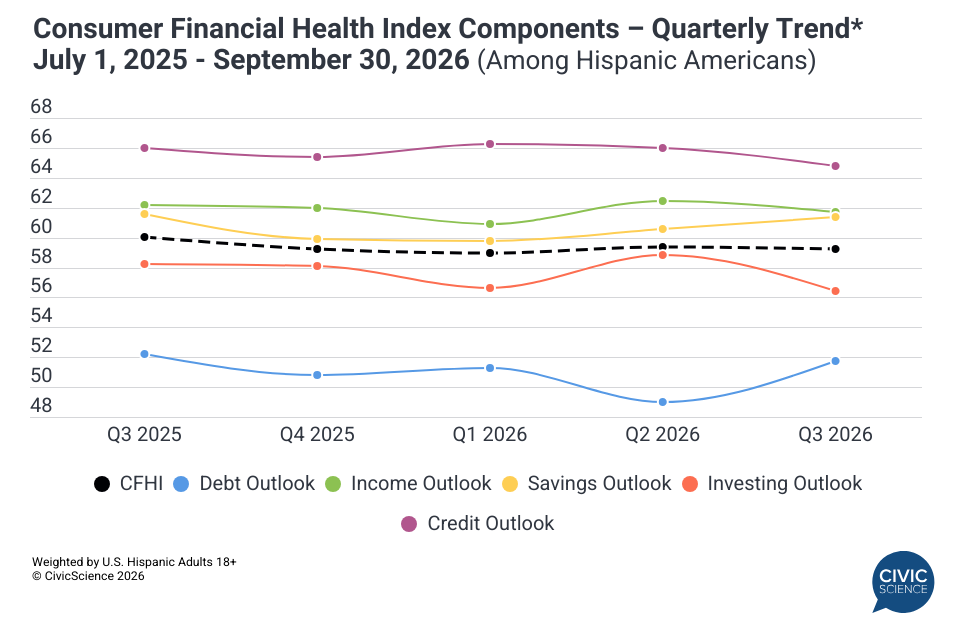
Of course, financial outlook varies across groups of consumers. As Hispanic Heritage Month comes to a close, quarterly CFHI data show that Hispanic Americans’ overall financial outlook trails Gen Pop’s, with notable differences beneath the surface. For Q3 2026, the CFHI score for Hispanic Americans stood at 59.22, 2.11 points below Gen Pop’s quarterly score of 61.33.
Hispanic Americans trailed Gen Pop across all five components, though the size of the gaps varied widely. The largest were in debt outlook (51.74, -4.22 points), investing outlook (56.44, -3.37 points), and credit outlook (64.82, -2.05 points). Income outlook (61.70, -0.64 points) and savings outlook (61.41, -0.26 points) came in closer to Gen Pop.
Despite trailing Gen Pop by the widest margin, debt outlook rose 2.74 points from Q2 2026, the largest quarterly gain of any component among Hispanic Americans since Q3 2025. Savings outlook also improved, rising 0.81 points for its second consecutive quarterly gain. Investing outlook moved in the opposite direction, falling 2.41 points to its lowest level in five quarters, while credit outlook fell 1.2 points and income outlook slipped 0.77 points. Those shifts largely offset one another, leaving the overall quarterly CFHI for Hispanic Americans nearly unchanged from Q2 (-0.17 points), illustrating how a steady headline score can obscure meaningful change.
Two consecutive monthly declines do not necessarily signal a sustained downward trend. The CFHI continues to evolve as Americans reassess their financial situations in response to changing economic conditions and other external factors. And as the Hispanic American data show, financial outlook can vary considerably from one consumer group to the next.
For businesses navigating an uncertain financial landscape, tracking these changes over time and across audiences can help decision-makers recognize emerging concerns early and respond as priorities change. With CivicScience’s real-time, consumer-declared data, brands can stay ahead of shifts in financial outlook and reach high-intent audiences at the right moment.