CivicScience has the world’s largest proprietary database of real-time declared intent, allowing brands to activate high-performing advertising that drives up to 80% better performance. See how our partners achieve superior marketing outcomes here.
One month into Q2 2026, American economic sentiment remains under significant pressure, with the CivicScience Economic Sentiment Index (ESI) showing only a slight uptick after hitting a 13-year low in early April. Ongoing geopolitical tensions and persistent inflation continue to fuel consumer anxiety and growing concerns about a potential recession.
Near-Term Recession Concerns Rise, With Notable Increase Among Republicans
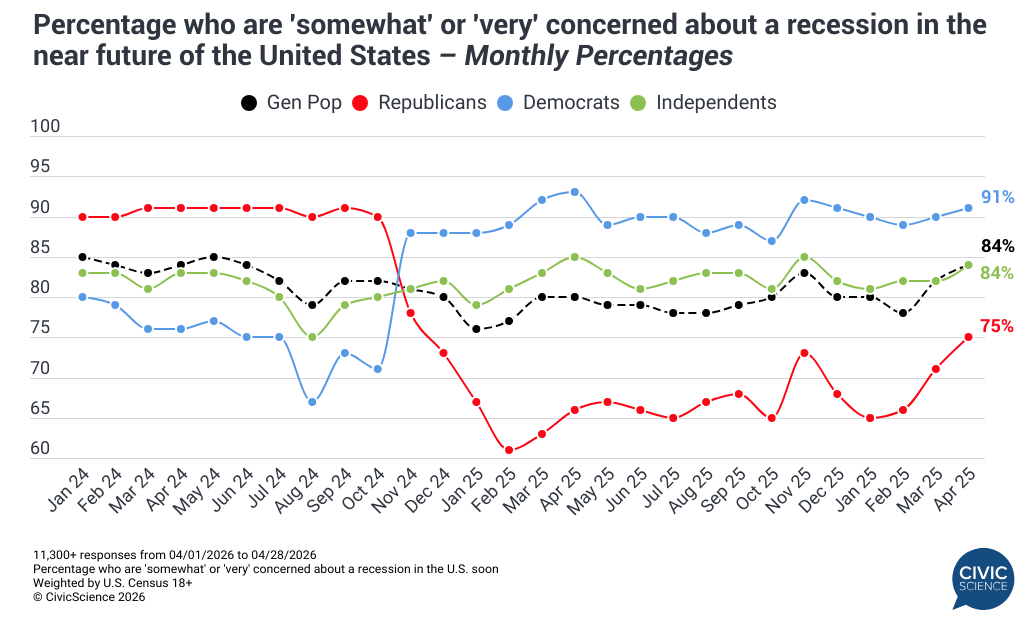
New consumer-declared data from CivicScience reveals that the strong majority (84%) of U.S. adults are at least ‘somewhat’ concerned about a recession coming in the near future, the highest monthly average since June 2024 (excluding ‘I don’t know’). The majority is nearly uniform across all adult generations, though the percentage who are ‘very’ concerned climbs with age – 39% of Gen Z aged 18-29 are ‘very’ concerned, compared to 46% of those aged 65+.
This sentiment is particularly prone to political polarization. For instance, Republicans were much more concerned than Democrats about the possibility of a recession in 2024, with little improvement until the 2024 presidential election. Then, following the election, Democrats’ concerns surged, while Republicans’ fears fell sharply. The trend looks different this year as concern among Republicans is spiking to its highest level since November 2024, when it was 78%.
Why It Matters Now: With the 2026 midterm elections just over six months away and primaries already in motion, this bipartisan concern is a critical indicator. Neither side of the aisle feels good vibes about the economy, creating a volatile environment for incumbents as voters prepare to head to the polls.
Growing Recession Fears Could Hit Future Well-Being Hard
Given the intensity of recession concerns across the board amid an already turbulent economy, cutting back is expected, but additional data suggest these cost-saving measures may come at the expense of well-being.
CivicScience has asked Americans 18+ about their desire to leave the house for years, and the share who say they prefer staying home has ticked up slightly each year since 2023. Today, 32% say their desire to go out has decreased, up from 31% last year and far higher than the 21% seen in 2023. Meanwhile, 23% say their desire to leave home has increased — a figure that has remained steady in recent years — while 45% say it has stayed the same. These feelings are amplified by recession concerns, as those most concerned are significantly more likely than those unconcerned to say their desire to leave home has decreased over the past month (36% vs. 22%).
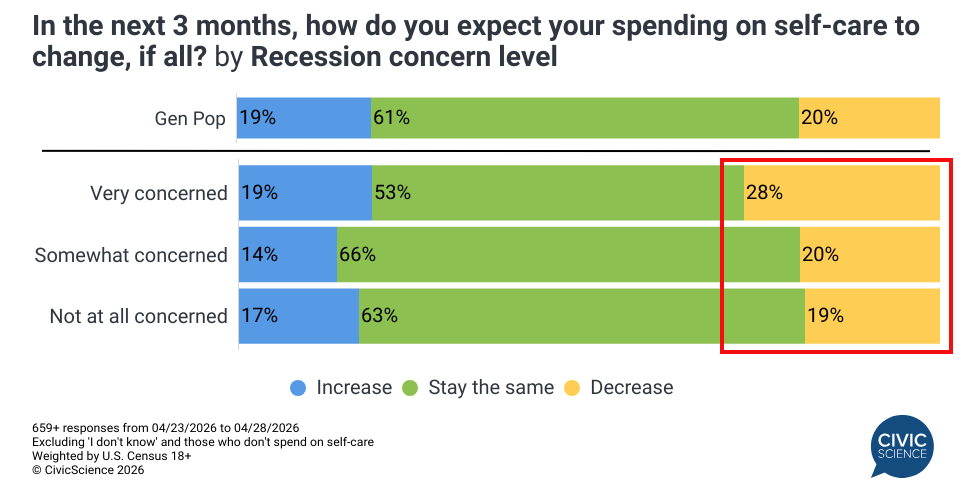
But severe recession concerns also correlate with a reduction in near-term self-care spending. While those strongly concerned are just as likely as Gen Pop to plan on increasing what they spend on self-care (e.g., wellness, “treat yourself” purchases, etc.) overall, 28% of consumers who are ‘very’ concerned about a recession will cut back on self-care spending — notably higher than the Gen Pop and those not concerned at all about a near-term recession — hinting that this group may be more intentional about their spending.
Digital Shift: Recession Anxiety Drives Online Shopping
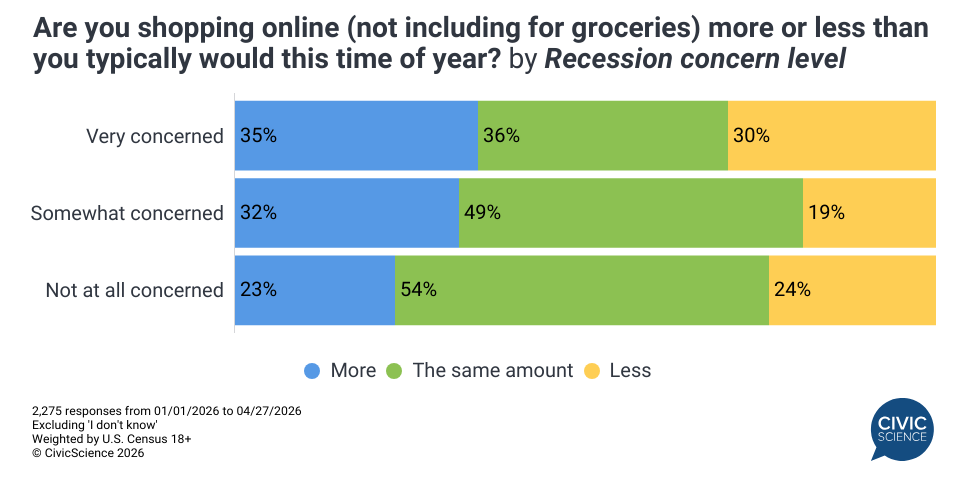
Recession fears are doing more than just shrinking planned spending; they are fundamentally changing how people shop. Additional CivicScience data reveals Americans who are ‘very’ concerned about a downturn are 52% more likely to increase their online shopping frequency than those who are unconcerned about a recession. This suggests that for the anxious consumer, the digital marketplace isn’t just about convenience; it’s likely being used as a tool for more aggressive price comparison and deal-hunting in a tightening economy.
Whether these patterns prove temporary or mark a more lasting shift remains to be seen, but the level of concern spanning demographics and political lines makes them worth watching closely in the months ahead.