CivicScience engages directly with consumers, collecting over one million survey responses daily, to turn real-time insights into high-performing advertising campaigns. See how leading brands use CivicScience to drive campaign performance here.
As March marks National Sleep Awareness Month, new self-reported data offers a clear picture of the “sleep debt” currently shaping consumer priorities. While 46% of adults manage an average of six to eight hours of sleep per night, a noteworthy 39% report falling short of that threshold, including 8% who average less than four hours per night. This stands in stark contrast to the 15% of Americans who get more than eight hours, setting the stage for a market increasingly focused on restorative solutions.
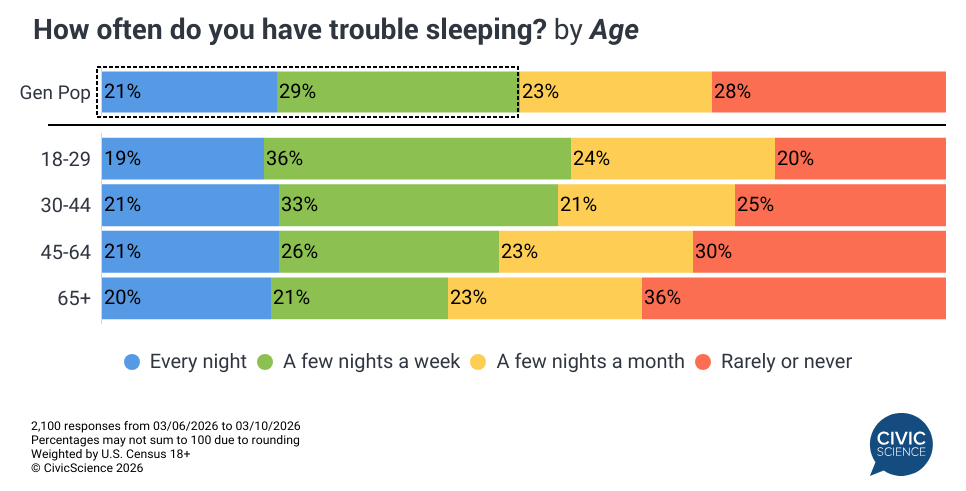
Individual sleep tolerance varies, but for many Americans, the struggle for rest is a constant: over one in five (21%) adults report difficulty sleeping every night, while an additional 29% say they struggle at least a few nights a week. This friction is part of a broader trend, as 72% of the population experiences some degree of trouble sleeping. While the frequency of these struggles generally softens with age, the burden remains high for younger cohorts, as Gen Z currently reports the highest overall incidence of sleep disturbances. Additionally, a notable gender gap persists, with 75% of women experiencing sleep issues compared to 68% of men, which is likely a key component impacting mental health.
Aside from the physical and mental impacts that often accompany sleep issues, additional survey data from CivicScience finds that it plays a role in consumer spending – Americans who struggle to sleep ‘every night’ are nearly twice as likely as those who never struggle to report their recent spending is ‘higher’ than usual (36% to 20%, respectively).
New Mattresses Are in Store for Many Americans
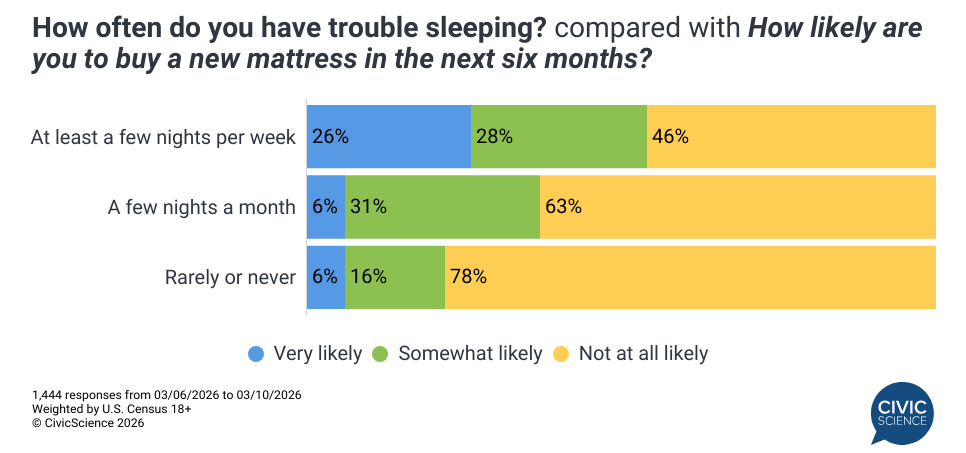
Some of that elevated spending noted above may be earmarked for near-term mattress purchases, as Americans aren’t lying down on their sleep troubles. New consumer-declared data from CivicScience show 41% of U.S. adults are at least ‘somewhat’ likely to buy a new mattress within the next six months, including 15% who are ‘very’ likely. This motivation intensifies as sleep issues become more frequent – over half of Americans who experience sleep troubles multiple times per week are considering a new mattress.
But sleep isn’t just about the nightly recharge among mattress buyers; it’s also the leading form of self-care, outpacing things like eating food they enjoy, being in nature, and spending time with friends and loved ones by at least five points each. These insights highlight a clear trend: for many, a mattress purchase is a strategic investment in better health.
Understanding the Near-Term Mattress Buyer
While general market trends provide a broad view, the true value of this consumer-declared data lies in its ability to dive deeper into the specific motivations of these high-intent shoppers. By looking beyond simple demographics to prospective buyers’ stated preferences, a more nuanced profile emerges.
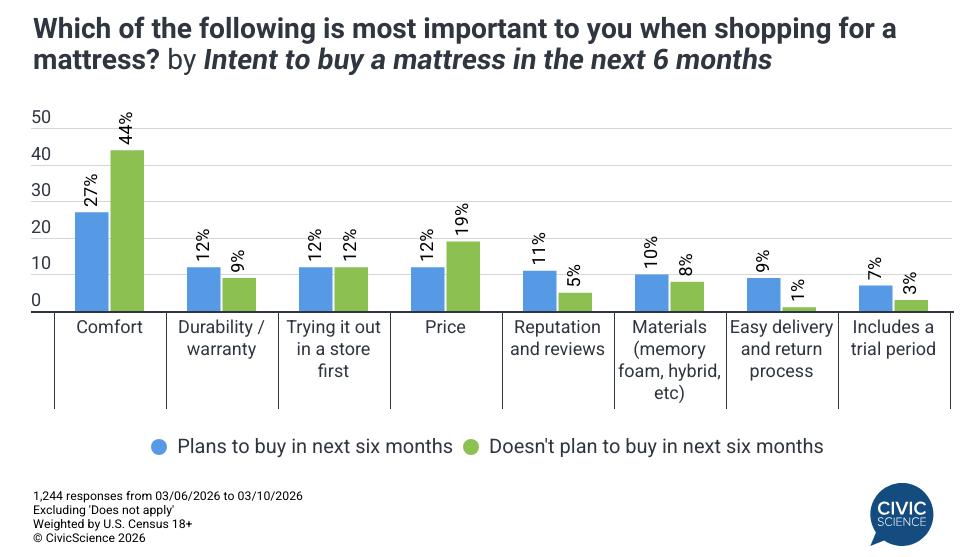
When near-term buyers are asked what they care most about when looking for their next mattress, comfort is unsurprisingly at the forefront. That said, it’s much less of a factor than for those not planning to buy soon. Instead, those planning to buy a mattress in the next six months are more spread out in their mattress must-haves, particularly in terms of delivery, trial periods, and reputation.
While shopping in general is becoming increasingly digital, near-term mattress buyers lean on in-store shopping. Three in ten will turn to a national mattress store chain, and 22% will shop from either a department store or a big-box store. Regional mattress stores (19%) follow and outpace online shopping (16%) and ‘other’ (14%).
This preference for physical storefronts does not mean the journey is entirely offline; rather, it is likely to be fueled by a highly digital research phase. These upcoming mattress buyers are a set of consumers who are highly engaged with visual and short-form media as they over-index the average American as active users of TikTok and, in particular, Instagram. They are also more likely than Gen Pop to frequently visit YouTube.
These habits represent a vital signal for brands and advertisers, especially as additional data finds that nearly half of near-term buyers (48%) say they ‘always’ or ‘often’ use video (social, streaming, and TV) to learn about products and make purchase decisions. In contrast, just 14% of non-buyers report the same level of video reliance, highlighting a clear opportunity to reach high-intent shoppers through visually-driven storytelling before they ever step foot in a store.
Leveraging CivicScience consumer-reported data allows for a deeper dive into insights like these to build custom audiences, giving brands and advertisers the power to pinpoint high-value consumers and reach them at the right time.
National Sleep Awareness Month serves as a reminder that quality sleep is a challenge facing much of the population. While the causes of this struggle are complex and vary, one immediate avenue Americans are considering to remedy the situation is upgrading their mattress. In doing so, restless consumers are aligning their spending with a clear goal: ensuring that the time they spend in bed is as restorative and comfortable as possible, with cost coming secondary.