The following is a special feature from CivicScience CEO and Founder John Dick. Learn how you can turn insights like these into actionable strategies here.
In the years leading up to the pandemic, overweightness in the United States had reached record heights, with the CDC reporting a population-wide obesity rate of 41.9% from 2017-2020. This represented a meteoric rise from the 30.5% rate recorded just twenty years earlier. With our widening waistlines came commensurate increases in chronic disease, pharmaceutical consumption, weight-exacerbated back, hip, and knee replacements (which had no small effect on our opioid epidemic), and the overall skyrocketing of U.S. healthcare costs.
When COVID raged, it was easy to expect this trend to continue, if not accelerate, as Americans stayed indoors, ordered more takeout, binge-watched Ted Lasso on their couch, and drowned their lockdown loneliness in midday wine. Instead, a funny thing happened. From 2021 to 2023, the CDC reported a drop in U.S. obesity rates, the first measurable decline in over a decade.
Answer our Poll: How concerned are you about obesity in America?
Perception and Reality
Over the past 15 years, CivicScience has tracked Americans’ views on their weight, fitness, health, and appearance, on several dimensions. Unlike the CDC and other medical organizations who measure absolute metrics – like the numbers reported after stepping on a scale – we typically ask people how they perceive themselves. Admittedly, this approach is open to scrutiny, as respondents are often unconsciously biased, skewed by their surroundings, and prone to judge themselves too harshly – or too easily. On the other hand, when studied at a large enough scale (with tens of millions of Americans who have responded to our surveys), these predilections offer an additional insight into “the why” behind our perceptions, choices, and behaviors.
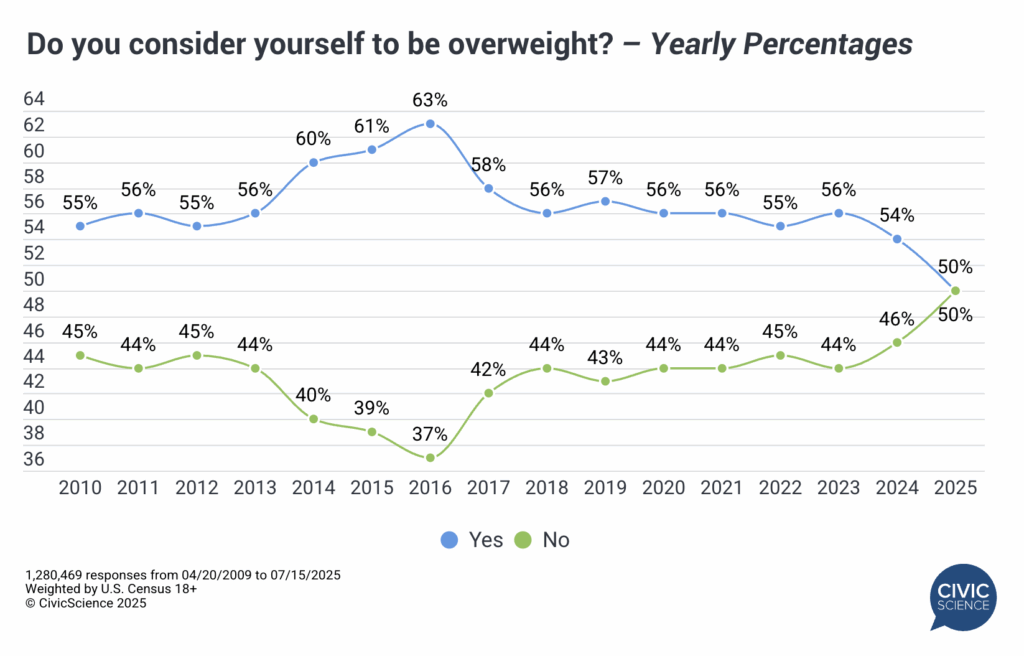
Since 2010, CivicScience has asked a representative sample of nearly 1.3 million U.S. adults (roughly 2,500 per week) the following question: “Do you consider yourself to be overweight?” At its peak in 2016, 63% of Americans answered ‘yes’ to that question. However, you can see in the chart below that things have changed quite significantly. As of July 2025, 50% of U.S. adults consider themselves to be overweight, the lowest yearly average to date.
Use our Data: CivicScience clients access real-time insights like these to stay in tune with consumer self-perceptions that shape key behavior trends, such as what clothing they buy, their engagement with health and wellness, and where they eat.
Not coincidentally, a different question we’ve asked since 2015 (n= 465,463) – gauging people’s perception of their relative physical attractiveness – has followed a similar pattern. Starting in 2017 and accelerating coming out of the pandemic, the percentage of Americans who believe they’re more attractive than their peer group has been on a steady rise, if slowing over the past two years.
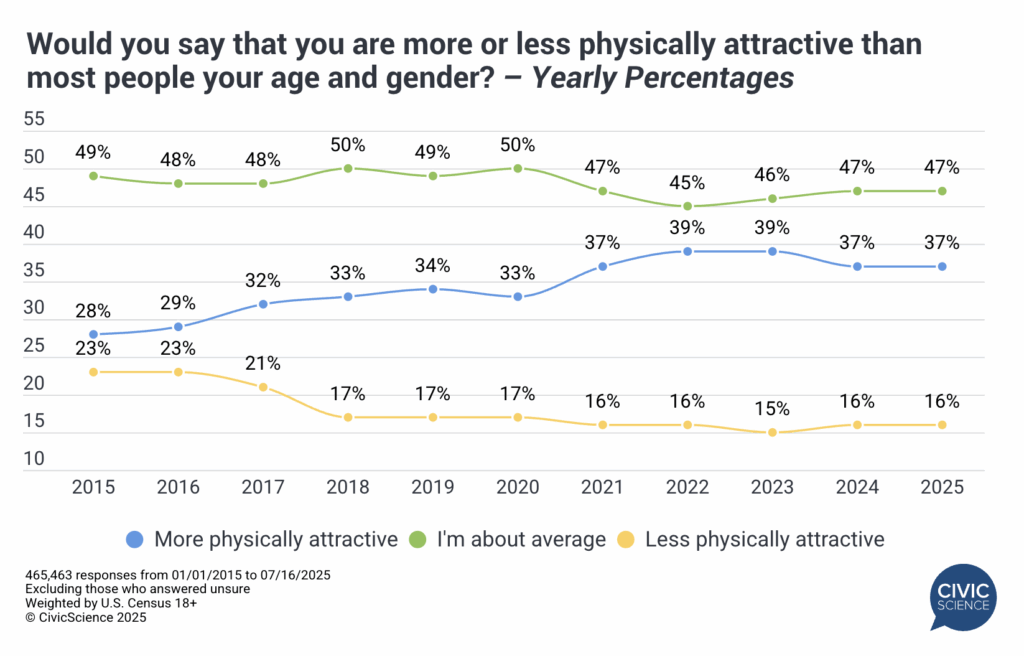
When self-reported claims of overweightness and unattractiveness first began declining in our data, I’ll admit, I was very skeptical. My theory – which I wrote and spoke about frequently back then – was that it was a byproduct of our increasingly divided and tribal culture. People weren’t being objective, I surmised, rather they were merely judging themselves relative to “the others,” upon whom they looked down their noses. In other words, what I imagined people saying was, “I might be able to stand to lose a few pounds and I’m not the most attractive person in the world, but I’m not as fat and ugly as those people.” A less cynical explanation could’ve been the emergence of the body positivity movement in the latter half of the last decade. Maybe people simply weren’t being as harsh on themselves.
In either case, I assumed the trend in our data was a self-reporting phenomenon, not a legitimate sign of the thinning or beautifying of America. The subsequent CDC findings, combined with the continued trend line in CivicScience data, now have me convinced it was real all along.
If Americans are indeed becoming less obese AND less likely to believe they are, the next burning question is “why?”
Maybe It’s Just Drugs
One obvious explanation could be the proliferation of Ozempic and other GLP-1 drugs. According to CivicScience tracking data (n= 2,044,098), roughly 1 in 10 U.S. adults are currently taking one of these medications, while another 8% have used them at some point and later quit. Even if those quitters regained whatever weight they lost, the combined numbers likely made a big dent in the population-wide obesity in America.
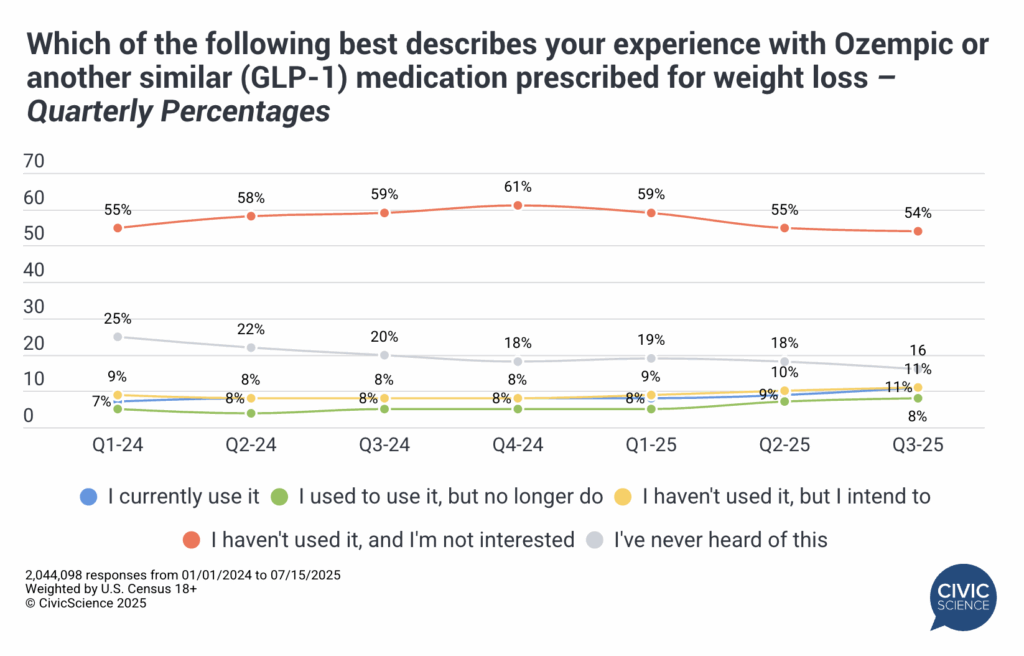
Still, the timeline would suggest something else is going on. GLP-1s weren’t even approved for weightloss until mid-2021. By the time we started tracking usage of the drugs in late 2023, one in four Americans still hadn’t even heard of them. Even if we account for the small percentage of adults who were taking GLP-1s for diabetes in 2017 (when they were first approved for that purpose), it can’t solely explain the shift we (and the CDC) began seeing at that time.
More Uplifting Reasons
A more hopeful explanation for America’s declining obesity might be the collective changes we’ve made to our lifestyles. Improved diet, exercise, sleep, and overall physical well-being could all have contributed. But has that, in fact, happened?
Again, we can turn to CivicScience tracking data for clues. Let’s look at a few lifestyle categories.
Diet
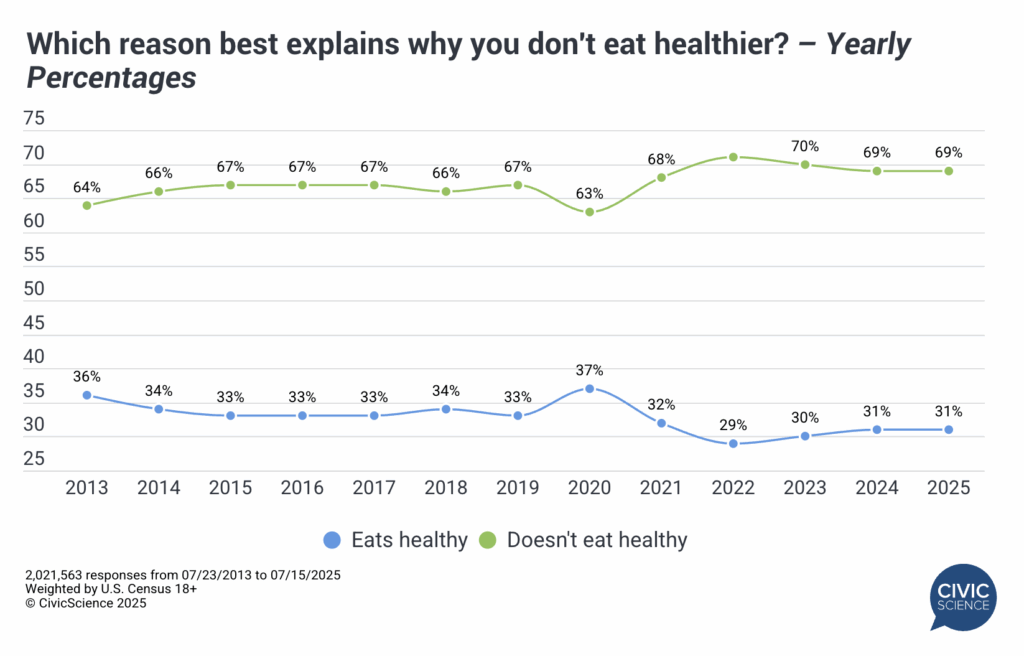
We’ve been asking Americans about the ifs, whys, and whynots of their healthy eating habits going back to 2013 (n= 2,021,563). In that first year, 36% of U.S. adults identified themselves as healthy eaters. That number decreased to 33% in 2019, before spiking to 37% in 2020, then fell in subsequent years, sitting at only 31% today. The financial costs of buying healthy food amidst all the inflationary headwinds are partly to blame. In any event, no, it doesn’t appear healthy eating is the hero in our story.
Sleep
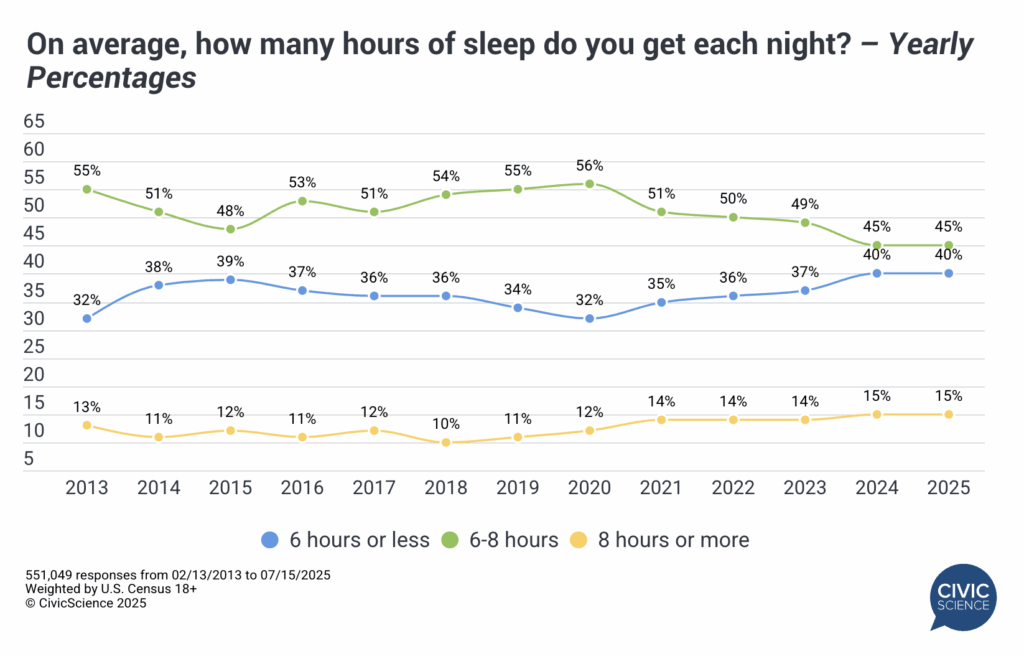
Ample research and medical recommendations will tell you that a lack of sleep (and resulting low energy) strongly correlates with body weight issues. It would make sense, then, if we saw a population-wide improvement in sleeping habits corresponding with our declines in obesity. Well, we don’t. The results have remained relatively consistent after tracking Americans’ reported hours of nightly sleep since 2013 (n= 551,049). While the number of U.S. adults who report sleeping less than 6 hours per night fell from 39% in 2015 to 32% in 2020, that group has jumped back to over 40% by 2024. The percentage who get the advised 8+ hours of nightly sleep has sat steadily between 11% and 15% of the total population. In other words, it’s hard to attribute our shrinking lbs to our increasing z’s.
What Do You Think? Do you typically get more sleep or less sleep on weekends?
Vitamins and Supplements
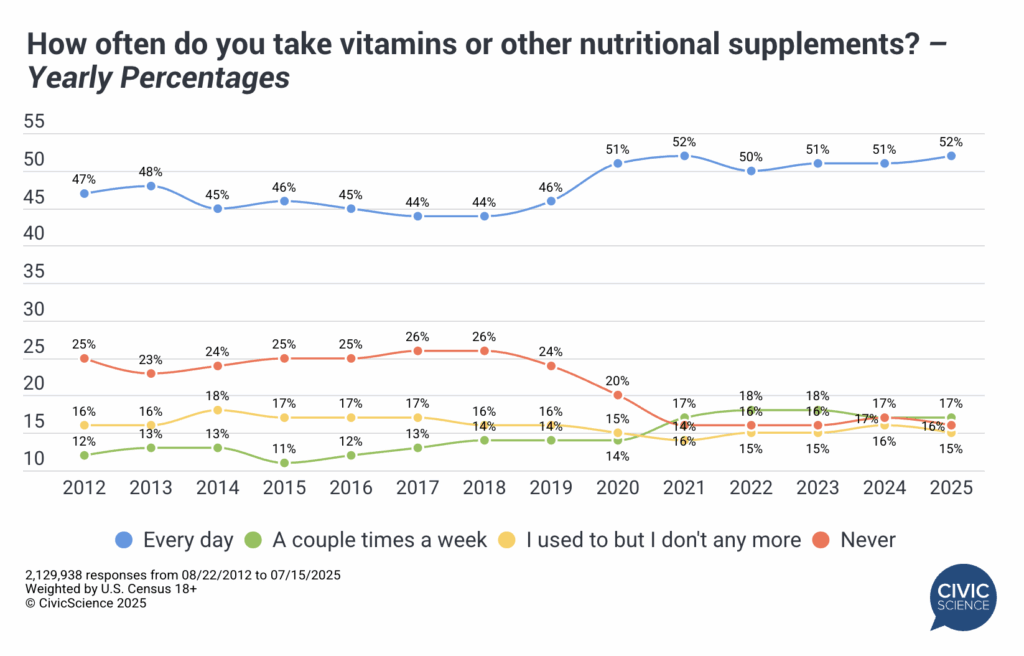
One viable way to lose weight (or at least slow weight gain) is to offset our unhealthy eating habits with the plethora of dietary supplements readily available to consumers today. CivicScience data reveals a similar trend. The percentage of U.S. adults who report taking daily vitamins or supplements has jumped from 44% in 2017 to 52% today. Another 17% take them at least a couple times a week, up from 13% in 2017. The empirical data confirms this as well: The vitamin and supplement market in the U.S. has more than doubled over the past 10 years.
Exercise
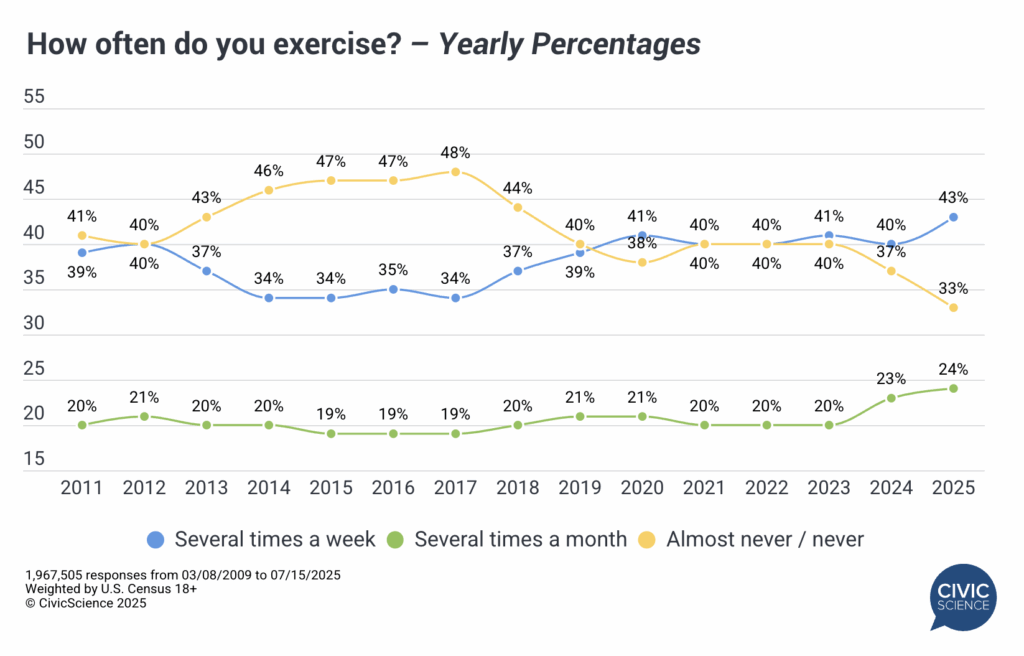
This is where the data gets a lot more interesting and nuanced. Cutting to the chase, the rate of exercise among Americans has been climbing significantly since 2017, right around the time we first saw the changes in our overweight and attractiveness questions. The rise in exercise frequency, in fact, has been even steeper. Thirty-four percent of U.S. adults reported exercising several times a week in 2017. That number now sits at 43%. Meanwhile, the number who say they almost never/never exercise has fallen from 48% of the population in 2017 to just 33% today.
How Are We Exercising?
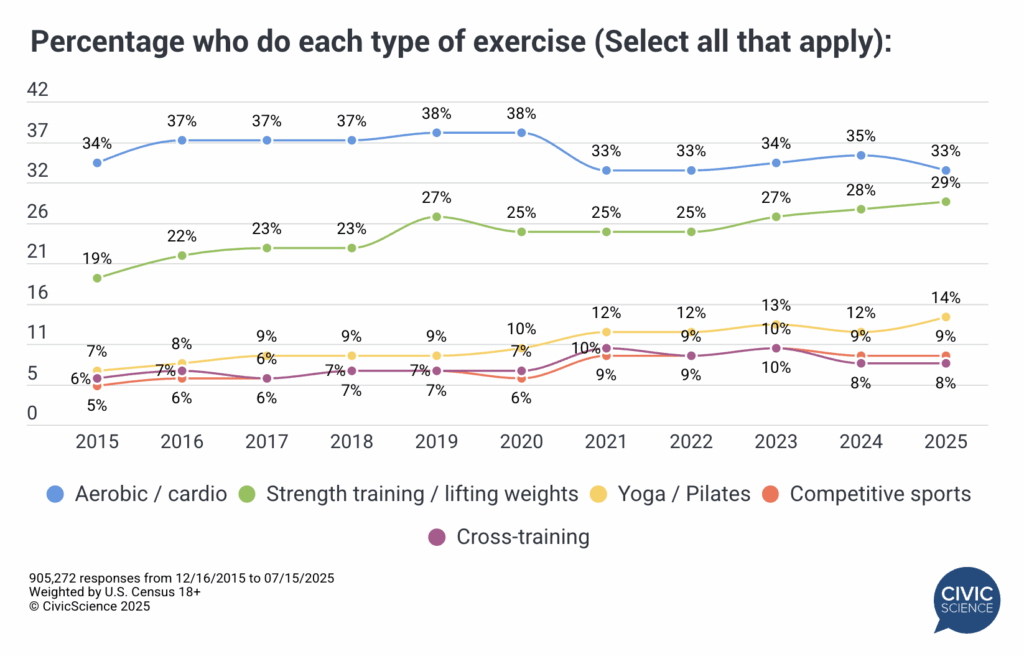
The obvious and albeit unsurprising correlation between increased rates of exercise and decreased rates of obesity is worth a bit more exploration. So we looked at ten-plus years of CivicScience data on the various kinds of exercise Americans do to see what else we could learn.
One thing that hasn’t changed since 2015 is that cardio and aerobic activities remain the most popular form of exercise in America. At the same time, however, the percentage of Americans who report regularly engaging in cardio or aerobic exercise has declined from a high point of 38% of U.S. adults in 2020 to a low point of 33% this year.
That conclusion may not surprise any of you who follow news on health and fitness. Over the past several years, a growing library of evidence has emerged that cardio exercise isn’t the most effective way to shed pounds (although it’s still great for heart health). Instead, it has become increasingly clear that strength and weight training are far more effective at driving rapid, significant, and sustainable weight loss.
It also won’t surprise you, then, that the form of exercise with the most notable growth over the last decade is strength and weight training. The number of Americans who report regularly doing this kind of exercise has increased by over 50% (from 19% to 29%) since 2015, inching closer to cardio and aerobic exercise in popularity.
Another category of exercise that has seen major leaps since 2015 includes studio activities like yoga and pilates. The percentage of Americans who report they regularly partake in one of these physical outlets has climbed from just 7% of the population in 2015 to 14% in 2025, representing the largest relative increase (+100%) over the trended period.
Other categories of exercise, like competitive sports (yes, even with pickleball) and cross-training, have stayed pretty much flat since 2015.
What We Learned (and Didn’t)
To answer the deliberately provocative and clickbait-y question posed in the headline of this article, no, America’s obesity epidemic is far from over. The rate of overweightness in the U.S. is still among the worst in the world and far above levels we saw even 20 years ago. But at least things are looking up and, pharmaceutical innovations aside, it is happening for what appear to be a lot of the right reasons.
So, if the data we covered here is any indication, we all need to hit the gym, pop a few dietary supplements, and maybe squeeze in some Pilates, while we’re at it. Although it wouldn’t hurt to eat better and get some more sleep, too.