CivicScience has the world’s largest proprietary database of real-time declared intent, allowing brands to activate high-performing advertising that drives up to 80% better performance. See how CivicScience partners achieve superior marketing outcomes here.
Secondhand shopping is nothing new. From thrift stores and vintage boutiques to online marketplaces, consumers have long turned to pre-owned goods for unique finds and everyday essentials. Depop, an online secondhand retailer specifically for clothing, has been connecting secondhand sellers with consumers for over a decade. It’s been gaining momentum in the U.S. and was recently acquired by eBay. Amid shifting consumer priorities and an evolving retail landscape, what makes the Depop consumer stand out?
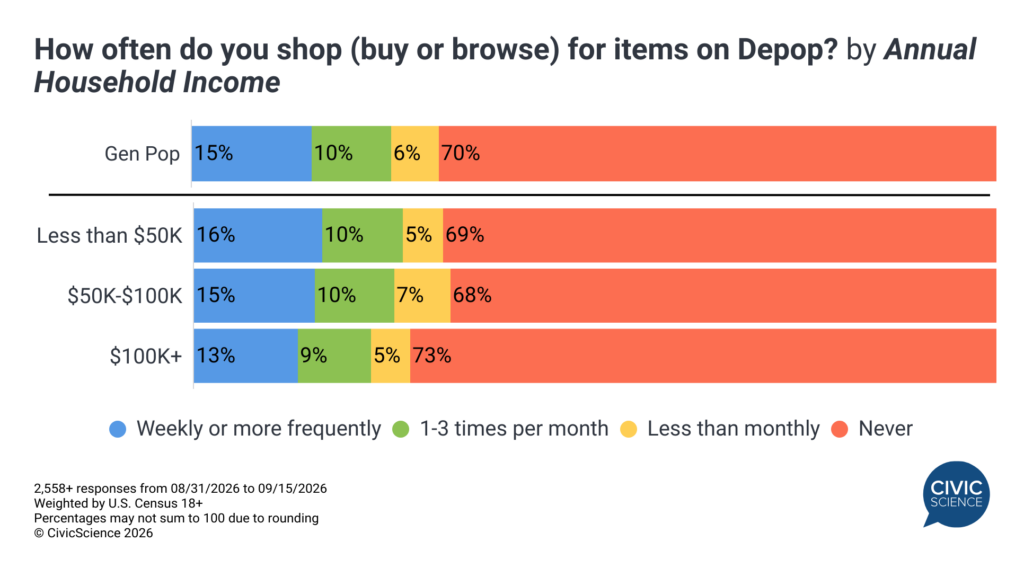
Recent consumer-declared data from CivicScience show that 3 in 10 U.S. adults Americans shop on Depop with some frequency – 15% visit the site weekly or more, and 10% do so 1-3 times per month. Given the secondhand market’s appeal to budget-conscious consumers, it may come as no surprise that those who earn $50K or less annually account for the largest share of weekly+ Depop usage. That said, 13% of those earning $100K or more also report using the platform at least weekly. Gen Z adults stand out as the platform’s most engaged age group, outpacing all other age groups in overall Depop usage by at least 20 percentage points.
It is also worth noting that men report using Depop at a slightly higher rate than women (27% vs. 24%), suggesting that the platform’s appeal extends across gender lines.
Debt Stress and Eco-Friendly Habits Over-Index Among Depop Shoppers
What motivates Depop shoppers? CivicScience data show a pessimistic debt outlook is one key stressor for them, as 67% of weekly+ Depop users expect the amount of debt they have to be higher in the next six months, more than twice as likely as Gen Pop (26%). With this in mind, these consumers may be looking to soften the blow of rising debt by turning to more affordable clothing purchases. However, this isn’t the only driver for these consumers. Weekly+ Depop shoppers also over-index in their care for the environment. Forty-one percent say that they change their behavior to help the environment ‘every chance they get,’ compared to just 30% of the Gen Pop, underscoring a value that could be behind their interest in secondhand shopping.
Pants and Outerwear Take Top Priority for Depop Shoppers
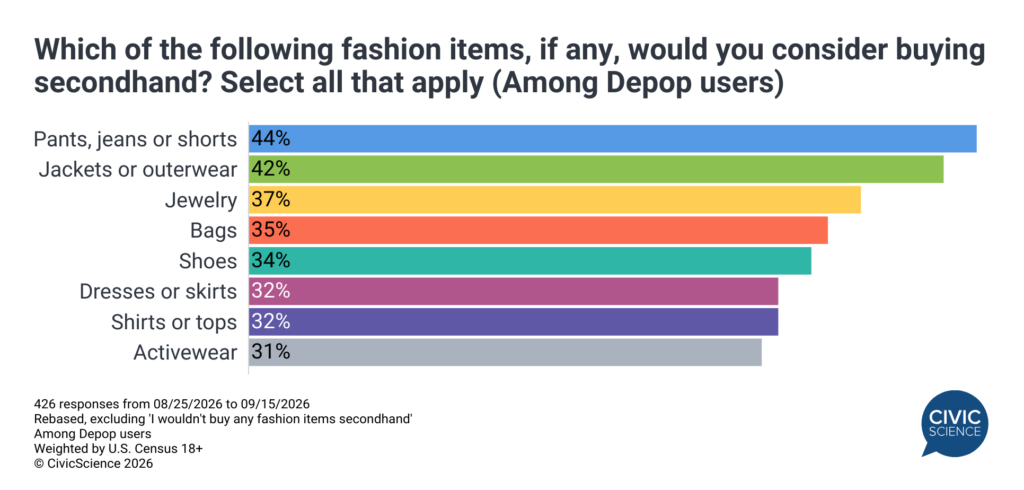
Taking a granular look at wardrobe preferences, openness to pre-owned fashion varies notably across categories among Depop shoppers. CivicScience data highlight bottoms (44%) and outerwear (42%) as the top items on shoppers’ radar, with jewelry and bags following close behind. Meanwhile, categories like shoes, tops, and activewear round out the bottom, though around a third of shoppers still express interest in each. The findings suggest that while practical wardrobe staples appeal to secondhand shoppers broadly, Depop users may also be drawn to the platform’s more distinctive, style-driven offerings.
Secondhand Shopping Finds a Place on the Holiday List
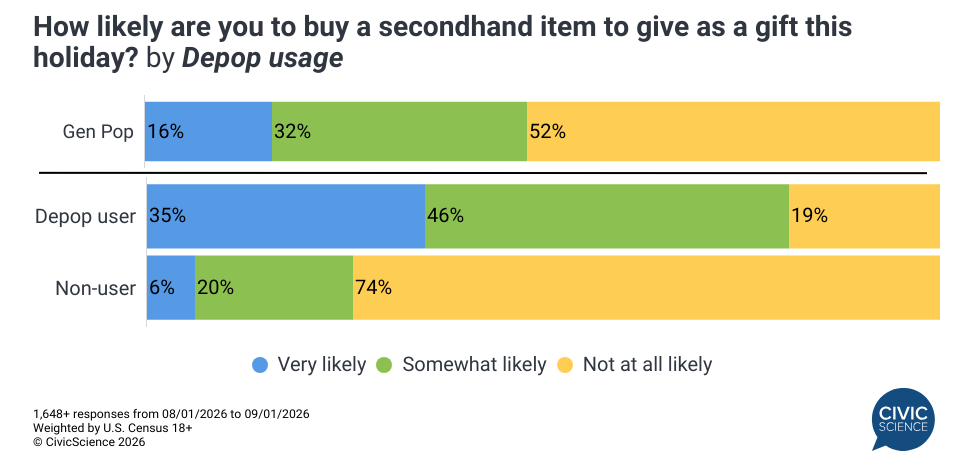
But buying secondhand is also a trend to watch in holiday shopping this year – nearly half of U.S. adults (48%) say they’re either ‘somewhat’ (32%) or ‘very’ (16%) likely to buy a secondhand item for a gift this holiday season. This marks an increase from 44% in the summer of 2025. Secondhand holiday shopping intent jumps significantly among Depop users as 35% are ‘very’ likely to go pre-owned and 46% are ‘somewhat’ likely to do so.
Notably, 59% of Depop shoppers plan to spend ‘more’ on holiday gifts this year than they did last year, compared to 35% of Gen Pop. As the holiday shopping season approaches, secondhand marketplaces may offer consumers an alternative to traditional retail, whether they’re searching for unique gifts, looking to save money, or both.
Although Americans are navigating inflation, economic uncertainty, and shifting priorities, they continue to shop. However, the way they’re shopping is changing. For frequent Depop shoppers, secondhand retail offers more than practicality; it brings together affordability, personal style, and alignment with personal environmental values. These shoppers may also be reshaping holiday spending, as secondhand marketplaces compete for gifting dollars in an increasingly competitive retail landscape.
For retailers, brands, and advertisers looking to understand and connect with today’s consumers, the secondhand market offers an important opportunity to look beyond traditional shopping behaviors and identify where evolving consumer priorities are creating new engagement opportunities.