We’re living in the golden age of television.
A lot of people, particularly older ones (or anyone in the broadcast, news, or cable industries), will be incredulous over that statement. The business model of TV has certainly seen better days. And it’s easy to be nostalgic for times when everyone was huddled around the same Thursday sitcoms, late-night talk shows, and American Idol. It was comforting, communal, and unifying – something we could use a lot more of right now. Not having to navigate a dozen apps or remember all those passwords didn’t suck either.
But, from a pure entertainment perspective, television has never been better than it is right now. For starters, the sheer volume of content is massive. Our choices are nearly endless (which can admittedly also be overwhelming). While there’s way more garbage out there, too, you can find tons of good stuff if you look (or listen to word-of-mouth) hard enough.
As the TV landscape is flooded with platforms and studios – at least until the inevitable phase of culling and mergers happens – the pressure is on to produce (or acquire) the highest-quality content. Competition has lifted all the boats.
HBO continues to reign as the most elite, artisanal content producer. We just finished the Tom Hanks-produced Billy Joel doc, and it was outstanding. The Pitt may be the best show of 2025 thus far (says the guy from Pittsburgh). Of the new generation, I still think Apple produces the best original content, pound for pound. Fingers crossed, the new Ted Lasso season isn’t a letdown.
Netflix, of course, rules the roost from a quantity-of-quality standpoint – their bankroll helps. I loved Dept. Q and Running Point, most recently. Season 2 of Wednesday is a guilty pleasure, even though it won’t win any Emmys for writing or acting. Hulu, Disney, and Amazon Prime all have a handful of winners on the docket at any given time.
Even the legacy networks have upped their game. Paradise on Peacock was one of my favorite new shows this year. Paramount crushed it with MobLand, the various Yellowstone spinoffs, and now South Park is having a renaissance. FX blessed us with arguably the best show since the end of the pandemic with The Bear.
We’re not into the bevy of psychological thrillers, dark dramas, or reality shows that always seem to dominate the charts, but I hear lots of rave reviews about those too. If that’s your thing, you have a lot to choose from.
With an all-time high of over 60% of Americans saying they binge-watch TV for escapism and self-care, all this top-quality content didn’t come along a moment too soon.
It’s a great time to be alive. On the couch.
Here’s what we’re seeing:
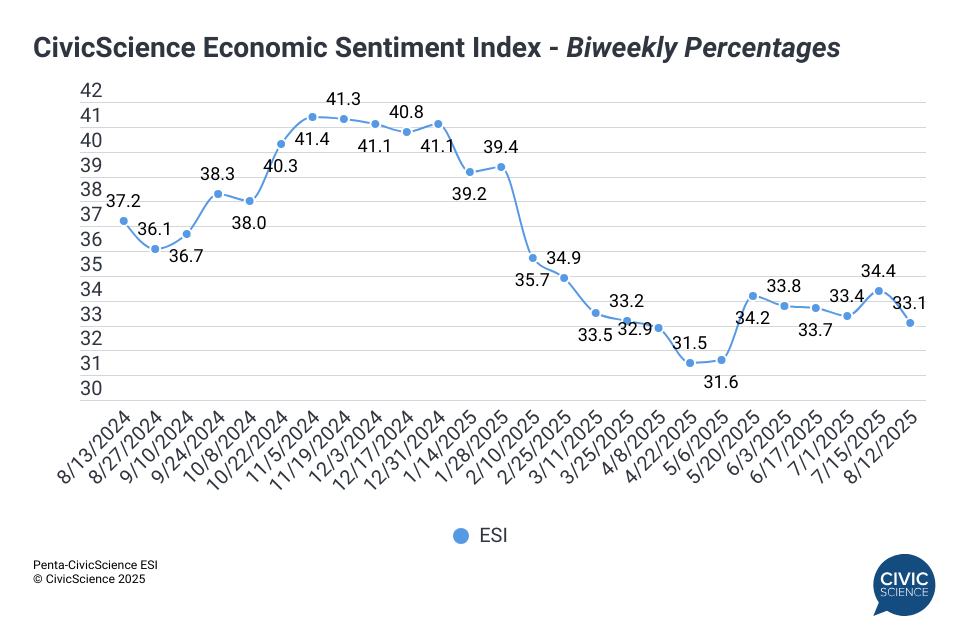
Consumer confidence fell steeply as employment concerns surged. Our Economic Sentiment Index dropped to its lowest point since early May, as four of our five indicators were in the red – led by a two-point drop in confidence around the job market. Only long-term optimism for the economy was (barely) above water. Sentiment around the housing market and major purchases also declined significantly – but, in fairness, the lukewarm CPI report and indications that the Fed is likely to cut rates next month came late in our data collection cycle. We’ll see if that bounces the numbers upward in our next reading.
As reciprocal tariffs take effect, consumers are reverting to some of their post-Liberation Day spending tactics. We highlighted 5 Ways Tariffs are Changing American Shopping Habits this week, noting that many of the schemes shoppers deployed in the immediate aftermath of the President’s early April tariff announcements – things like stockpiling, accelerating, or delaying purchases – have resurfaced, after subsiding somewhat in June and July. Now that the tariffs are becoming official, pull-forward buying is increasing, particularly among Democrats who are getting a jump on their holiday gift buying. If and when tariff-related price increases do start showing up at the cash register, consumers are readying to cut back on things like dining out and live entertainment. The beauty and cosmetics industry seems to be uniquely protected.

Celebrity endorsements are carrying increased weight. In our 3 Things to Know this week, we found that a growing number of consumers report being influenced by celebrity tie-ins when deciding where to spend their money. Twenty-five percent of U.S. adults say celebrity endorsements impact their purchasing decisions at least “somewhat,” up from 15% this time last year. Celeb-lovers over-index as customers of Walmart, Taco Bell, and myriad other brands we studied. We also learned that Americans have pretty flimsy trust in government data, particularly data about public health and education. As you might expect, there are dramatic differences by political party. Finally, as air conditioning season is in full swing, we saw that 80% of Americans who pay electric bills are concerned about the growing cost of their electricity bills.

The nostalgia trend is showing no signs of slowing. If you’ve seen me on a stage or webinar over the past 3 or 4 years, you know I’m big on the underlying cultural drivers and significant marketing upside of nostalgia in American consumerism today – particularly among younger age groups (which is the unintuitive part). It’s influencing everything from the TV shows people watch to the products they buy to the music they listen to. In our latest study on the topic, we took a closer look at the growing impact of nostalgia on the apparel industry and the brands where nostalgic impulses are highest among their potential customers.

Stop thinking TikTok is only a young person’s game. In 2019, a year after the platform launched in the U.S., just 6% of U.S. adults used TikTok, with the majority of users falling between the ages of 18 and 24. Back then, only 2% of adults aged 45+ were on it. And, while the popularity of the app has surged across every age group, nowhere has the rate of acceleration been higher than among the 45+ crowd. Today, over 1 in 4 of them (a 13x net increase since 2019), along with another 44% of those aged 35-44, use TikTok. Accordingly, the percentage of Americans who say they follow one or more influencers on social media has nearly doubled in the last year alone.

More awesomeness from the InsightStore this week:
- We published our latest Emotional Well-Being Index, and it’s not great.
The most popular questions this week:
How much do you care about redistricting in your state?
Do you think OpenAI should or should not allow ChatGPT to be used by children?
How important do you think music education is in schools?
How close are you with your sibling(s)?
How accurate do you generally find weather apps to be?
Answer Key: A lot – it’s a scourge; Absolutely not – at least not without parent or teacher supervision; Very; Close; 70%.
Hoping you’re well.
JD