We’ve never needed high-quality news and journalism more than we do right now.
And we’ve never done more to destroy it.
As if things weren’t bad enough for the news industry, the advent of AI has the potential to be the final nail in the coffin. Publisher traffic has been plummeting as “AI Overviews” replace clickable search results. Aside from the few companies that scored big, one-time licensing deals to sell out their content for training AI models, the rest are being fleeced.
Numerous efforts are underway to address the problem, some involving expensive IP lawsuits, while others involve publishers developing pay-for-usage arrangements in collaboration with AI companies. It’s easy to be cynical about the earnestness of the AI behemoths. We’ve seen this movie before. Facebook once devoted something between half-measures and lip service to supporting journalism. How did that work out?
Over 80% of Americans say they are at least somewhat concerned about preserving professional journalism and news reporting. That rivals any other issue facing our country.
Unfortunately, they’re not willing to fund it themselves. Only 35% of U.S. adults report paying for any kind of online content subscription – news, sports, entertainment, or otherwise. In the 1970s, 77% of U.S. households subscribed to a daily newspaper. Those days are long gone.
I’ll say again what I first said two years ago. It’s up to advertisers – and advertisers alone – to save news and journalism. They’re doing anything but.
For those of you not in the trade, I’ll let you in on a dirty little secret. The predominant platforms advertisers (or, more often, their agencies) use to target their campaigns make it very easy to exclude “News” from their mix. It’s a simple click.
And it happens all the time, the fear being that news isn’t “brand safe” – that, if someone sees an ad next to an article they disagree with, they’ll rebuke the advertiser for it. It’s misguided (news readers are some of the most valuable consumers), lazy (if you know your customer well enough, you can easily target news content they align with), and erosive to democracy (full stop).
On one hand, it’s hard to ask brand CMOs to step up. Their job security is notoriously tenuous, and, especially at times like these, the pressure from their CFOs is suffocating.
On the other hand, they’ve done it before, leveraging their power and dollars to advance everything from diversity to the environment to women’s sports. This is arguably as important – if not more so – than any of those things.
We need leaders. Who’s in?
Here’s what we’re seeing:
Consumer confidence reached a new bottom. The modest improvement we saw last time was short-lived, as our Economic Sentiment Index resumed its decline. Views on the job market were the biggest culprit, falling over two points even as the BLS released rosy nonfarm payroll numbers from October (don’t choke on the giant grain of salt). Overall, the aggregate ESI is down roughly 10 points from this time last year. If you’re looking for a silver lining, the long-term outlook for the overall U.S. economy climbed 1.1 points. Maybe people don’t think it can get any worse. Knock on wood.

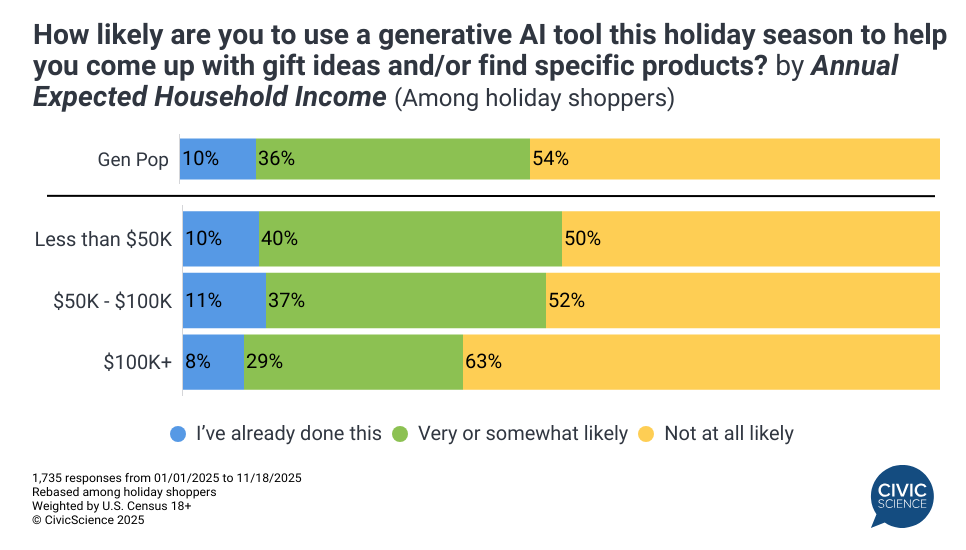
It’s the first official Christmas of the AI era. In the first of a tracking study I suspect will become perennial, we examined how tools like ChatGPT and its friends are reshaping the way Americans shop for the holidays. One in ten U.S. holiday shoppers report having used a generative AI tool to help with gift ideas and product searches this season, with another 36% saying they’re at least somewhat likely to by year’s end. It skews younger, but not overwhelmingly. Notably, GenAI shoppers are more likely than average to say they plan to spend more – and far more likely to buy gifts related to entertainment, home décor, and health & wellness.
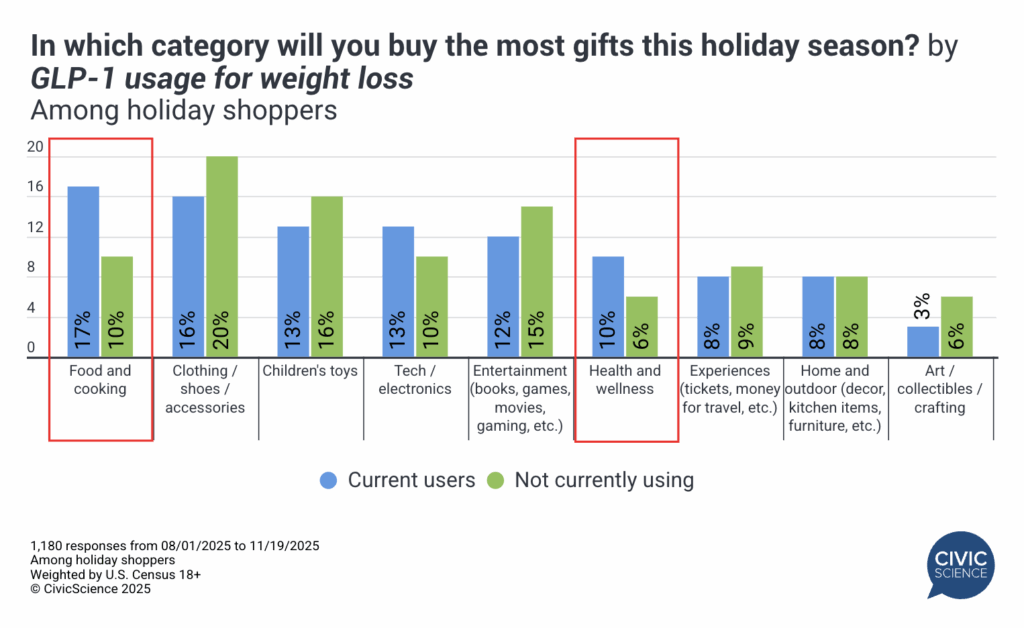
GLP-1 drugs are shaking up the holidays too. In our latest GLP-1 Consumer Tracker Report (now including 175,000 IDed users), we focused on how the drugs are impacting holiday plans and behaviors. Food is the most prominent theme across all the data. For example, GLP-1 users are far more likely than non-users to say they will be making their entire Thanksgiving dinner from scratch. And, if you’re in the food, cookware, or health & wellness industry, they’d be a great group to target while they’re holiday shopping. They’re less likely than average to shop at big box stores, more likely at small businesses and boutiques. Here’s everything else you need to know.
It’s hard to get a doctor’s appointment. In our 3 Things to Know this week, we examined the difficulties Americans face in scheduling an in-person visit with their primary care physician or specialists. Three in ten respondents say it’s very or somewhat difficult, citing everything from long wait times to transportation to getting time off work. We also learned that people really don’t like ordering from a kiosk in a restaurant. Lastly, we found that Baby Boomers are big goal-setters and not waiting for New Year’s Day to kick them off.

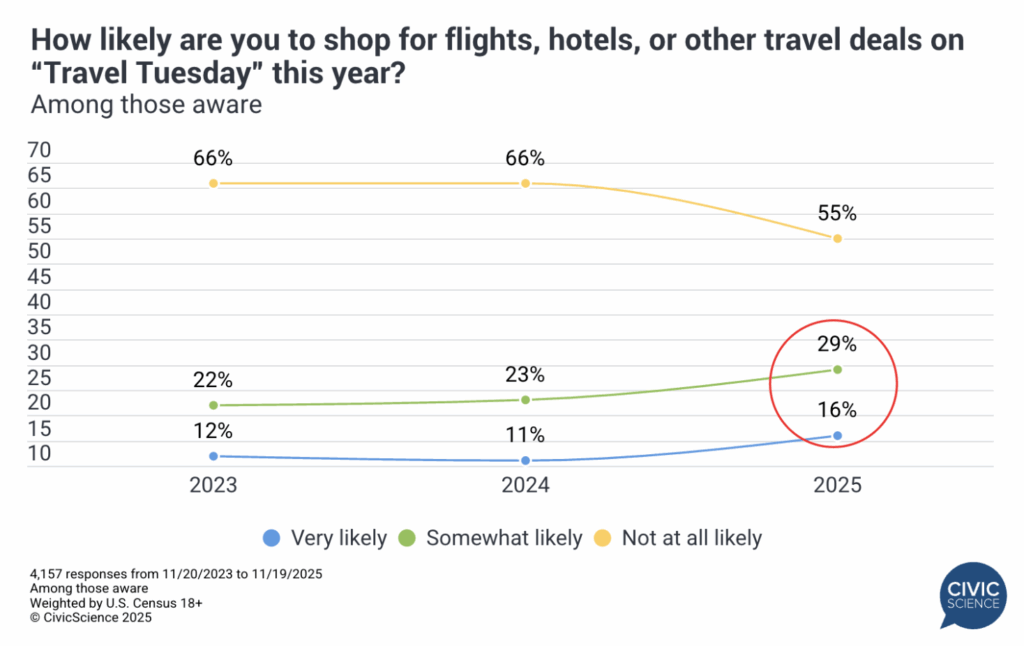
I just learned that Travel Tuesday is a thing. Not to be left behind in the season’s promotional flurry, travel companies have invented their own day of discounts – competing with Giving Tuesday – by offering flights, hotels, and vacations on the cheap on the Tuesday after Thanksgiving. Interest in the event is up this year, with 16% of U.S. adults saying they’re very likely to participate and another 29% saying they’re somewhat likely. Most popular among Gen Z, participants in the event view travel as an important means of “self-care.” They also over-index in wanting to stay at vacation rentals like Airbnb and VRBO, or resorts, when they travel.
More awesomeness from the InsightStore:
- Twitch is growing in popularity across more than just video games – with people using the platform to watch live music performances, fitness classes, and more.
The most popular questions this week:
Are you planning to cook a Thanksgiving meal this year?
Does the weather affect your mood?
Do you think of animal cloning as ethical or unethical?
How openly do you generally discuss family issues with children?
Answer Key: Like clockwork, I love it; Very much; I’m okay with it; No and it’s one of my biggest regrets; Very openly.
Hoping you’re well. Happy Thanksgiving!
JD
P.S.- If you’ve read this email long enough, you know that it’s coming up on my favorite week of the year, which means I also won’t be writing next week.