CivicScience has the world’s largest proprietary database of real-time declared intent, allowing brands to activate high-performing advertising that drives up to 80% better performance. See how our partners achieve superior marketing outcomes here.
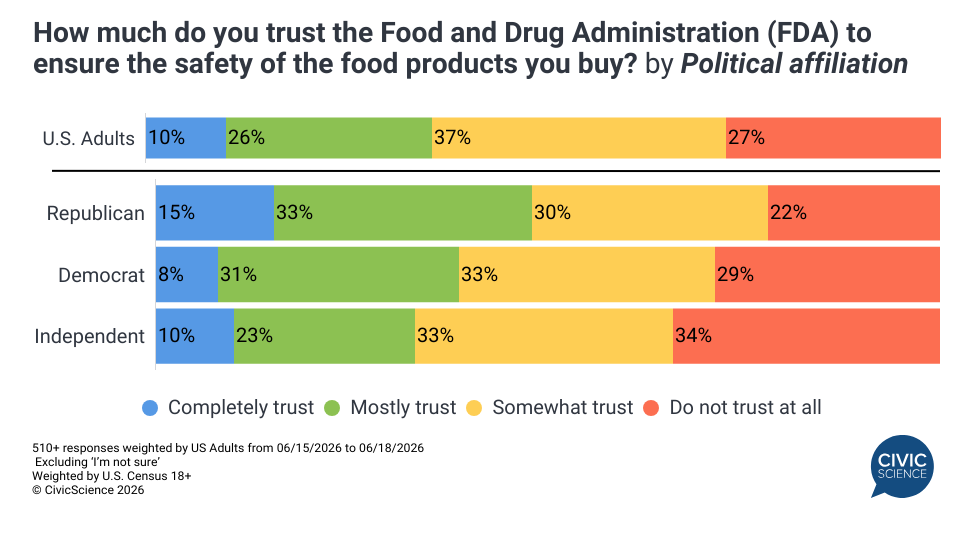
1. More than one-quarter of U.S. adults say they don’t have any trust in the FDA to ensure the safety of the food products they buy amid rising instances of New World screwworm.
More than three in four Americans (78%) are aware of the recent New World screwworm outbreaks in the United States, sparking widespread concern across regions and age groups. Among those aware of the situation, nearly 80% of consumers are ‘somewhat’ or ‘very’ concerned about recent screwworm cases.
At the same time, public trust in the Food and Drug Administration (FDA) regarding food safety is highly fragmented, with only a modest 10% of U.S. adults trusting the agency completely (excluding those unsure). A combined 63% of the population maintains a cautiously positive outlook (‘mostly’ or ‘somewhat’ trusting the agency), but a substantial 27% say they do not trust the FDA at all. This skepticism is particularly pronounced among older demographics and specific political affiliations; 36% of Baby Boomers and 34% of independents say they have zero faith in the FDA to ensure food safety, compared with a much more favorable trust profile among Gen Z adults and self-identified Republicans.
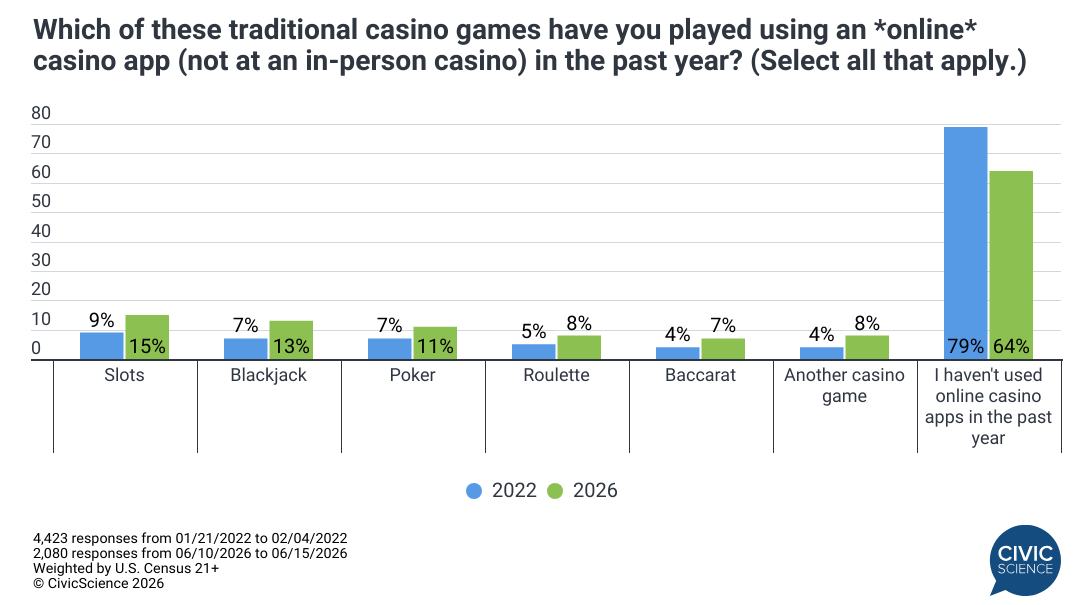
2. The percentage of Americans 21 and older who use online casino apps has surged more than 70% since 2022.
While online sports betting and trading have captured the spotlight, there’s another spiking trend in gambling to watch: Online casino apps. New CivicScience data show the adoption of online casino applications among U.S. adults aged 21 and older has surged significantly since 2022, resulting in a double-digit increase in users from 21% in 2022 to 36% in 2026. Virtual slots remain the most popular digital game format, climbing to a 15% participation rate, closely followed by blackjack (13%) and poker (11%).
Despite this influx of new players entering the market, spending habits among active users have remained remarkably rigid over time: 35% of players consistently spend $500 or more annually, 37% spend between $100 and $499, and roughly 28% spend less than $100, indicating a highly stable revenue structure for operators.
Take Our Poll: How do you feel about online gambling?
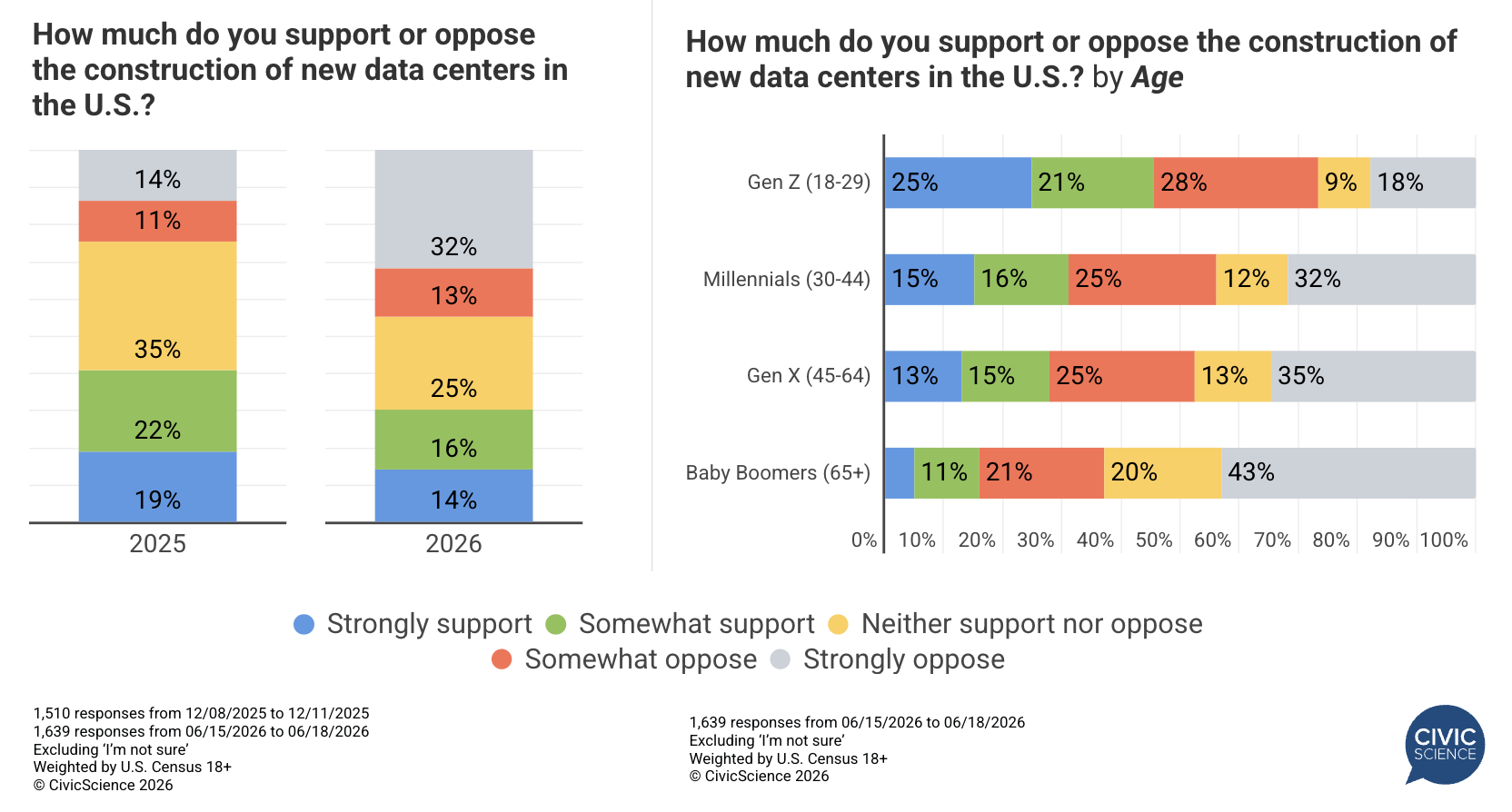
3. Opposition to data center construction climbs to 45% of U.S. adults, driven largely by older generations and political divides.
Attitudes about data centers are shifting rapidly, according to CivicScience trend data. Forty-five percent of Americans now oppose the construction of new data centers, up 20 percentage points from last December. While older generations express the strongest opposition—63% of Baby Boomers oppose new facilities—younger demographics are much more supportive, with Gen Z at 46%. Politically, Democrats and independents lean heavily toward opposition (52% and 46% strongly oppose, respectively), whereas Republicans show the highest favorability, with 21% strongly supporting and 25% somewhat supporting new construction.
Weigh In: Do you generally support or oppose the development of data centers in your area?