CivicScience has the world’s largest proprietary database of real-time declared intent, allowing brands to activate high-performing advertising that drives up to 80% better performance. See how our partners achieve superior marketing outcomes here.
Health and wellness have remained a top consumer priority leading into 2026, and the latest data indicate Americans are putting that priority into action. Using the latest consumer-declared data, CivicScience begins a new multi-part series exploring the latest routines, products, philosophies, and more in health and wellness as H2 2026 rolls along. Today’s younger wellness enthusiasts—specifically Gen Z—are setting themselves apart, redefining wellness as something that extends well beyond the gym. Here’s how that looks in practice:
Americans Are Exercising More, but Why Varies by Generation
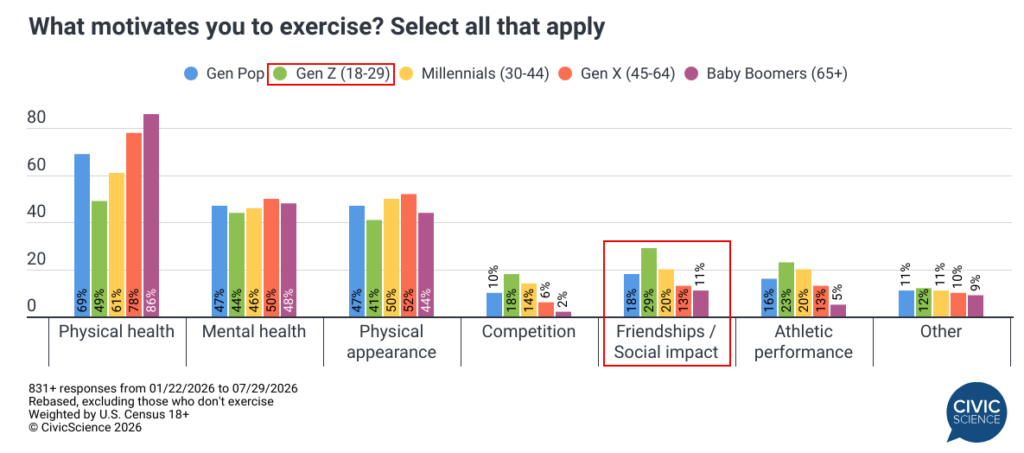
The latest data show that Americans are making more time for exercise than they were two years ago, as the share who say they ‘rarely/never’ exercise has fallen from 37% in 2024 to 31% in 2026. They’re also exercising more frequently since 2024, with the percentage who exercise ‘several times per week’ rising three points to stand at 43% today. However, there is nuance to this trend as consumer motivations and approaches to wellness vary significantly across generations.
While younger Americans, led by Gen Z (18-29), are the most likely to exercise overall, adults aged 65 and older report exercising most frequently (several times per week). Although physical and mental health are the leading motivators across every generation, Gen Z approaches wellness differently. Compared to their older counterparts, Gen Zers are more likely to be motivated by the social aspects of fitness and improving their athletic performance while being comparatively less concerned about their physical appearance.
Gen Z Is Embracing Trend-Forward Fitness
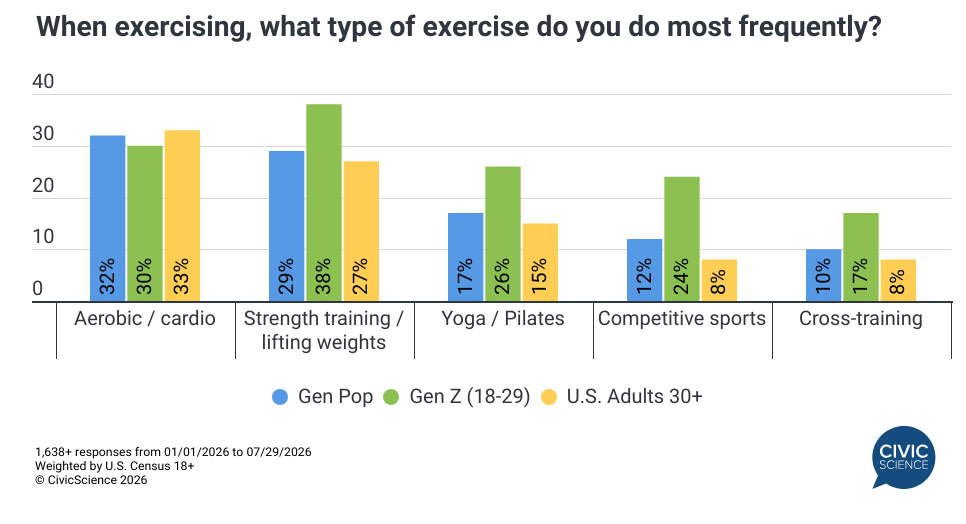
The types of workouts gaining interest reflect changing consumer preferences. Yoga and Pilates have seen the biggest bump in interest, rising from 12% to 17% over the last two years, while cross-training, competitive sports, and strength training have also gained ground since 2024.
Gen Z exercisers are more likely than average to participate in every studied fitness category except for aerobic exercise. They have an especially strong 12-percentage-point lead on the Gen Pop when it comes to competitive sports (24% vs 12%), as well as a nine- percentage-point lead in both strength training (38% vs 29%) and yoga and Pilates (26% vs 17%). Although it ranks as Gen Z’s least common exercise, they maintain a seven-percentage-point lead over Gen Pop in cross-training.
Workouts as the New Social Scene
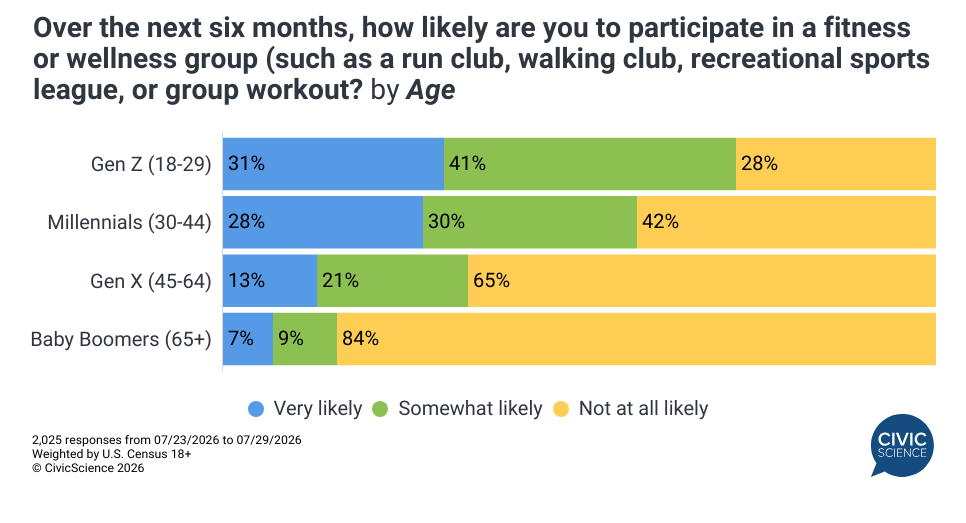
In an era of being ever-connected to devices, Americans still desire in-person connection and a “third space” away from work and home. New CivicScience data suggest that exercise/wellness groups and leagues are likely to fulfill that purpose for many Americans in the near term. The data show that 43% of Americans are at least ‘somewhat’ likely to participate in a fitness or wellness group (such as a running or walking club) in the next six months, including 19% who are ‘very’ likely to do so. This interest skyrockets among Gen Z, whose exercise increasingly serves both physical and social needs – 72% of 18-29-year-olds tell CivicScience they’re likely to join a fitness/wellness group in the next six months, with more than 3 in 10 reporting they’re ‘very’ likely to join.
But the data also suggest social wellness isn’t just a temporary, fleeting trend. Just 37% of Gen Z exercisers say they typically work out by themselves, a far lower rate than the 57% observed among Gen Pop and the 63% among consumers aged 30+.
Wellness Beyond the Gym
For Gen Z, health and wellness don’t end when the workout is over. Compared to the average American, they’re more likely to prioritize protein when grocery shopping and invest in home gym equipment. They also overindex on their intent to purchase wearable fitness trackers. Together, these behaviors suggest that wellness is an integral part of daily life, rather than relegated to a single moment.
As Gen Z reshapes the health landscape, they’re prioritizing connection and belonging far beyond the traditional gym. From group fitness to shared performance goals, this audience isn’t just looking for a place to work out; they’re seeking a community-driven lifestyle where social connection and health go hand in hand. For brands looking to connect with these younger consumers, fostering genuine community may prove far more valuable than focusing on fitness alone.