CivicScience has the world’s largest proprietary database of real-time declared intent, allowing brands to activate high-performing advertising that drives up to 80% better performance. See how our partners achieve superior marketing outcomes here.
No matter how far you’re going, moving to a new residence is no small task. It takes time, effort, and money. Because the process often begins months before the first box is packed, understanding these shifts requires looking at early indicators of consumer intentions. CivicScience has the latest forward-looking consumer intent data, providing a real-time view of how Americans are approaching relocation in 2026.
Yearly Moving Plans Hit Highest Level in Four Years
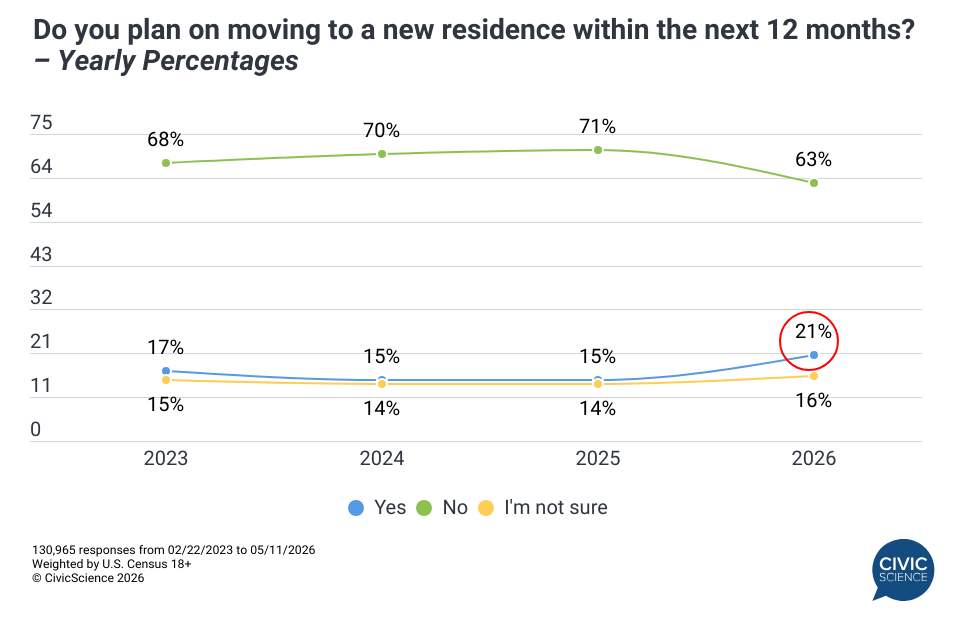
CivicScience has asked Americans about their intent to move since 2023. While the yearly average of those planning to move has held relatively steady over that period, 2026 marks the highest percentage of Americans reporting plans to move – 21% say they plan to move to a new residence within the next 12 months, a six-point increase over last year.
As far as where they’re looking to move, a majority (55%) of these planned movers tell CivicScience their moves will be within their current state, down from 58% in 2025. Suburbs are the most common type of area movers are targeting (38%), just ahead of rural residences (33%), while city moves are the least common (29%).
The latest consumer-reported data from CivicScience highlights several key demographics shaping American moving intent this year:
- Younger adults under the age of 45 set the pace in moving intent this year, with Gen Z aged 18-29 and Millennials aged 30-44 each more than twice as likely as Americans aged 45-54 and 65+ to plan to move this year.
- 26% of U.S. parents plan to move this year, outpacing non-parents (19%) and grandparents (15%) by at least seven points.
- Those currently living with a parent or guardian (25%) and current renters (23%) report the strongest moving intent (excluding ‘none of the above’). Homeowners, meanwhile, are the least likely to plan to move (18%) and are likely to maintain their current mortgage rates given today’s housing market.
- Americans living in the West and Southern U.S. also report the strongest moving intent (24% and 20%, respectively), compared to 15% among Midwestern residents. Those living in the Northeast are the least likely to move, at just 13%.
The “Why” Behind the Move
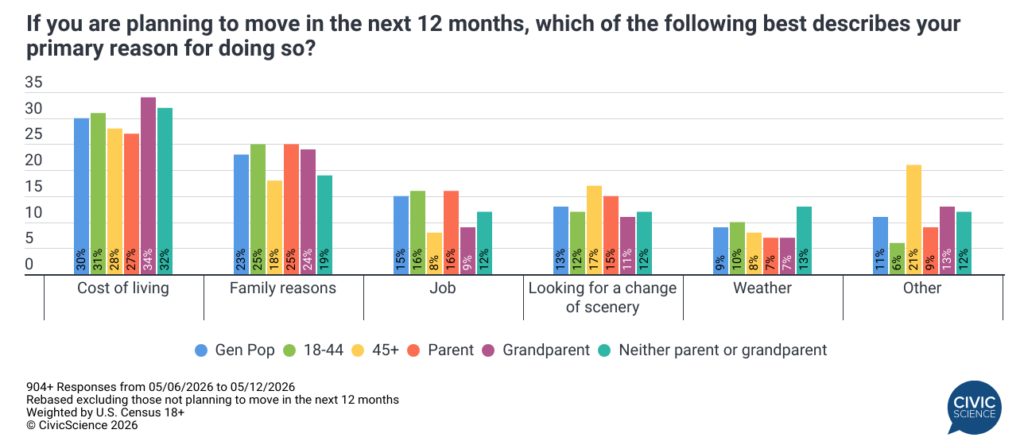
As Americans continue to feel the pressure of rising inflation, the cost of living is the unsurprising leading driver of moving plans this year, cited by 3 in 10 consumers with moving plans. This remains the most common driver across age and parental status, but is most pronounced among grandparents and non-parents.
While family is the next most commonly cited reason for moves, parents and those under 45 are more than twice as likely as those aged 45+ to say they’re moving for job reasons. Those planning to move aged 45+, meanwhile, lead the way in ‘looking for a change in scenery,’ while those who are neither a parent nor a grandparent set the pace on citing the weather as their primary reason for relocation.
Moving Logistics and AI’s Role in Research
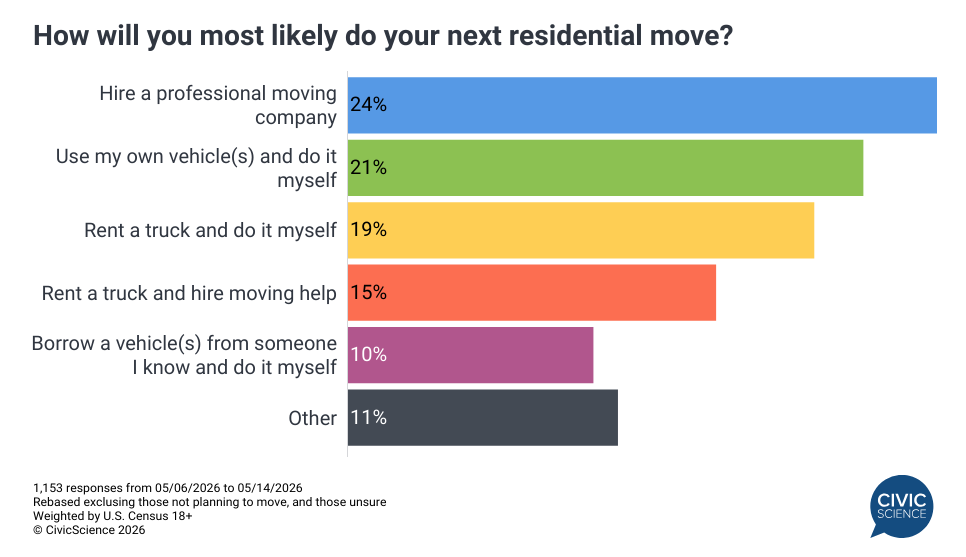
It’s one thing to plan to move, it’s another to execute it. The latest CivicScience data among those planning a move finds movers are largely split into three methods of handling the move: Hiring a professional moving company to handle the entire move is the most common approach, followed by the DIYers who will either use their own vehicle and do all the moving themselves, or rent a truck and handle the logistics themselves (excluding those unsure). Fifteen percent say they plan to rent a truck and hire help, while 10% will borrow someone’s vehicle and handle the loading/unloading themselves.
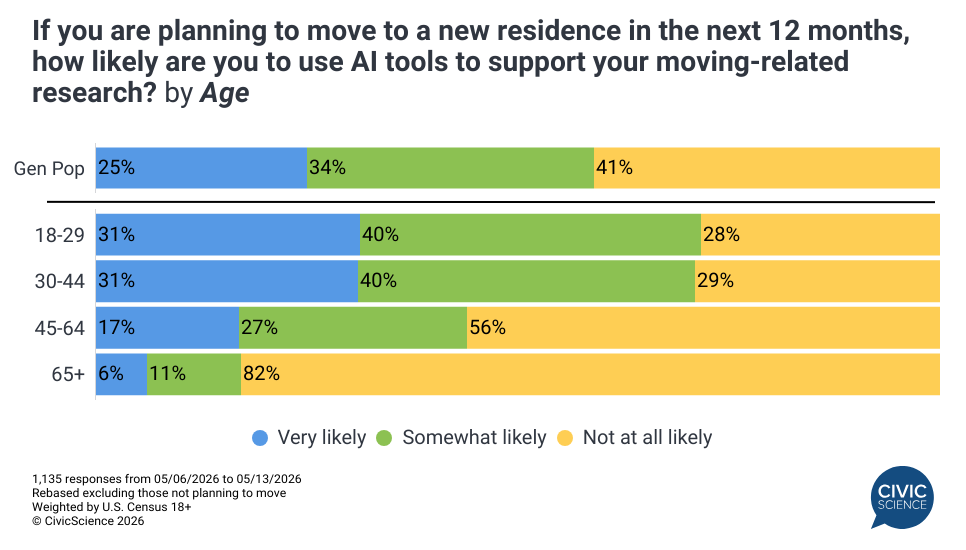
Aside from hiring help, movers are also open to using AI to research and plan their moves. Consumer-declared data show 59% of those planning to move this year are at least ‘somewhat’ likely to use AI tools to help with their research (such as searching listings, evaluating areas to live, and budgeting), including 25% who are ‘very’ likely to use it. Likely AI usage jumps to 72% among Americans planning to move out of their current state, outpacing in-state movers by nearly 20 points (54%). AI usage also strongly correlates with the type of area they’re moving to – 51% of city movers are ‘very’ likely to use AI for research, more than twice the percentage who say they plan to move to a suburban or rural area.
Younger consumers typically over-index on AI usage overall, and the data show this trend holds when it comes to moving. That said, more than 4 in 10 of planned movers aged 45-65 also say they’re at least somewhat likely to use AI for research.
The 2026 moving landscape is being defined less by a single trend than by a confluence of pressures, priorities, and new behaviors that vary considerably depending on who you ask. Younger adults, renters, and out-of-state movers are each charting a distinct course through what remains a complicated housing environment.