CivicScience has the world’s largest proprietary database of real-time declared intent, allowing brands to activate high-performing advertising that drives up to 80% better performance. See how our partners achieve superior marketing outcomes here.
May is Mental Health Awareness Month – a time dedicated to recognizing the importance of mental well-being and encouraging conversations around mental health support. The month comes as many Americans are worried about the state of mental well-being today. According to CivicScience data, nearly half of U.S. adults are ‘very’ concerned about mental health and emotional wellness in the U.S., while another 37% are ‘somewhat’ concerned.
At CivicScience, we regularly ask Americans how they are feeling through our Well-Being Index, which measures both positive and negative emotions among U.S. adults. Since the pandemic, Americans’ overall sense of well-being has continued to shift alongside economic uncertainty, geopolitical events, and everyday stressors, with the most recent reading pointing to a rise in both stress and sadness throughout April.
To dig deeper, CivicScience took a closer look at overall mental health concerns, how consumers cope with stress, and whether Americans are increasingly seeking out support.
Few Americans feel they have a complete grasp on their mental health.
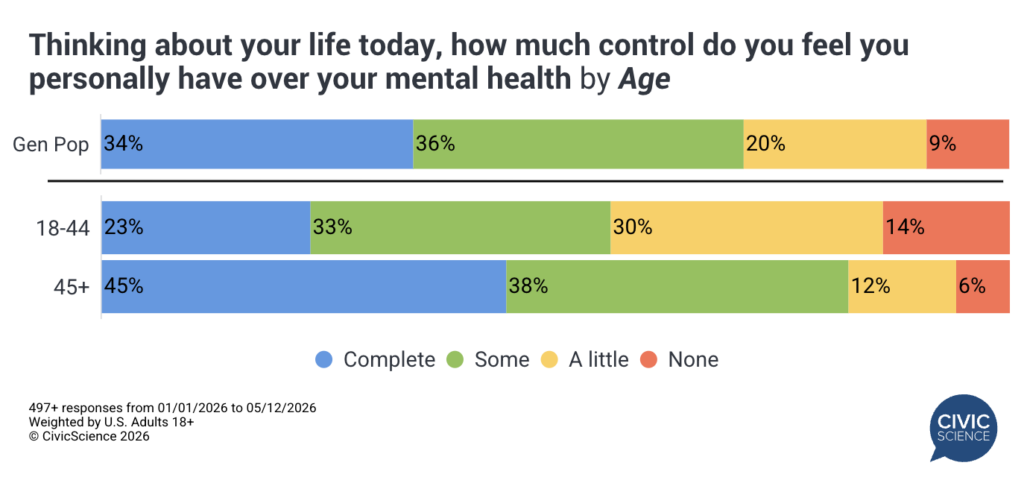
Recent CivicScience data suggests many Americans continue to feel emotionally strained. Only 34% of U.S. adults 18+ say they feel they have ‘complete’ control over their mental health, while 36% say they have only ‘some’ control. While this does represent the majority of adults, it still means that nearly 3 in 10 U.S. adults feel they have ‘a little’ to ‘no control at all’ over their mental health.
Younger adults appear to be feeling the mental load especially hard. Among consumers aged 18-44, just 23% say they feel they have complete control over their mental health, compared to 45% of those aged 45 and older. Younger consumers are also more than twice as likely as older adults to say they feel they have no control over their mental health (14% vs. 6%).
Amid these struggles, Americans focus more on emotional well-being than on their physical health. While most consumers (63%) say mental and physical health are equally important to them, Americans are more than twice as likely to say mental health is more important to them than physical health, rather than vice versa (25% vs. 12%).
Stress and emotional fatigue are shaping everyday behaviors.
Mental and emotional strain also appears to be influencing how consumers spend their time and cope day to day.
According to additional consumer-reported data, 60% of Americans say they have mentally “checked out” at least once in the past week as a way to escape stress. Meanwhile, roughly one-third of U.S. adults say their desire to leave the house has decreased over the past month.
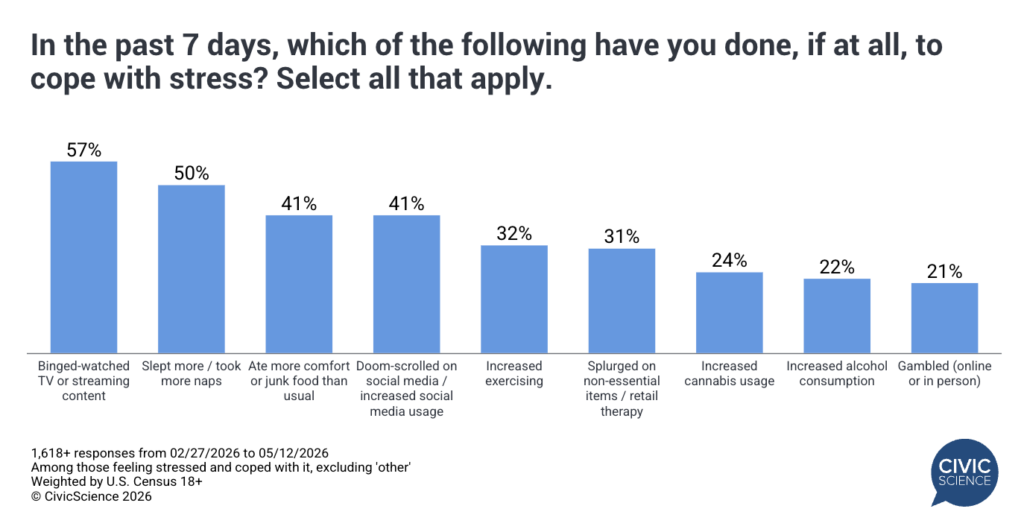
Consumers are also increasingly turning to comfort-oriented and escapist habits as a way to manage stress. Close to 6 in 10 Americans say they binge-watched TV or streaming content in the past week, while 50% say they slept more or took extra naps. Another 41% say they ate more comfort or junk food than usual, while the same percentage say they doomscrolled or increased their social media usage. At the same time, Americans are comparatively far less likely to report they’ve increased alcohol consumption or gambled as coping mechanisms in the past week.
Beyond specific activities, consumers – especially younger adults – are also gravitating toward small comfort items and cozy habits to support their well-being amid ongoing stressors.
People are becoming more open to seeking professional help.
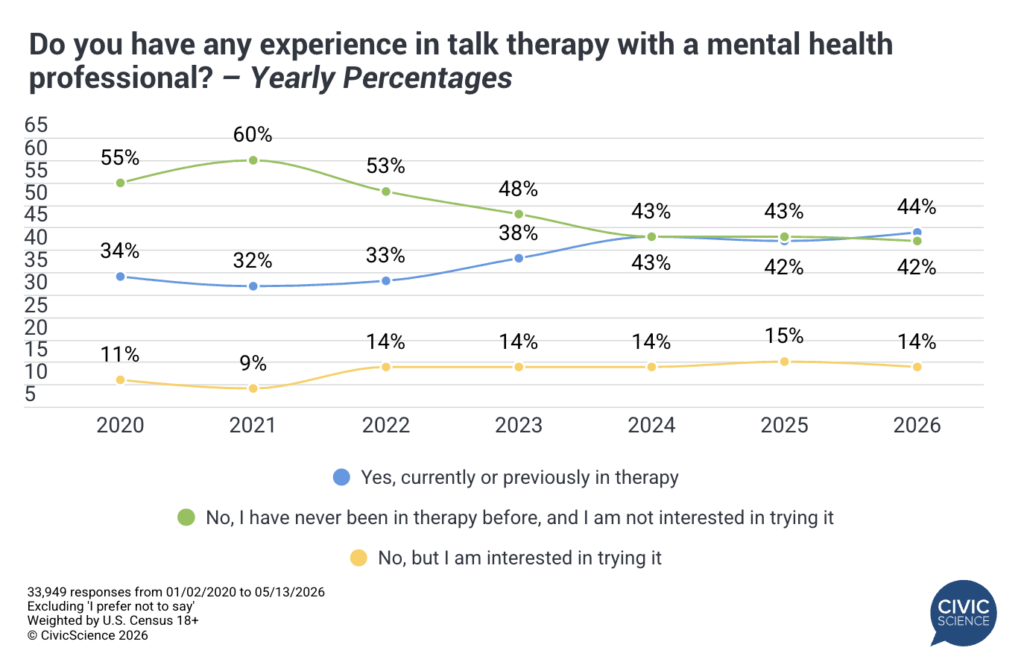
While the state of American mental health looks bleak, CivicScience data suggests Americans are becoming increasingly open to seeking professional support. As of May 2026, the percentage of consumers who say they have experience with therapy has surpassed the percentage who say they have not tried therapy and are not interested in it, marking the first time since CivicScience began yearly tracking (44% vs. 42%).
Forty-five percent of women say they have experience seeing a therapist, compared to 41% of men. While men are still more likely to say they have not seen a therapist than say they have, the percentage of men who report currently seeing or previously having seen a therapist is now at its highest point yet observed by CivicScience.
Still, barriers prevent some from seeking professional support. Among consumers not currently seeing a therapist, most say they do not feel they need one right now. However, cost and insurance coverage continue to rank among the leading obstacles to seeking support.
Comfort levels also appear to be playing a growing role among younger consumers. Among adults aged 18-44 who are not currently in therapy, the percentage who say they feel uncomfortable seeing a therapist has risen from 18% in 2025 to 26% in 2026.
Beyond Mental Health Awareness Month
Mental health challenges continue to weigh heavily on many Americans today. But alongside rising stress and emotional fatigue, the data also reflects a growing willingness among consumers to openly discuss mental health, seek support, and develop coping habits.