CivicScience has the world’s largest proprietary database of real-time declared intent, allowing brands to activate high-performing advertising that drives up to 80% better performance. See how our partners achieve superior marketing outcomes here.
1. Young adults report record-high job market concerns as new graduates increasingly opt for further education and gap years rather than immediate employment.
As college graduation season ramps up, CivicScience data among adults ages 18-34—those most likely to be earning undergraduate or graduate degrees—show growing concerns about finding a job in the near future. Just over half say they expect it will be ‘more difficult’ to find a new job six months from now, marking the highest quarterly percentage among this age group in the last two years. Amid this uncertainty, younger adults appear to be prioritizing job qualities beyond compensation alone. Adults ages 18-34 are the most likely to say work-life balance and flexibility are key considerations when choosing a role, with the importance of these benefits declining with age. Having a job that aligns with their personal values ranks second among this group, outpacing all other age groups by at least 10 percentage points. In contrast, older generations are more likely to prioritize compensation and salary when making career decisions as they near retirement.
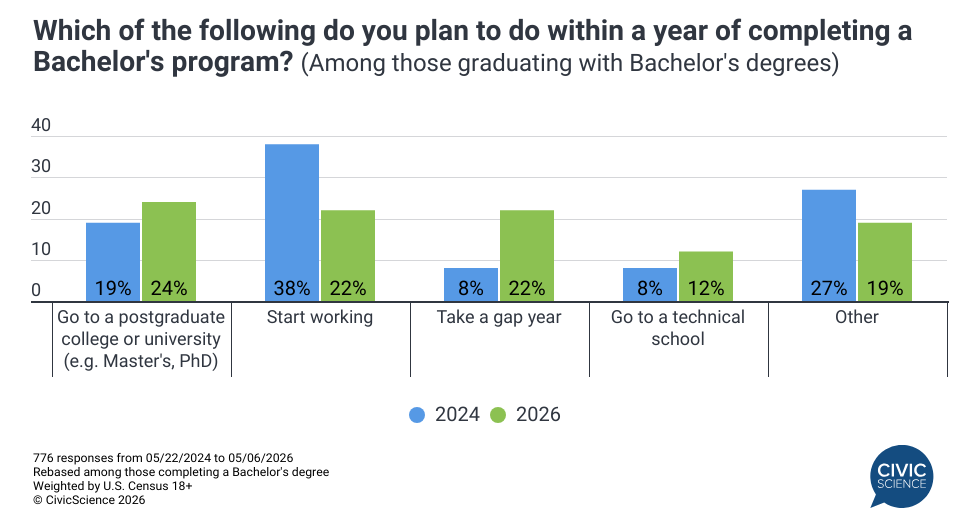
Looking specifically at this year’s graduates—including the 34% earning a bachelor’s degree—those completing a bachelor’s program are most likely to say they plan to pursue post-graduate education (24%), with working and taking a gap year tied at 22%. This marks a notable shift from two years ago, when 38% said they intended to begin working immediately after graduation and fewer than 10% planned to take a gap year.
2. U.S. hobby trends remain steady overall, though cooking and travel gain traction.
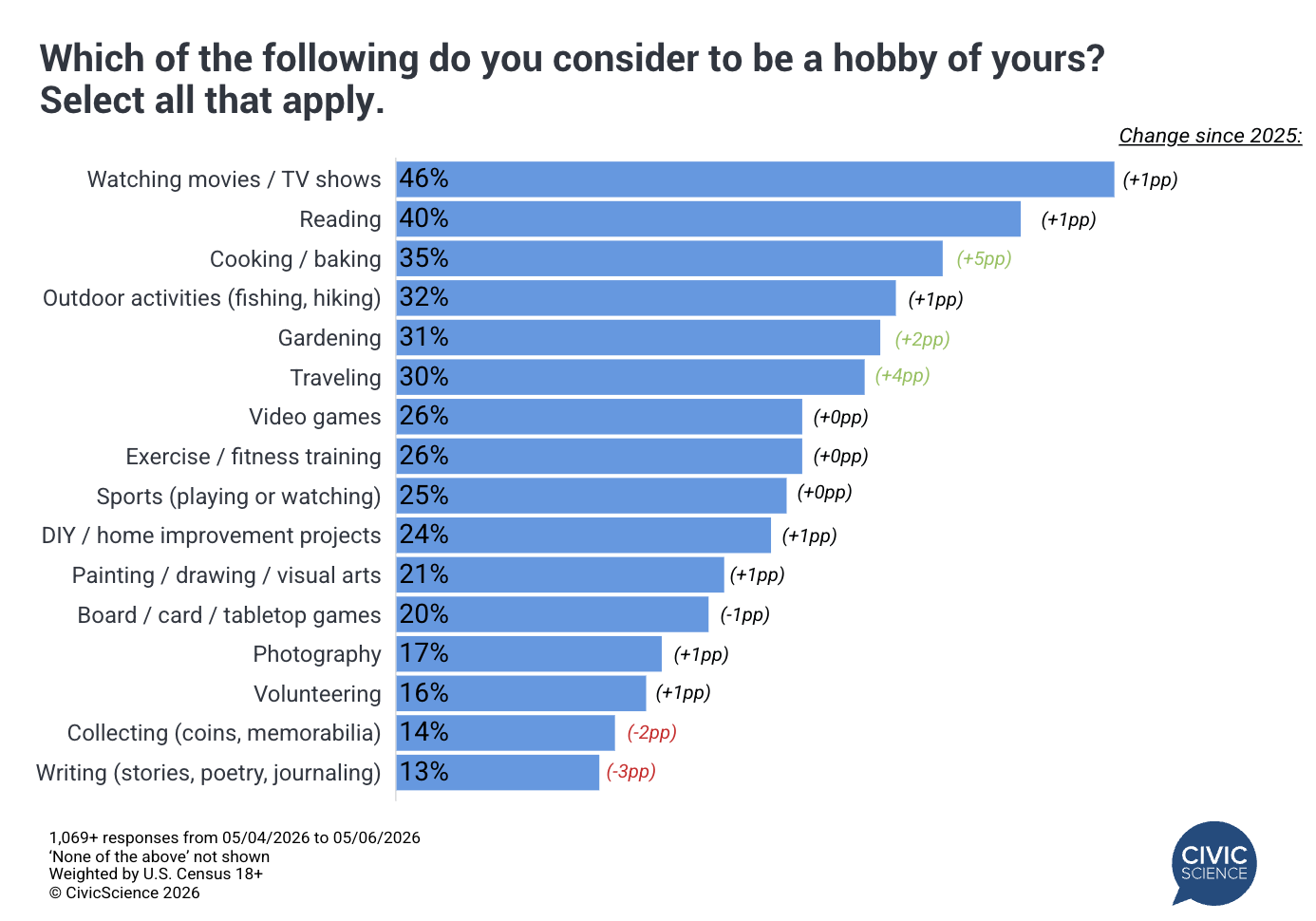
Between 2025 and 2026, leisure preferences among U.S. adults remained largely stable, with a notable lean toward domestic and accessible activities. Watching movies and TV remains the most prevalent hobby in 2026, followed by reading and cooking or baking. Interestingly, while traditional hobbies like exercise and video games showed no growth (remaining flat at 26%), more active or niche categories saw modest upticks; traveling grew from 26% to 30%, and cooking saw the largest year-over-year jump of five percentage points. Conversely, interests such as writing and collecting objects experienced slight declines, suggesting a shift toward broader, more experiential or utility-based pastimes.
The Weekly Pulse report dives deeper into how these hobbies shape stimulation and stress management—including a look at the specific activities that lead the pack in creative expression. CivicScience clients and Media Partners have access to the full Weekly Pulse report. Click here to learn more about how to get it.
Take Our Poll: Do you view exercise as more of a hobby or a chore?
3. American sports viewership generally grows as the season’s stakes rise, though Gen Z fans buck the trend with strong preseason interest.
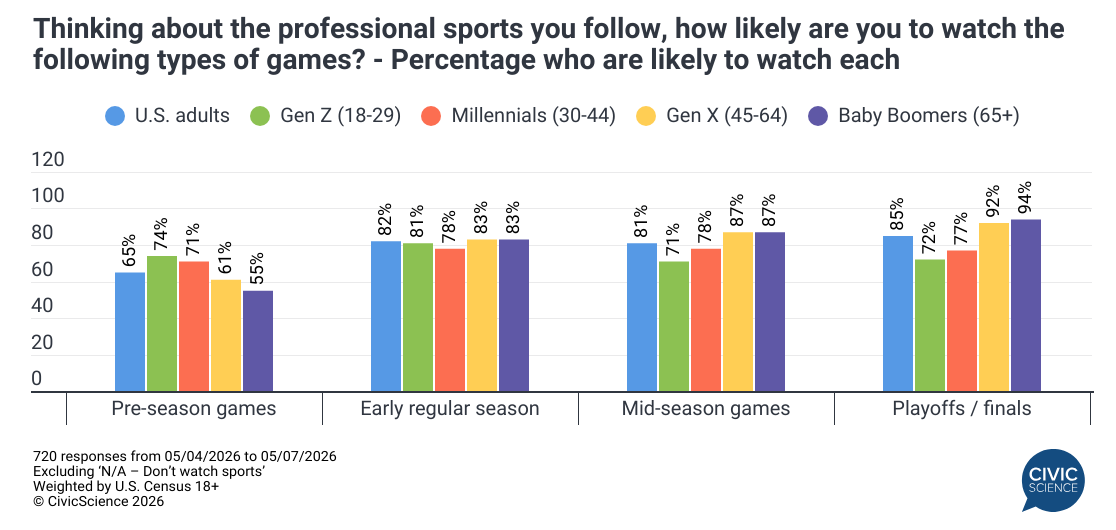
Each of the ongoing North American professional sports leagues is at a different stage of its season right now. This raises the question: how consistent is viewership as a season progresses? New consumer-reported data from CivicScience among U.S. adult sports fans finds that while interest generally builds as the stakes increase, engagement patterns shift significantly by age.
Gen Z fans exhibit a unique front-loaded engagement pattern: they are most likely to tune in during the preseason (74%), with interest actually dipping slightly by the postseason, suggesting their engagement may depend more heavily on team performance later in the season. In contrast, those aged 45+, particularly Baby Boomers, are most likely to engage during the high-intensity environment of the playoffs and finals.
For media publishers and advertisers, these distinct generational behaviors underscore the need for a diversified strategy—targeting younger audiences early in the season through “hype” and narrative-driven content while reserving high-impact traditional spend for the concentrated, loyal viewership of older demographics during the postseason.
What Do You Think: Are preseason games valuable for team prep?