CivicScience has the world’s largest proprietary database of real-time declared intent, allowing brands to activate high-performing advertising that drives up to 80% better performance. See how our partners achieve superior marketing outcomes here.
As AI becomes more embedded in how consumers search and shop today, one thing is clear: adoption depends on trust. Consumer-declared CivicScience data show that consumers who trust AI are far more likely to use it regularly.
That trust varies by category – especially in beauty, where numerous product options and personal factors like skin type, tone matching, and style raise the stakes, making AI-driven recommendations feel riskier. That hesitation is reflected in how consumers are using AI today.
How Consumers Are Using AI for Decision-Making Now
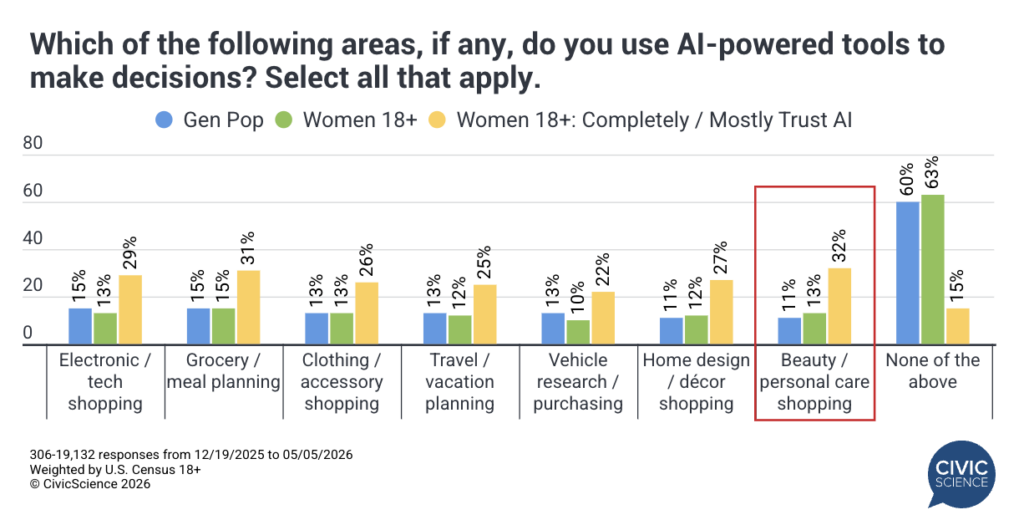
To put this into context, CivicScience examined how consumers are currently using AI-powered tools across different shopping categories. When asked which areas they use AI to help make decisions, beauty and personal care (11%) ranks lower than other categories, notably electronics and meal prep, though they rank in the middle among women (13%).
Among women who report higher levels of trust in AI-generated information, the share who use AI for beauty and personal care shopping jumps to 32%. This suggests that while using AI for beauty product research remains limited overall, reaching core audiences and instilling trust in the tech could drive more meaningful adoption.
Beauty Buyers Take a More Fragmented Approach to AI
Platform preferences also vary among beauty buyers. While ChatGPT remains the most commonly used AI platform overall, this group under-indexes compared to the Gen Pop (30% vs. 43%). Instead, beauty buyers over-index in their use of platforms like Gemini, Perplexity, and Meta AI.
This difference suggests that beauty consumers are engaging with a broader mix of AI tools, rather than relying on a single dominant platform – aligning with additional CivicScience data showing that beauty buyers are more likely to prefer specific AI assistants for each brand or retailer than a single assistant across all stores.
But Not All Beauty Buyers Think Alike
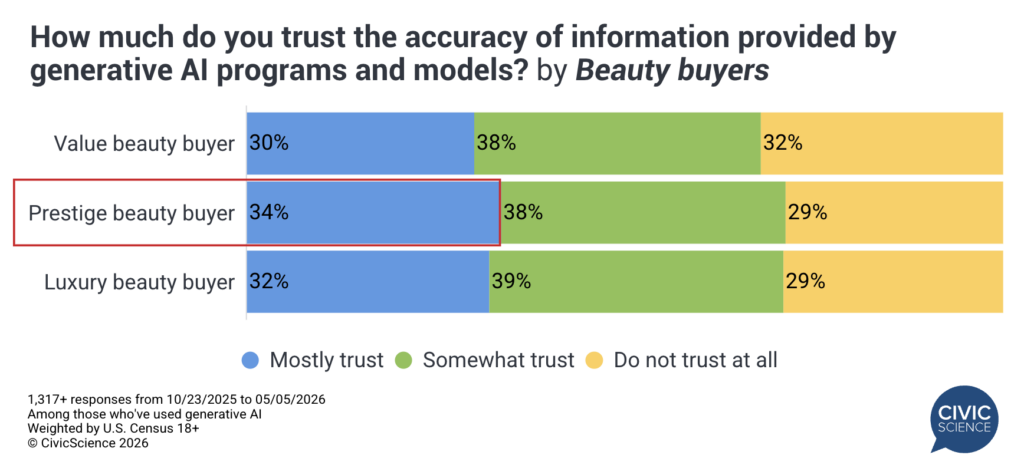
While current adoption remains on the lower end, there’s still significant market potential among beauty buyers — though not evenly distributed. For instance, CivicScience data show that prestige beauty buyers are more likely to trust AI-generated results than both value and luxury shoppers, while value buyers are the least trusting.
This suggests a potential “sweet spot” for AI adoption in beauty. Prestige buyers are typically less price-sensitive than value shoppers, but also less brand-loyal than luxury beauty buyers.
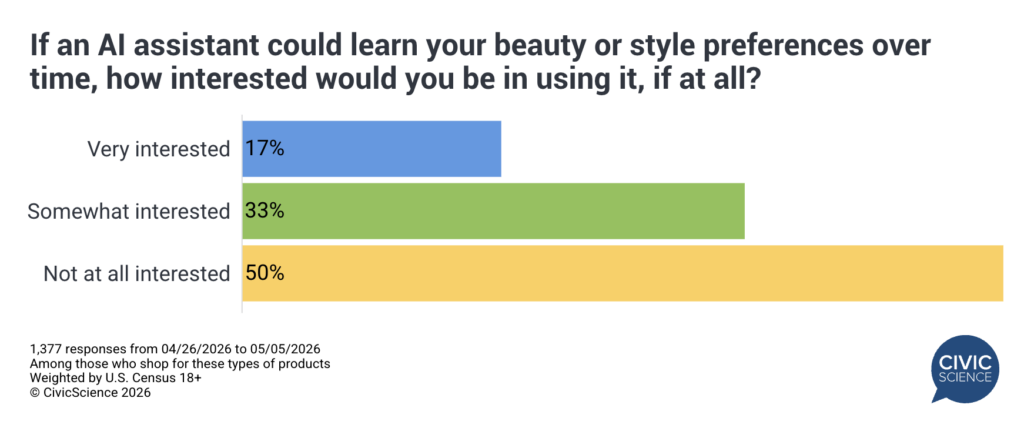
At the same time, broader consumer interest suggests openness to AI in beauty under the right conditions. When asked whether they’d use an AI assistant that could learn their beauty preferences and styles over time, 17% of consumers say they would be very interested, 33% somewhat interested, and half say they are not interested at all (among those who buy these types of products).
That interest is nuanced. It tends to be higher among skincare enthusiasts and those who experiment more with makeup styles. Where consumers shop also plays a role, with Ulta shoppers showing slightly greater openness to these tools compared to Sephora shoppers.
AI may not redefine beauty shopping overnight, but it doesn’t need to. Adoption is more likely to build in pockets, particularly when recommendations feel complementary rather than risky. The brands that win will be those that understand where AI enhances the decision, not where it replaces it.