CivicScience has the world’s largest proprietary database of real-time declared intent, allowing brands to activate high-performing advertising that drives up to 80% better performance. See how CivicScience partners achieve superior marketing outcomes here.
It’s no secret that the way in which Americans perceive their personal financial health is intricately linked with consumer spending. As a result, brands and advertisers looking to stay top of mind only stand to benefit from staying ahead of these shifts in perception that create a material impact. The CivicScience Consumer Financial Health Index (CFHI) uses real-time, consumer-reported data to provide insights into these shifts as they happen, empowering decision-makers to meet their clients at the moment of peak intent.
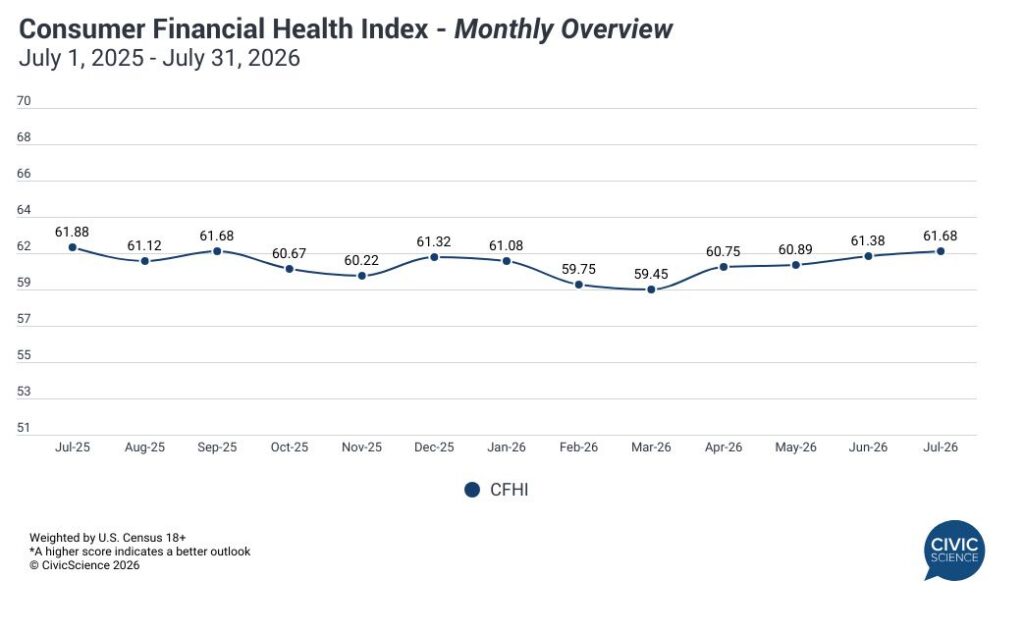
The CFHI hit yet another yearly high in July 2026, climbing 0.3 points to reach 61.68. Although this marks the fourth consecutive month of growth, the Index’s current reading remains slightly lower (by 0.2 points) than in July 2025.
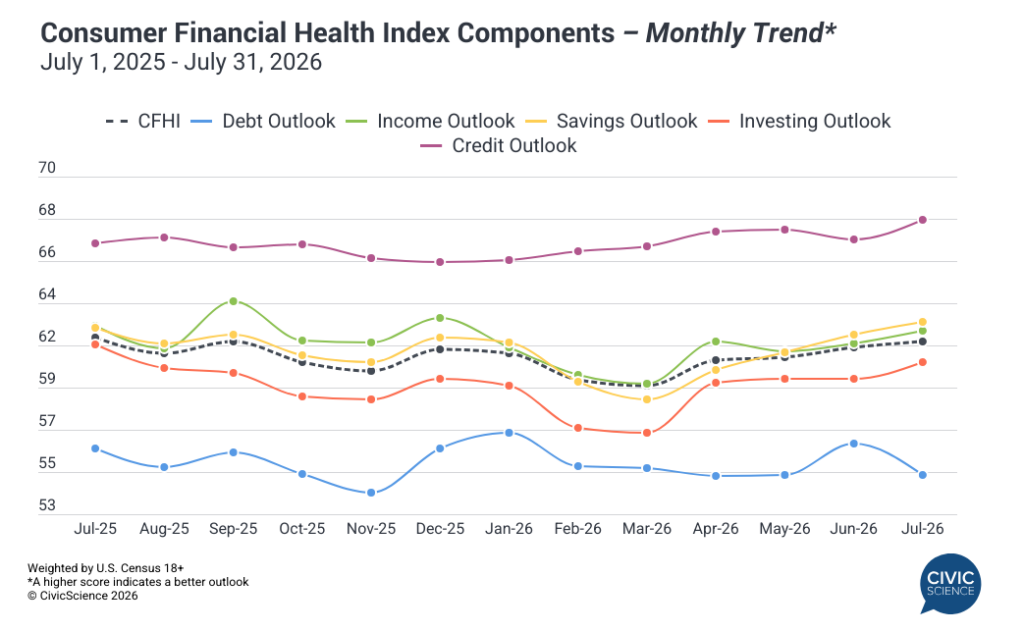
A closer look at the individual components demonstrates a second consecutive month of widespread improvements. Credit outlook shows the largest month-over-month increase, at 0.98 points, followed by the investing outlook (+0.82 points). Income outlook (+0.65 points) and savings outlook (+0.63 points) round out the positive shifts. And although July brought a substantial 1.56-point month-over-month downturn in debt outlook, the collective positive momentum overshadowed that singular dip. However, just two of the five CFHI components finished higher in July than their July 2025 levels, with debt outlook down 1.35 points. This will be a trend worth monitoring as holiday shopping soon ramps up amid persistent inflation and geopolitical uncertainty.
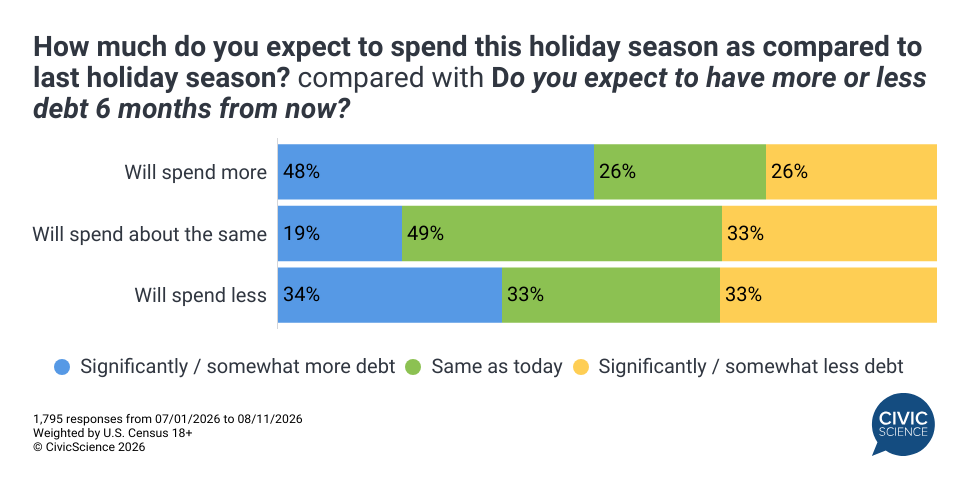
That underlying debt caution becomes clearer with holiday shopping underway. With the backdrop of summer sales like Amazon Prime Day and Christmas in July, CivicScience data show 38% of holiday shoppers expect to spend more this holiday season. However, 48% of that higher-spending group also expect their debt to rise over the next six months, underscoring the need to track debt expectations alongside purchase intent for brands.
After another consecutive month of gains, the CFHI reading in July once again reached a new high for 2026. Yet, with back-to-school and early holiday shopping already setting in for some consumers, improving financial sentiment may not tell the whole story. As Americans balance greater confidence in some areas of their finances with the possibility of taking on more debt, their priorities — and spending behaviors — could shift quickly. To stay ahead of these changing financial tides, CivicScience clients leverage an always-on stream of consumer-declared insights to make confident decisions in real time.