CivicScience has the world’s largest proprietary database of real-time declared intent, allowing brands to activate high-performing advertising that drives up to 80% better performance. See how our partners achieve superior marketing outcomes here.
Amazon Prime Day has officially ended for the summer season. As shoppers receive and unbox their deliveries, new data from CivicScience explores their mindsets and priorities to assess where consumers stand after the first major sales event of the summer and what it might suggest as we look ahead to the coming weeks and months.
Here are 5 key takeaways to know about Amazon Prime Day and those who shopped, according to consumer-declared data:
1. Prime Day Shoppers Spent More This Year
CivicScience data show that spending among Prime Day shoppers has increased, with 46% of U.S. adults telling CivicScience they spent more on this summer’s event compared to last year. Increased spending was largely driven by Gen Z adults (18-29), with 7 in 10 reporting they spent more during this year’s sale. Millennials (aged 30-44) also contributed to the increase, though they trail Gen Z adults in this behavior by 14 percentage points. Conversely, just 23% of shoppers aged 65+ spent more during Prime Day this summer, while Gen X (45-64) led the way in spending less.
2. Discounts on Everyday Essentials Drove Purchases
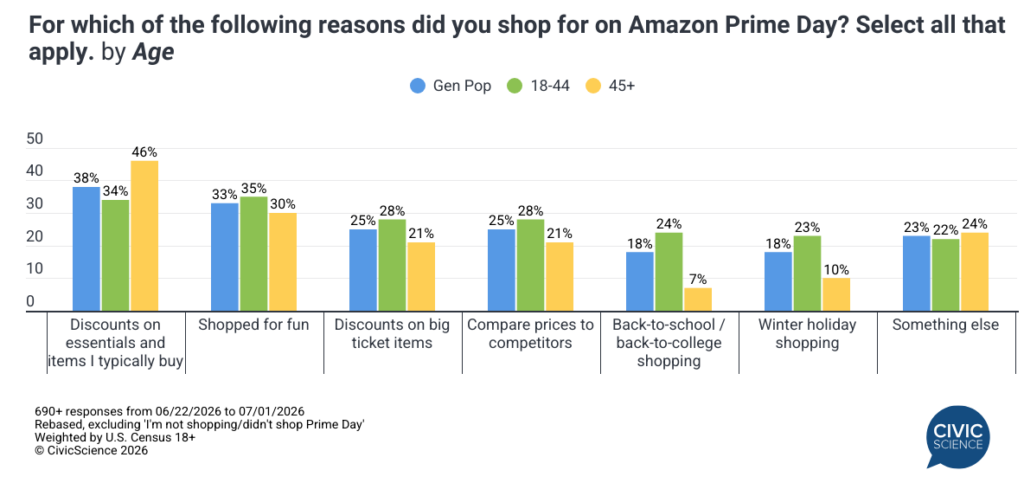
What motivated shoppers to add items to their cart during this summer’s sale? Additional CivicScience data show that the largest percentage of shoppers (38%) were seeking discounts on essentials or items they typically buy anyway, while one-third shopped just for fun, perhaps as a way to save on some retail therapy. Other strong motivators included discounts on big ticket items and the ability to compare prices to competitors. And while less common, it’s worth noting that back-to-school/college lists and winter holiday shopping were also on the radar for nearly one in five shoppers.
However, these motivations vary drastically by age. While adults aged 18-44 were motivated by a mix of fun, discounted everyday purchases, and big ticket items, those aged 45 and older largely prioritized saving on essentials.
3. Americans Increasingly Use Beauty as a Form of Self-Care as the Category Captures Top Spot in Prime Day
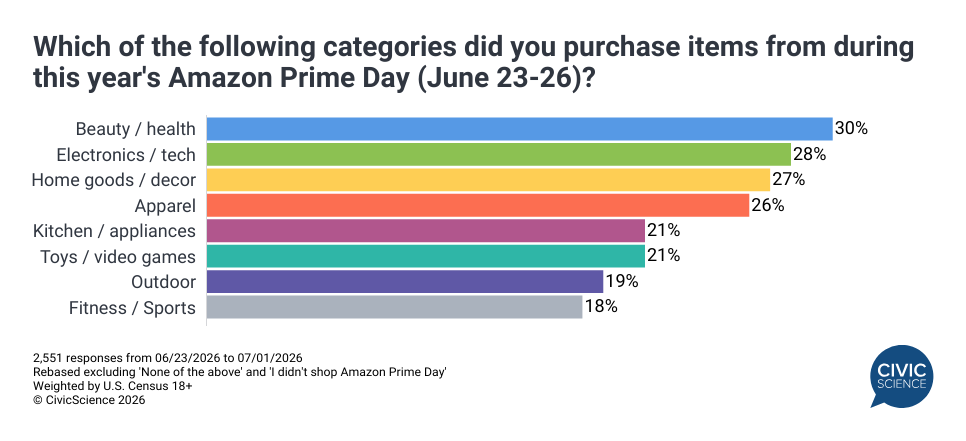
The latest CivicScience data show 47% of U.S. adults use beauty (such as skincare, hair care, makeup, etc.) as a form of self-care ‘somewhat’ or ‘very’ often, up from 42% in 2025. This trend is even more pronounced among Amazon Prime Day shoppers, with 60% occasionally using beauty as a form of self-care. With this in mind, it may come as no surprise that beauty and health purchases outpaced all other categories among Prime Day shoppers. The trend suggests that beauty spending–especially with its link to self-care–may be evolving from a superfluous category into an everyday essential.
4. Prime Day Shoppers Grapple with Pessimistic Debt Outlook
The savings that Prime Day offers seems to have appealed especially to those with financial uncertainty. Forty percent of Prime Day shoppers anticipate having more debt six months from now, compared to just 26% of the Gen Pop. This suggests that stocking up on everyday essentials isn’t just an effort to save money now, but potentially to get ahead of typical spending needs when budgets tighten down the road.
5. Christmas in July is Right On Time for Deal-Hungry Prime Shoppers
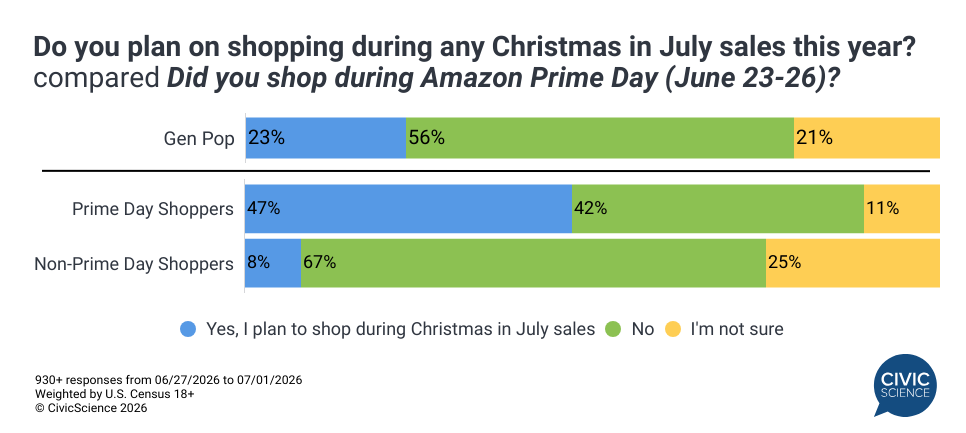
With an eye towards proactively finding the best price, Prime Day shoppers are already looking forward to and ready to get a jump on winter holiday purchases in the next sales season: Christmas in July. While nearly half (47%) of Prime Day shoppers plan to shop Christmas in July sales this year, just 23% of the Gen Pop say the same. Clearly, what these consumers may lack in financial certainty, they make up for with an attempt to stretch each dollar as far as it will go.
The data from June’s Amazon Prime Day demonstrates shoppers’ priorities, beyond the limited-time sales event. While shoppers stocked up on everyday essentials, their purchasing behavior strengthened the position of beauty products as a resilient essential while indicating the potential for turbulent financial winds in the near future. However, despite ongoing uncertainty, Prime Day shoppers are dedicated to the deal. And with Christmas in July sales just around the corner, this demographic of shoppers shows no sign of slowing down.