CivicScience has the world’s largest proprietary database of real-time declared intent, allowing brands to activate high-performing advertising that drives up to 80% better performance. See how CivicScience partners achieve superior marketing outcomes here.
The new NFL season is now just two weeks away, with the first game a Super Bowl rematch between Seattle and New England in a rare Wednesday night game. Beyond the on-field rivalries, the upcoming season brings noteworthy shifts in how, where, and why fans are tuning in. Fresh CivicScience data reveal key trends shaping the 2026 viewership landscape – from changing platform preferences and second-screen habits to evolving sports betting habits and drivers.
NFL Season Interest Ticks Up Slightly With Older Americans Setting the Pace
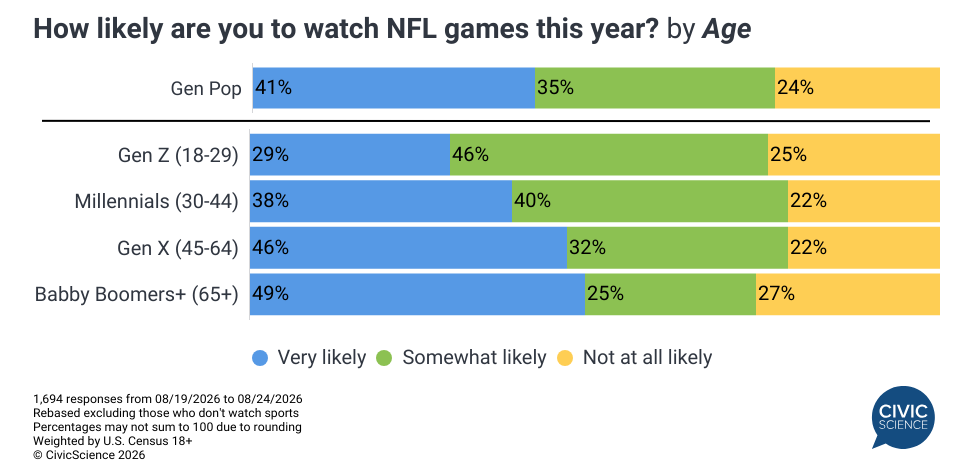
New consumer-declared data from CivicScience suggests interest ahead of the season generally aligns with pre-season intent ahead of the 2025-2026 season. Just over three-quarters of U.S. adults who watch sports are at least ‘somewhat’ likely to watch games this season, with 41% ‘very’ likely to tune in. Sports fans aged 65+ hold the strongest interest with nearly half ‘very’ likely to watch, followed closely by Gen X sports fans.
Noteworthy Nugget: As far away as it feels now, the Super Bowl is on the radar. For the first time in NFL history, the “Big Game” in 2027 falls on Valentine’s Day, February 14, 2027. Disney (which owns ABC and ESPN, both of which will air the game) has already announced all its Super Bowl ad slots have been sold out, with burgeoning alcohol brand Cutwater Spirits being the only brand so far to publicly confirm it’ll be advertising during the game.
Sneak Peek: Early CivicScience data indicate it will be a significant opportunity for Cutwater to build awareness, as only 40% of drinking-age U.S. adults are aware of the brand as of this writing. Awareness jumps to 53% among those who are also at least ‘somewhat’ likely to watch NFL games this year.
Streaming is Closing the Gap on TV Broadcasts as a Viewership Medium
American usage of video streaming subscriptions is on the uptrend this year, and that’s spilling over into NFL viewership. When asked how they primarily plan to watch upcoming NFL games, 43% of viewers say they’ll watch via traditional cable TV broadcasts, while 38% say they’ll watch via a streaming service (e.g., YouTube TV). These percentages mark a dramatic shift from the 2023 data, when viewers were twice as likely to watch on TV as to tune in via streaming (51% vs. 25%).
As for other methods of watching games this year, 8% of respondents will primarily watch at bars and social gatherings, 2% plan to attend in person, and 8% have an ‘other’ method in mind.
The Strong Majority of NFL Viewers Turn to a Second Screen During the Game
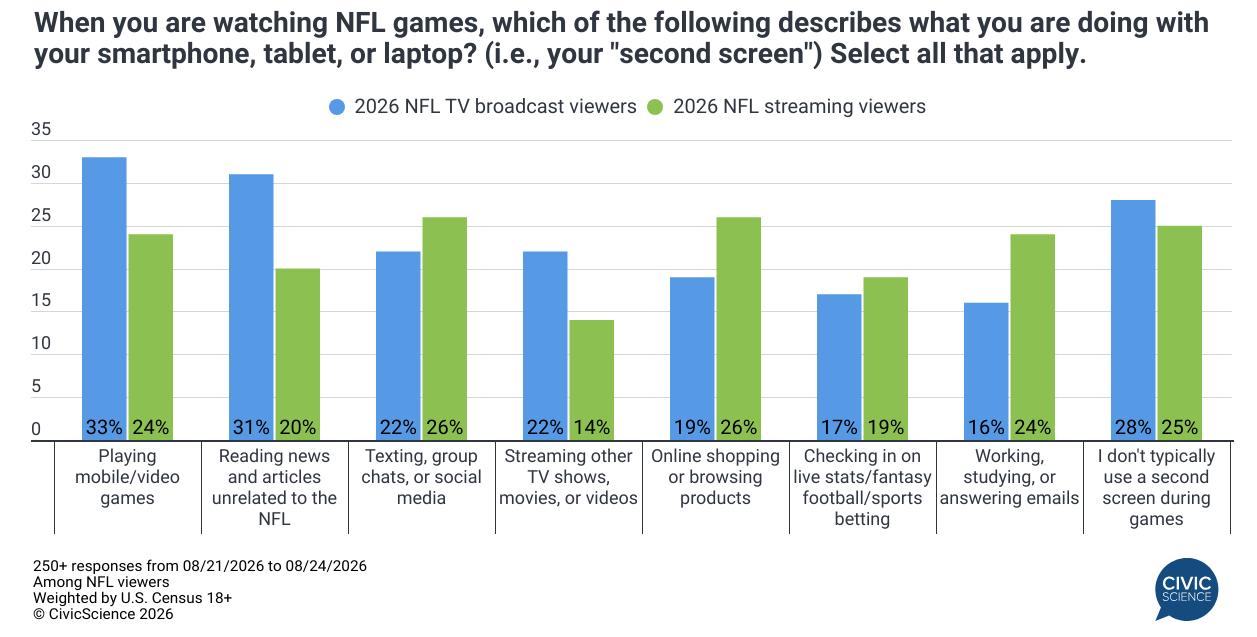
Roughly three-quarters of respondents who say they’ll watch NFL games either on cable or streaming each report they typically use a second screen during games. Despite a similar usage rate, these second-screen habits vary drastically between the two audiences. For instance, TV broadcast viewers are far more likely than those planning to stream games this season to play mobile/video games or read non-NFL-related content articles as they watch. Streamers, on the other hand, prioritize actionable tasks, over-indexing on online product research and shopping, working or answering emails, and digital socializing.
This underscores that capturing fan attention extends well past in-broadcast advertising alone. While stream placements are ideal channels for direct-response e-commerce and real-time activations, reaching TV audiences requires off-screen, cross-platform strategies such as mobile game placements and news feed ads.
More NFL Fans Plan to Bet Online This Year, Driven by Spike Among Women
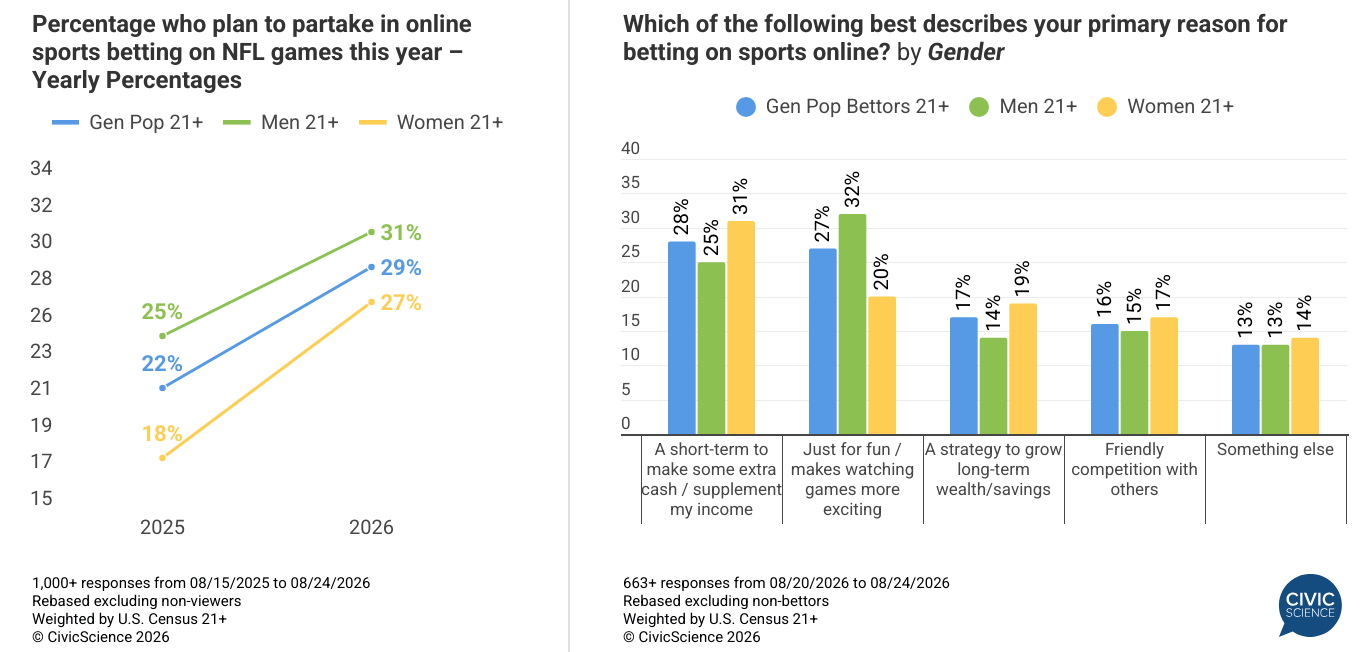
Despite an overall growing desire for sports betting regulation, NFL betting intent among viewers is up significantly this year. New consumer-reported data reveal that 29% of NFL fans 21+ say they plan to bet online this season, up from 22% ahead of the 2025 kickoff. Women are heavily propelling this uptick, marking an impressive 50% year-over-year surge as their betting intent has jumped from 18% to 27%. This shift builds upon a broader trend CivicScience observed last year, where women showed growing participation across sports betting overall. Men are still more likely than women to bet, with intent rising by six points Year-over-year among men 21+.
Zooming out on what’s driving Americans to bet on sports today reveals interesting gender divides. For Gen Pop aged 21+, sports betting is nearly as likely to serve as short-term supplementary cash (28%) as to just have fun and make games more exciting (27%). Just under 1 in 5 say their betting is part of a longer-term financial strategy. Women notably over-index relative to their male counterparts in reporting betting for financial reasons, whether for short-term cash or a long-term strategy. Men are far more likely to say they bet for the fun of it.
As kickoff approaches, shifts across viewing channels, device habits, and betting motivations illustrate how game-day routines are evolving. Understanding these specific touchpoints offers a clearer picture of where fan attention actually goes during a broadcast. For brands and media networks alike, tuning into these steady consumer adjustments will be key to staying connected throughout the season.