CivicScience has the world’s largest proprietary database of real-time declared intent, allowing brands to activate high-performing advertising that drives up to 80% better performance. See how CivicScience partners achieve superior marketing outcomes here.
It’s the age-old question: Which do you value more, time or money? Or maybe you’re of the belief that “time is money.” Regardless, CivicScience has been tracking where Americans stand for several years now. Here’s what a fresh look at this ongoing, consumer-declared data has to offer:
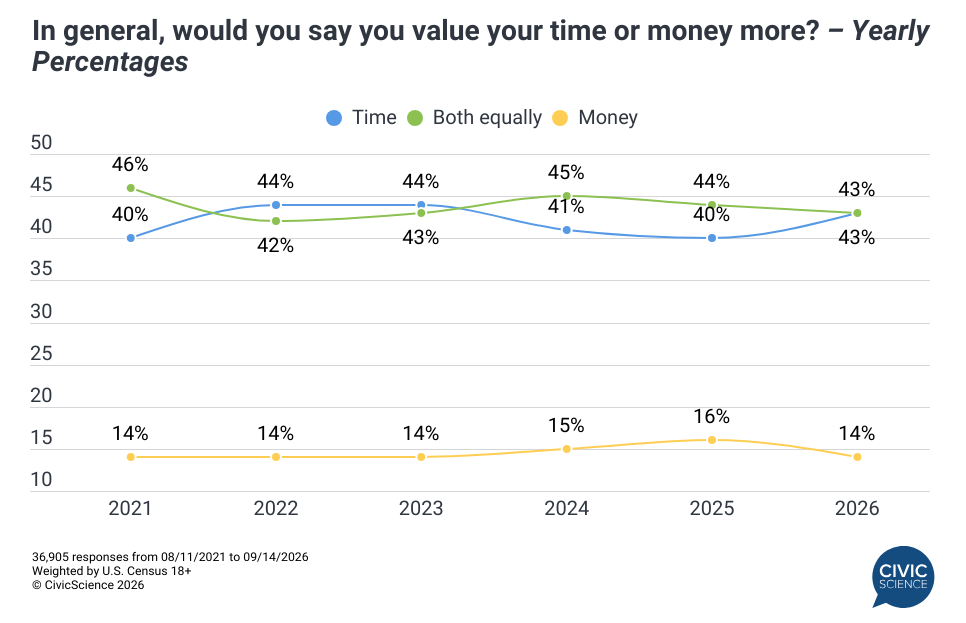
After two consecutive years of Americans most likely to say they value their time and money ‘equally,’ the share of those who value time the most increased slightly, rebounding to 43%. Meanwhile, after a short-lived high in 2025 (16%), money valuers remain the clear minority (14%).
This question lends itself to interesting splits among demographics, with the share who value time outright decreasing with age. Nearly half (46%) of Gen Z aged 18-29 value time, compared to 40% of Boomers aged 65+. Millennials (30-44) are the most likely generation to value money outright (17%), outpacing other generations by at least two percentage points. Boomers, meanwhile, set the pace in valuing time and money equally (50%).
Men are more likely than women to value time (46% vs. 40%), whereas women are more likely to value both money and time equally (45% vs. 41%). Additional data show that those working in hybrid roles are most likely to value time (57%), whereas remote workers are most likely to value both time and money equally (49%) and money outright (17%).
Debt Outlook and Employment Concerns Weigh Heavy on Time Valuers
Americans’ ideologies on time vs. money are also reflected in their financial outlooks. Time valuers hold a particularly pessimistic view of their six-month debt outlook compared to their counterparts – 35% tell CivicScience they expect to have more debt in the next six months. This not only outpaces Gen Pop (25%) but it also significantly outranks those who value money most (22%) and those who value both time and money equally (21%).
Time valuers are similarly the most stressed about their job stability – 30% reporting they’re ‘very’ concerned about their current employment situation, up from 20% and 17%, respectively, among those who value money and those who value time and money equally.
Video Streaming Consumption and Fall Sports
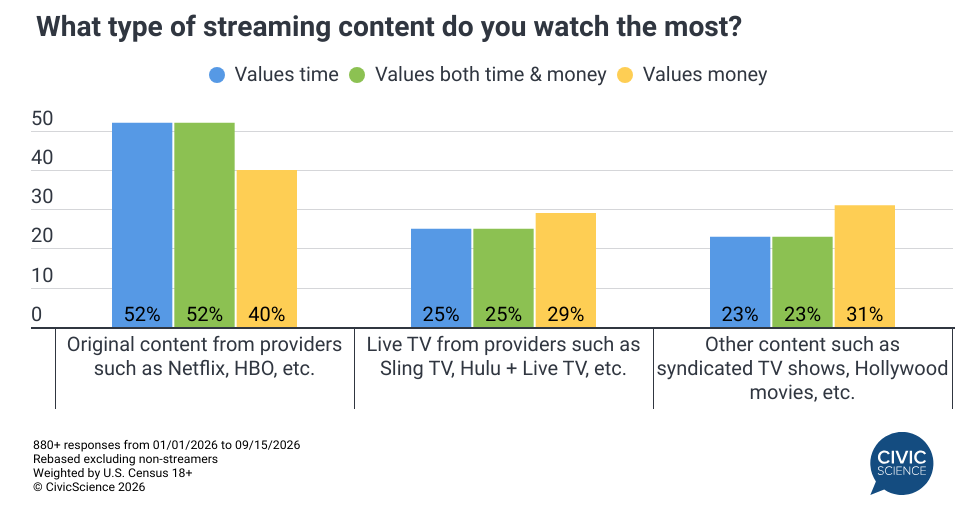
A look at self-reported streaming consumption data finds that streamers who either value time in and of itself or value it equally with money tend to coalesce around original content from streaming platforms. Those who value money, on the other hand, are more likely to gravitate towards live TV and other syndicated content when they watch streaming.
The fall sports season is just beginning to ramp up, which typically means a need for streaming subscriptions to tune in. Even though time valuers watch less live TV day-to-day, 28% say they’re ‘very’ likely to subscribe to a new service specifically to watch fall sports. This compares to only 15% of money-focused viewers and 11% those who value time and money equally. Given the stressors highlighted above that are impacting time valuers most, a brief mental escape via watching the sports they love may be just what they need.
Holiday Shopping and AI Support
There are also noteworthy differences when examining holiday shopping timelines. Data show 23% of time valuers have already begun holiday shopping, a higher percentage than those who value both time and money (17%) and those who value money outright (11%). Unsurprisingly, given their emphasis on money, money valuers (35%) are most likely to say they plan to start between Thanksgiving and the end of November, in peak deal-hunting time.
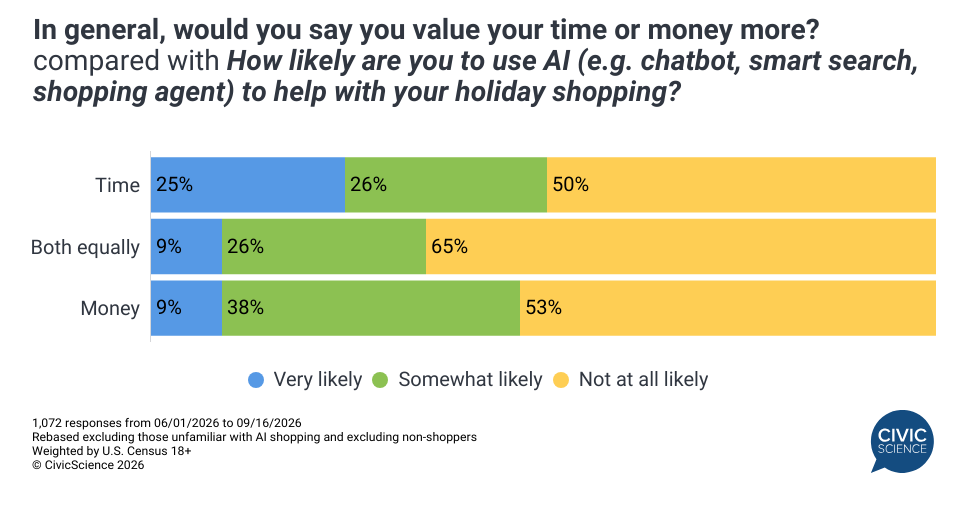
AI/agentic shopping is sure to play a more significant role in consumer holiday shopping compared to years past, and there’s a good chance time valuers may be at the forefront of this trend. One-quarter say they are ‘very’ likely to use AI to support their holiday shopping efforts, compared to just 9% each among those who value money and those who value both equally.
Advertising to These Consumers
These differing mindsets also shape the types of advertisements that will have the most impact. Consumers who place more value on time are the most likely to say that humorous ads resonate with them the most (42%). On the other hand, Americans who say they value both time and money equally, and those who value only money, lead in citing informative ads as the most impactful for them (36% each, compared to 31% among time valuers). Ads that are emotional or inspirational are comparatively less impactful across the board.
No single strategy will land with all consumers since each segment operates from a different financial and emotional starting point. Money valuers plan patiently around deals, equal valuers stay steady and practical, and time valuers act with more urgency. For brands, reading those signals correctly matters more than knowing which label someone falls under.