CivicScience has the world’s largest proprietary database of real-time declared intent, allowing brands to activate high-performing advertising that drives up to 80% better performance. See how CivicScience partners achieve superior marketing outcomes here.
Over the past few years, more Americans have made concerted efforts to drink less alcohol for a variety of reasons. Participation in month-long challenges like Dry January and Sober October is increasing, contributing to growth in the movement to cut back. Both of these months began as official campaigns with causes attached in the United Kingdom, but have since been gradually embraced on an informal basis by Americans, too.
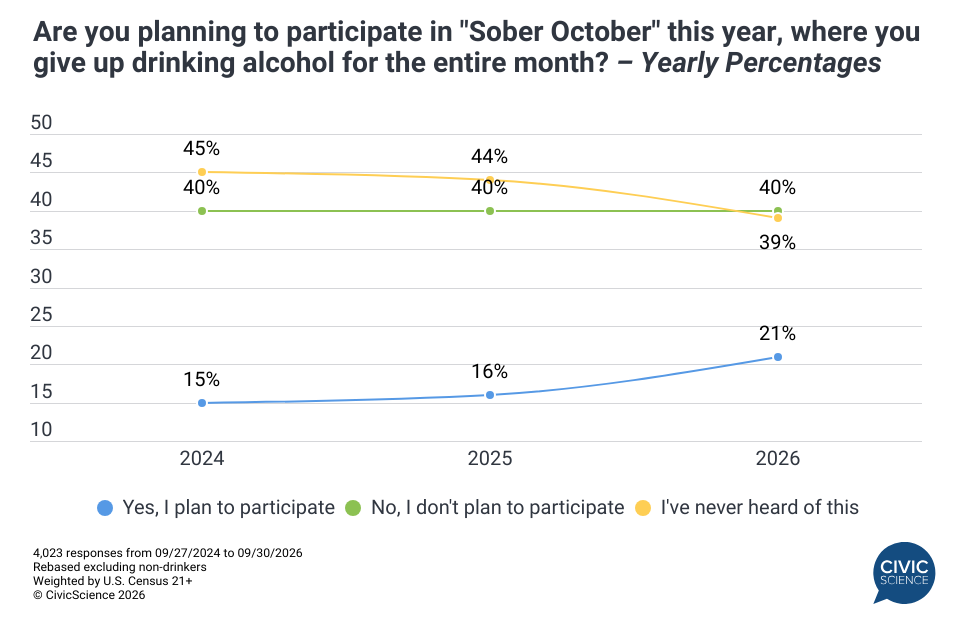
New consumer-reported data among drinkers aged 21+ suggest a spike in Sober October participation this year: 21% plan to refrain from drinking alcohol in October, a five-percentage-point jump year-over-year. Rising awareness may be part of the story: 39% of drinkers say they’ve never heard of Sober October, the lowest such percentage in three years of CivicScience tracking. Meanwhile, the share of drinkers uninterested in forgoing alcohol for the month has remained consistent at 40% throughout the same time frame.
Gen Z adults of drinking age (aged 21-29) are the most likely to intend to participate in Sober October this year (34%), followed by Millennials aged 30-44 (28%). Intent falls dramatically to 13% and 9% among Gen X (45-64) and Baby Boomer (65+) drinkers, respectively. However, it is worth noting that the share among Boomers has tripled since last year.
Staying Sober This Month Isn’t Just a Cost-Cutting Measure
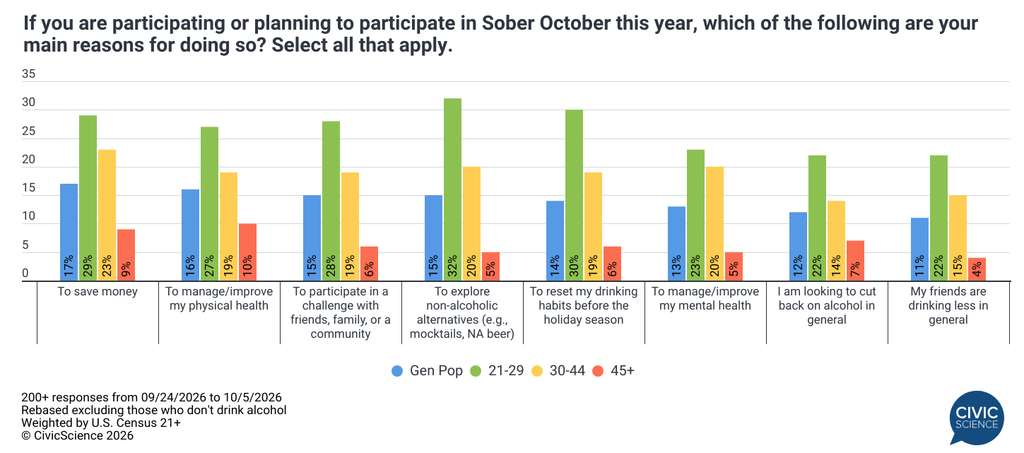
Rising gas prices, geopolitical conflict, and a worsening economic outlook are squeezing household budgets, leaving less room for discretionary spending on products like alcohol. Saving money (17%) ranks as the top reason for participating in Sober October, though only narrowly. Improving physical health trails by just one percentage point (16%), with habit-related reasons not far behind, as many participants use the month to recalibrate ahead of the year’s final stretch.
As this year’s Sober October trendsetters, Gen Z 21+ approach the month differently than their older counterparts and over-index on every motivator. They’re more than twice as likely as participants overall to be exploring non-alcoholic alternatives, which ranks as their top reason, or resetting their drinking before the holidays. For some, the month may also be a convenient off-ramp, with more than 1 in 5 (22%) looking to cut back on alcohol in general, 10 percentage points above average.
Participants Are Open to Mocktails, Within Limits
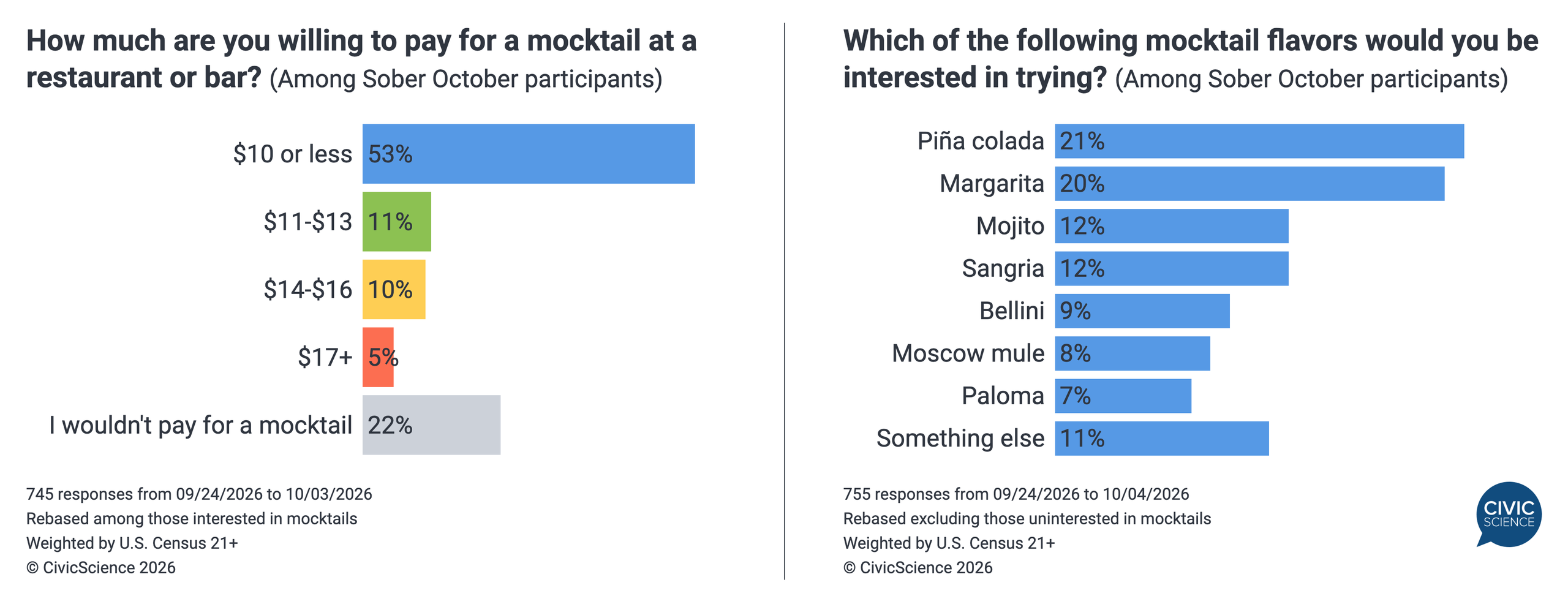
Gen Z participants are more than twice as likely to use the month to explore non-alcoholic alternatives. Of course, mocktails are a natural point of interest. More than half of Sober October participants (56%) say they’re interested in mocktails, though those drinks have grown more expensive alongside their popularity. Most participants interested in mocktails have a firm price limit in mind. Just over half (53%) would pay $10 or less for a mocktail at a restaurant or bar, while only 15% would pay $14 or more. Another 22% wouldn’t pay for one at all.
When ordering, participants gravitate toward familiar flavors like fruit-forward classics, with piña colada (21%) and margarita (20%) well ahead of the pack. Both are drinks that translate easily without alcohol, which may explain their appeal over spirit-driven options like the Moscow mule. Notably, a margarita draws nearly three times the interest of a paloma, despite both being tequila-based, a sign that name recognition may matter as much as flavor profile. With 11% wanting something else entirely, there’s room on menus for options beyond the classics.
With intent rising and motivations spanning budgets, health, and curiosity, Sober October is drawing a wider range of participants than a single cause could account for. For many, the month works as a temporary reset rather than a permanent change, though habits picked up along the way, like ordering a mocktail, may stick. How those preferences hold over the holidays could offer an early read on where the category is headed in 2027, when Dry January starts.